Sample Creates New York Murals
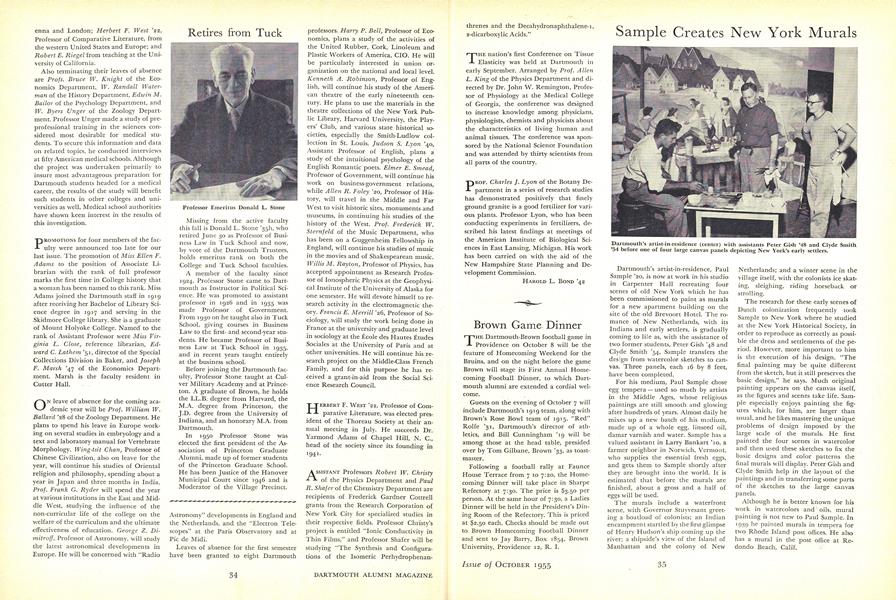
Dartmouth's artist-in-residence, Paul Sample '20, is now at work in his studio in Carpenter Hall recreating four scenes of old New York which he has been commissioned to paint as murals for a new apartment building on the site of the old Brevoort Hotel. The romance of New Netherlands, with its Indians and early settlers, is gradually coming to life as, with the assistance of two former students, Peter Gish '48 and Clyde Smith '54, Sample transfers the design from watercolor sketches to canvas. Three panels, each 16 by 8 feet, have been completed.
For his medium, Paul Sample chose egg tempera - used so much by artists in the Middle Ages, whose religious paintings are still smooth and glowing after hundreds of years. Almost daily he mixes up a new batch of his medium, made up of a whole egg, linseed oil, damar varnish and water. Sample has a valued assistant in Larry Bankart '10, a farmer neighbor in Norwich, Vermont, who supplies the essential fresh eggs, and gets them to Sample shortly after they are brought into the world. It is estimated that before the murals are finished, about a gross and a half of eggs will be used.
The murals include a waterfront scene, with Governor Stuyvesant greeting a boatload of colonists; an Indian encampment startled by the first glimpse of Henry Hudson's ship coming up the river; a shipside's view of the Island of Manhattan and the colony of New Netherlands; and a winter scene in the village itself, with the colonists ice skating, sleighing, riding horseback or strolling.
The research for these early scenes of Dutch colonization frequently took Sample to New York where he studied at the New York Historical Society, in order to reproduce as correctly as possible the dress and settlements of the period. However, more important to him is the execution of his design. "The final painting may be quite different from the sketch, but it still preserves the basic design," he says. Much original painting appears on the canvas itself, as the figures and scenes take life. Sample especially enjoys painting the figures which, for him, are larger than usual, and he likes mastering the unique problems of design imposed by the large scale of the murals. He first painted the four scenes in watercolor and then used these sketches to fix the basic designs and color patterns the final murals will display. Peter Gish and Clyde Smith help in the layout of the paintings and in transferring some parts of the sketches to the large canvas panels.
Although he is better known for his work in watercolors and" oils, mural painting is not new to Paul Sample. In 1939 ,ie painted murals in tempera for two Rhode Island post offices. He also has a mural in the post office at Redondo Beach, Calif.
Dartmouth's artist-in-residence (center) with assistants Peter Gish '48 and Clyde Smith '54 before one of four large canvas panels depicting New York's early settlers.