THE STORY OF BLINDNESS.
By GabrielFarrell 'II. Cambridge: Harvard UniversityPress, 1956. 270 pp. $4-50.
Dr. Farrell, who was for more than twenty years director of the world-famous Perkins Institution in Massachusetts, presents in this book an excellent historical treatment of the subject of blindness. He impresses upon the reader, as he means to do, a sense of social responsibility for those who are lacking in sight. Self-interest, as well, should dictate concern for the problem of the sightless in view of the fact that at least 750,000 Americans now living will some day be blind.
Through the centuries occasional blind persons achieved eminence, but the vast mass of those less gifted could only survive through charity. This was for a long time society's only recognition of obligation to the blind. Dr. Farrell's account of the development of schools and institutions for the blind in Europe and America since the 18th century is a heartening one.
The Perkins Institution has for many years set a standard which has dominated the schools for the blind both in this country and to a limited degree those in other countries. The work of its early director, Samuel Gridley Howe, is especially noteworthy. His successful efforts to educate Laura Bridgman of Etna, N. H., a deaf, blind and mute child, drew visitors to Perkins from all parts of the world, including Charles Dickens. When Helen Keller's mother, some forty years later, read about the education of Laura Bridgman in Dickens' American Notes it led to the appointment in 1887 of Anne Sullivan, a graduate of Perkins Institution, to be Helen Keller's teacher, thus forming a link of a chain that reaches into the present day.
Social responsibility for the blind is recognized in the United States today through special legislation. The efforts of the blind are directed at present toward securing economic parity with the seeing, as an essential first step toward social integration.
The book concludes with a discussion of the advances that have been made in curing various diseases that have caused so much blindness, as trachoma and opthalmia neonatorum, meaning "inflammation of the eyes of the newborn." A perusal of this book leaves the reader with the conviction that medical research, combined with physical rehabilitation and social acceptance, makes the problem of the blind a hopeful one.
More From This Issue
-
 Feature
The Honorary Degree Citations
July 1956 -
 Feature
The 1956 Commencement
July 1956 -
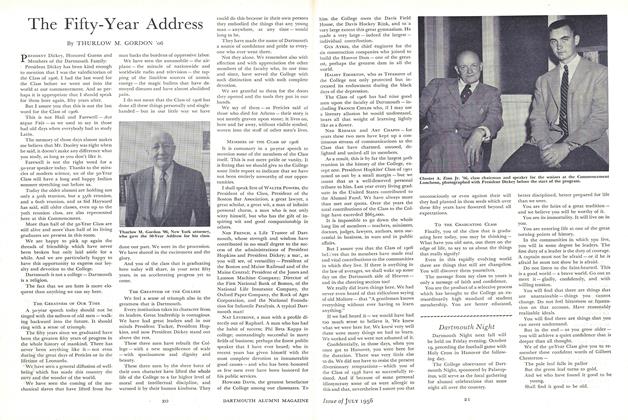 Feature
The Fifty-Year Address
July 1956 -
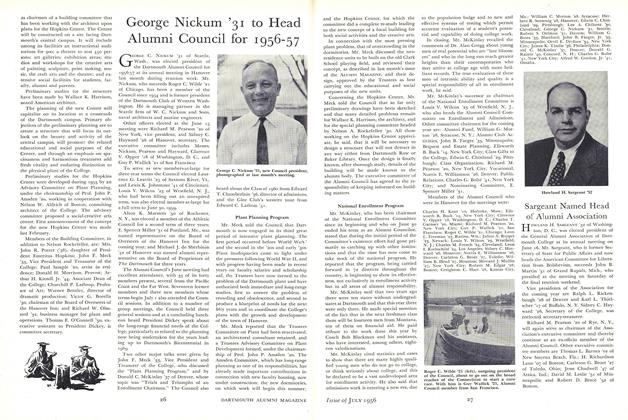 Feature
George Nickum '31 to Head Alumni Council for 1956-57
July 1956 -
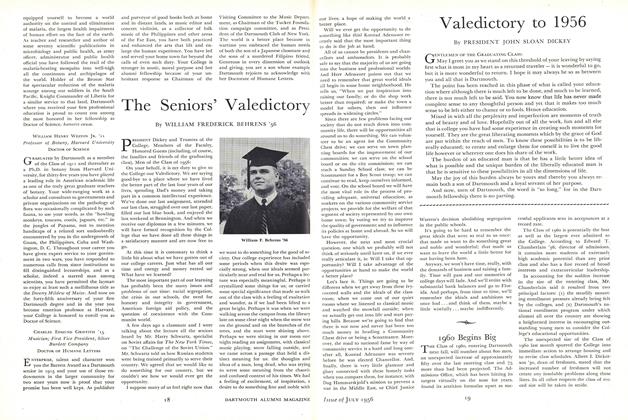 Feature
The Seniors' Valedictory
July 1956 -
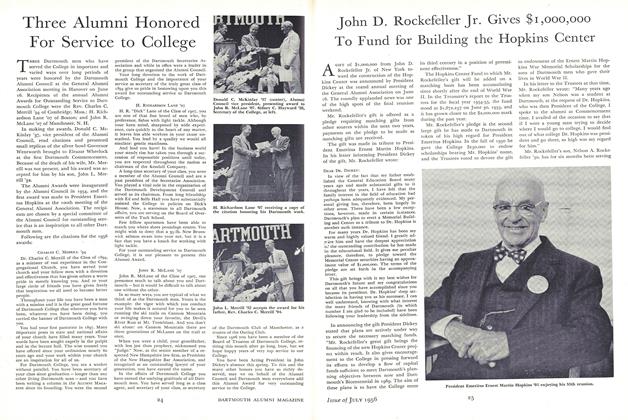 Feature
Three Alumni Honored For Service to College
July 1956
RALPH P. HOLBEN
Books
-
 Books
BooksCOMBAT MISSILEMAN.
June 1962 -
 Books
BooksKate Sanborn, July 11, 1839 - July 9, 1917
November 1918 -
 Books
BooksHISTORY OF ECONOMIC THOUGHT
June 1936 -
 Books
BooksTHE ORGANIZATION OF JUDICIAL POWER IN THE UNITED STATES.
NOVEMBER 1969 -
 Books
BooksTHE PLATFORM SCRIPTURE.
MARCH 1964 -
 Books
BooksArgumentation and Debate
November 1917
