Medicine and Morals
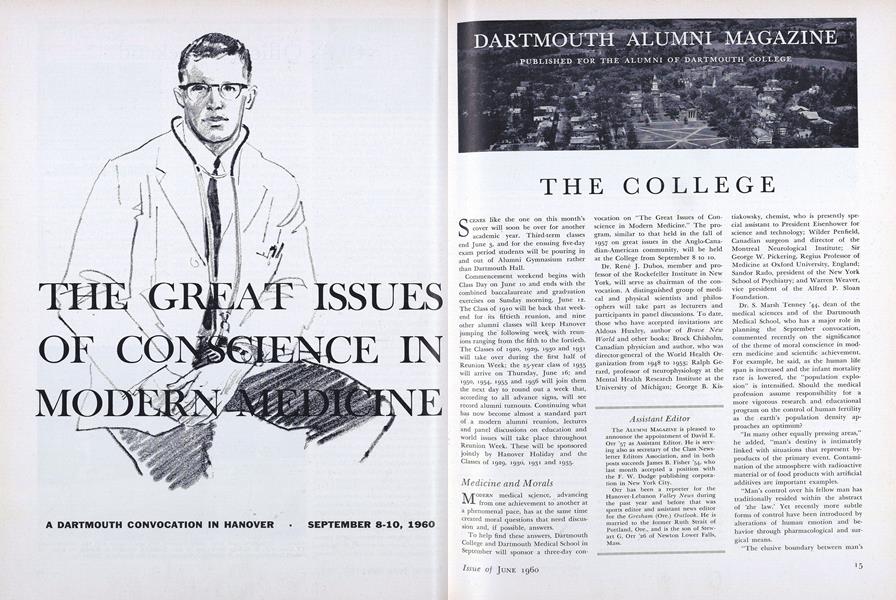
MODERN medical science, advancing from one achievement to another at a phenomenal pace, has at the same time created moral questions that need discussion and, if possible, answers.
To help find these answers, Dartmouth College and Dartmouth Medical School in September will sponsor a three-day convocation on "The Great Issues of Conscience in Modern Medicine." The program, similar to that held in the fall of 1957 on great issues in the Anglo-Canadian-American community, will be held at the College from September 8 to 10.
Dr. Rene J. Dubos, member and professor of the Rockefeller Institute in New York, will serve as chairman of the convocation. A distinguished group of medical and physical scientists and philosophers will take part as lecturers and participants in panel discussions. To date, those who have accepted invitations are Aldous Huxley, author of Brave NewWorld and other books; Brock Chisholm, Canadian physician and author, who was director-general of the World Health Organization from 1948 to 1953; Ralph Gerard, professor of neurophysiology at the Mental Health Research Institute at the University of Michigan; George B. Kis-tiakowsky, chemist, who is presently special assistant to President Eisenhower for science and technology; Wilder Penfield, Canadian surgeon and director of the Montreal Neurological Institute; Sir George W. Pickering, Regius Professor of Medicine at Oxford University, England; Sandor Rado, president of the New York School of Psychiatry; and Warren Weaver, vice president of the Alfred P. Sloan Foundation.
Dr. S. Marsh Tenney '44, dean of the medical sciences and of the Dartmouth Medical School, who has a major role in planning the September convocation, commented recently on the significance of the theme of moral conscience in modern medicine and scientific achievement. For example, he said, as the human life span is increased and the infant mortality rate is lowered, the "population explosion" is intensified. Should the medical profession assume responsibility for a more vigorous research and educational program on the control of human fertility as the earth's population density approaches an optimum?
"In many other equally pressing areas," he added, "man's destiny is intimately linked with situations that represent byproducts of the primary event. Contamination of the atmosphere with radioactive material or of food products with artificial additives are important examples.
"Man's control over his fellow man has traditionally resided within the abstract of '.the law.' Yet recently more subtle forms of control have been introduced by alterations of human emotion and behavior through pharmacological and surgical means.
"The elusive boundary between man's assumed right to individual freedom and his obligation to protect through control is further obscured as public health evidence suggests that one of man's fondest habits may be a cause of cancer.
"It is this kind of thing we hope will be thoroughly discussed at the fall convocation."
The convocation's general chairman, Dr. Rene Dubos, is one of the world's foremost medical scientists. A microbiologist and experimental pathologist who demonstrated the feasibility of obtaining germ-fighting drugs from soil microbes, his pioneering work led to the development of several antibiotics. He is an editor of the Journal of ExperimentalMedicine and the author of five books, including The Mirage of Health, published last year.