A Search for a Faster and Better Way to Learn
3-year Research Project at the College Seeks to Test the Effectiveness of the Teaching Machine
THE educator and the student today are confronted with a problem as complex as any ever faced in higher education. Simply stated, the dilemma is that the expanding body of knowledge, together with the growing complexity of that knowledge in many fields, has led to an intensity and a tempo of learning that strains the capacities of both students and curriculum.
The problem is being probed by psychologists and scientists in an effort to find a solution. One thing that seems clear is that new techniques are needed to increase the efficiency of the learning process with regard to factual material, so that the student and the instructor will have more time to proceed into new areas of knowledge.
Resulting from this search for a solution, and characteristic of our technological age, is the invention of the so-called "teaching machine." The present type of machine was developed by Professor Frederick Skinner of Harvard, an authority on the learning process, who has used the principles of conditioned response learning in his device.
John W. Gardner, president of the Carnegie Corporation, who recently submitted a report to President Eisenhower on national goals in education, refers to the machine as an "innovation that seems certain to have an impressive impact on the teaching process." He prefers, however, that it be called a "self-teaching device" instead of a "teaching machine," which is the name that has taken hold for the time being. "Where television holds the danger of standardized instruction," Mr. Gardner says, "the self-teaching device, can individualize instruction in ways not now possible - and the student is always an active participant."
Today on the Dartmouth campus two separate experiments involving the machine are being carried on. The results will help to determine the machine's value on both the undergraduate and graduate levels of education. Its value on the graduate level is being studied by Prof. Robert J. Weiss, chairman of the Medical School's Department of Psychiatry, and Edward J. Green, Associate Professor of Psychology in the College. They are being aided by a three-year $50,000 grant from the Carnegie Foundation.
On the undergraduate level, the machine is being used on an experimental basis by the German Depart- ment and is being considered by several other departments for future use.
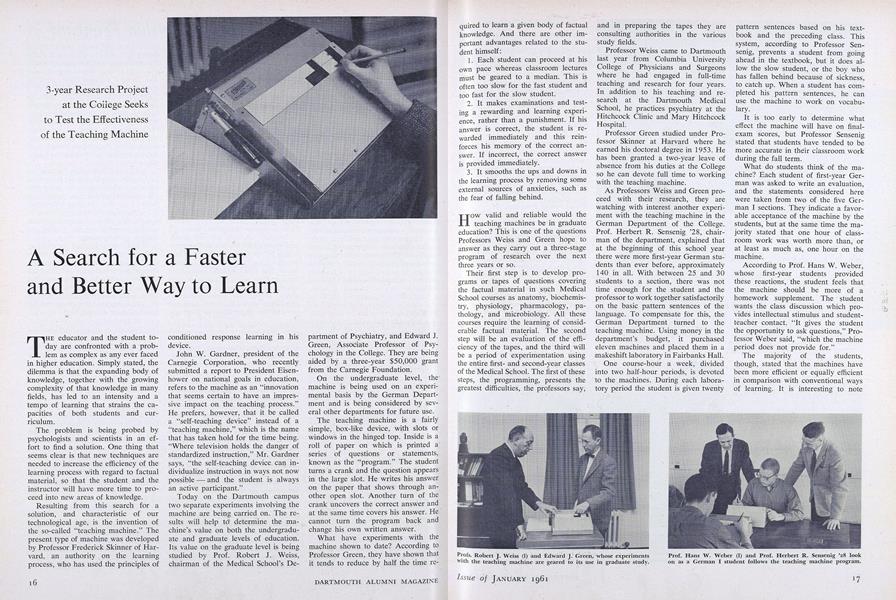
The teaching machine is a fairly simple, box-like device, with slots or windows in the hinged top. Inside is a roll of paper on which is printed a series of questions or statements, known as the "program." The student turns a crank and the question appears in the large slot. He writes his answer on the paper that shows through another open slot. Another turn of the crank uncovers the correct answer and at the same time covers his answer. He cannot turn the program back and change his own written answer.
What have experiments with the machine shown to date? According to Professor Green, they have shown that it tends to reduce by half the time required to learn a given body of factual knowledge. And there are other important advantages related to the student himself:
1. Each student can proceed at his own pace whereas classroom lectures must be geared to a median. This is often too slow for the fast student and too fast for the slow student.
2. It makes examinations and testing a rewarding and learning experience, rather than a punishment. If his answer is correct, the student is rewarded immediately and this reinforces his memory of the correct answer. If incorrect, the correct answer is provided immediately.
3. It smooths the ups and downs in the learning process by removing some external sources of anxieties, such as the fear of falling behind.
How valid and reliable would the teaching machines be in graduate education? This is one of the questions Professors Weiss and Green hope to answer as they carry out a three-stage program of research over the next three years or so.
Their first step is to develop programs or tapes of questions covering the factual material in such Medical School courses as anatomy, biochemistry, physiology, pharmacology, pathology, and microbiology. All these courses require the learning of considerable factual material. The second step will be an evaluation of the efficiency of the tapes, and the third will be a period of experimentation using the entire first- and second-year classes of the Medical School. The first of these steps, the programming, presents the greatest difficulties, the professors say, and in preparing the tapes they are consulting authorities in the various study fields.
Professor Weiss came to Dartmouth last year from Columbia University College of Physicians and Surgeons where he had engaged in full-time teaching and research for four years. In addition to his teaching and research at the Dartmouth Medical School, he practices psychiatry at the Hitchcock Clinic and Mary Hitchcock Hospital.
Professor Green studied under Professor Skinner at Harvard where he earned his doctoral degree in 1953. He has been granted a two-year leave of absence from his duties at the College so he can devote full time to working with the teaching machine.
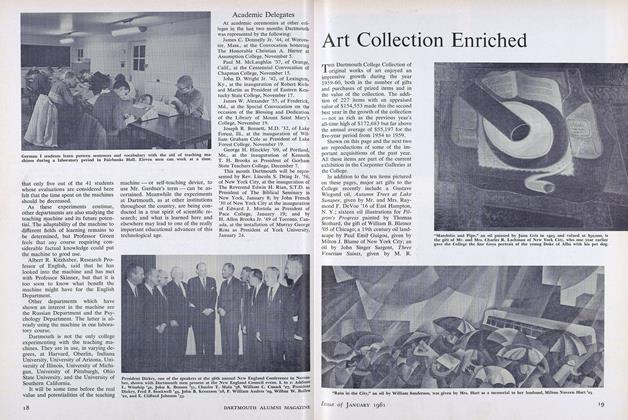
As Professors Weiss and Green proceed with their research, they are watching with interest another experiment with the teaching machine in the German Department of the College. Prof. Herbert R. Sensenig '28, chairman of the department, explained that at the beginning of this school year there were more first-year German students than ever before, approximately 140 in all. With between 25 and 30 students to a section, there was not time enough for the student and the professor to work together satisfactorily on the basic pattern sentences of the language. To compensate for this, the German Department turned to the teaching machine. Using money in the department's budget, it purchased eleven machines and placed them in a makeshift laboratory in Fairbanks Hall.
One course-hour a week, divided into two half-hour periods, is devoted to the machines. During each laboratory period the student is given twenty pattern sentences based on his textbook and the preceding class. This system, according to Professor Sensenig, prevents a student from going ahead in the textbook, but it does allow the slow student, or the boy who has fallen behind because of sickness, to catch up. When a student has completed his pattern sentences, he can use the machine to work on vocabulary.
It is too early to determine what effect the machine will have on finalexam scores, but Professor Sensenig stated that students have tended to be more accurate in their classroom work during the fall term.
What do students think of the machine? Each student of first-year German was asked to write an evaluation, and the statements considered here were taken from two of the five German I sections. They indicate a favorable acceptance of the machine by the students, but at the same time the majority stated that one hour of classroom work was worth more than, or at least as much as, one hour on the machine.
According to Prof. Hans W. Weber, whose first-year students provided these reactions, the student feels that the machine should be more of a homework supplement. The student wants the class discussion which provides intellectual stimulus and studentteacher contact. "It gives the student the opportunity to ask questions," Professor Weber said, "which the machine period does not provide for."
The majority of the students, though, stated that the machines have been more efficient or equally efficient in comparison with conventional ways of learning. It is interesting to note that only five out of the 41 students whose evaluations are considered here felt that the time spent on the machines should be decreased.
As these experiments continue, other departments are also studying the teaching machine and its future potential. The adaptability of the machine to different fields of learning remains to be determined, but Professor Green feels that any course requiring considerable factual knowledge could put the machine to good use.
Albert R. Kitzhaber, Research Professor of English, said that he has looked into the machine and has met with Professor Skinner, but that it is too soon to know what benefit the machine might have for the English Department.
Other departments which have shown an interest in the machine are the Russian Department and the Psychology Department. The latter is already using the machine in one laboratory course.
Dartmouth is not the only college experimenting with the teaching machines. They are in use, in varying degrees, at Harvard, Oberlin, Indiana University, University of Arizona, University of Illinois, University of Michigan, University of Pittsburgh, Ohio State University, and the University of Southern California.
It will be some time before the real value and potentialities of the teaching machine - or - self-teaching device, to use Mr. Gardner's term - can be ascertained. Meanwhile the experiments at Dartmouth, as at other institutions throughout the country, are being conducted in a true spirit of scientific research; and what is learned here and elsewhere may lead to one of the really important educational advances of this technological age.
Academic Delegates
At academic ceremonies at other colleges in the last two months Dartmouth was represented by the following:
James C. Donnelly Jr. '44, of Worcester, Mass., at the Convocation honoring The Honorable Christian A. Herter at Assumption College, November 5.
Paul M. McLaughlin '37, of Orange, Calif., at the Centennial Convocation of Chapman College, November 15. John D. Wright Jr. '42, of Lexington, Ky., at the inauguration of Robert Richard Martin as President of Eastern Kentucky State College, November 17.
James W. Alexander '55, of Frederick, Md., at the Special Convocation on the occasion of the Blessing and Dedication of the Library of Mount Saint Mary's College, November 19.
Joseph R. Bennett, M.D. '32, of Lake Forest, Ill., at the inauguration of William Graham Cole as President of Lake Forest College, November 19.
George H. Hinckley '09, of Portland, Me., at the inauguration of Kenneth T. H. Brooks as President of Gorham State Teachers College, December 7.
This month Dartmouth will be represented by Rev. Lincoln S. Dring Jr. '56, of New York City, at the inauguration of The Reverend Edwin H. Rian, S.T.D. as President of The Biblical Seminary in New York, January 8; by John French '3O of New York City at the inauguration of Edward J. Mortola as President of Pace College, January 19; and by H. Allen Brooks Jr. '49 of Toronto, Canada, at the installation of Murray George Ross as President of York University, January 24.
Profs. Robert J. Weiss (1) and Edward J. Green, whose experiments with the teaching machine are geared to its use in graduate study.
Prof. Hans W. Weber (1) and Prof. Herbert R. Sensenig '28 look on as a German I student follows the teaching machine program.
German I students learn pattern sentences and vocabulary with the aid of teaching machines during a laboratory period in Fairbanks Hall. Eleven men can work at a time.
President Dickey, one of the speakers at the 36th annual New England Conference in November, shown with Dartmouth men present at the New England Council event. L to r: Addison L. Winship '42, John K. Benson '31, Charles T. Main '38, William C. Cusack '27, President Dickey, Fred F. Stockwell '43, John B. Kenerson '28, F. William Andres '29, Wilbur W. Bullen '22, and E. Clifford Johnson '33.