1921
When the Dartmouth players put on "Hamlet" last spring, they were eager to locate a lute, but lutes are harder to come by in this atomic age than in the Elizabethan. A beat-up one was finally found, and Ophelia as she swung crazily about the stage plucked at it in a way which would have horrified Paul Smith.
A professor of mathematics at Columbia, Prof. Paul Smith is unique. He builds lutes, and his wife Suzanne Bloch plays them. You know of course that the lute is an obsolete instrument of the guitar family, that it is believed to be of Persian origin, that it became popular with the Arabs and passed from them through Europe, that it was a favorite instrument from the 14th to the 17th centuries on the Continent and in England, that the back is pear shaped, and that the natural beauty of the lute used to be ornamented with exquisite inlays of rare woods, mother of pearl and ivory, with paintings on the sound board.
Our century builds more atom bombs than lutes. If by luck you discover one only a couple of hundred years old in a pawn shop, it is likely to be dried out to the point of brittleness with pegs and strings out of order, if indeed they still exist. Lute repairmen are not listed in the New York telephone directory.
You might wonder that Paul Smith would care to torment himself with building a lute, especially when a major hobby has been mountain climbing in the Alps. His wife is a world-renowned musician good enough to play music from Shakespeare's day in Town Hall. Paul too is musical. For many years he has fooled around with re- corders, plays them well in fact, and is a noted collector of these wooden precursors of the metal flute. He would be the last to say that the task he set for himself was easy and brief for a man not accustomed to work with his hands. Step one: he sketched lutes in old paintings, mainly in the 17th century Dutch school. Step two: he read Sir Thomas Mace's "The Lute Made Easy," published 1676. Step three: he dug out old boards from a Vermont farm attic. Step four: he sought advice from a Greek artisan, Alex Politis, who mends Balkan instruments in the Bronx. Then the business of actual creation: rigging up a stove for wood bending, shaping of the boards, sawing out pegs, mixing violin-lute varnishes, and manufacturing glue for melon-shaped slats.
You see the picture as it finally shapes up. The daughter of a famous musician and the musician wife, a singer, takes on to the Town Hall stage a beautiful lute, a labor of love fashioned by her white-haired husband and professor of the higher mathematics. Accompanying herself, she sings the songs of Shakespeare's day on a date that is an anniversary of Shakespeare's death.
By way of final culmination, what could be more appropriate? But in the world of music there is no final note; in the world of art, all is becoming; in the world of the mind, play is an accompaniment of work. A postscript consequently is that during two years in his bedroom workshop of Morningside Heights, Prof. Paul Smith has built three lutes. With the spare time left over, he played recorder duets, lovely music of" Shakespeare's day with his wife Suzanne.
Attention lawyers: Bob Loeb and RayMallary, Maury Cole and Rock Grundman,Bill Fowler and John Sullivan, Bill Marcy and Line Miller, Ned Price and Ev Taylor,Joe Vance and Warren Ege, Jack Sercombe and Ken Sater. Admitted to the bar in Okinawa June 24, Bob Wilson has clients resembling characters in a Hitchcock movie: a drunken Air Force major involved in a hit-and-run accident; a young Marine shot in the leg when he was trying to escape from prison; two divorces (juicy) and a murder (bloody); Americans (lonely) trying to adopt Oriental children; a woman with a vacant smile, owing to four teeth knocked out in an automobile accident; a man who walks with difficulty owing to a broken hip and femur (another smashup); rich men looking for lucrative foreign investments; foreign technicians inquiring about positions and checking up on contracts; Orientals trying to become American citizens; laundrymen and bakers; and corporations formed in Delaware and Panama. Consequently Bob has to work day and night, including Saturdays and Sundays. Indefatigable, he has trips lined up for Hong Kong, Taiwan, Singapore, and Manila, with just a possibility for Korea. He is also the leading contributor to a new magazine, "Ry-Am Journal," with articles on Kitanakagusuku Castle, more commonly known as Nakagusuku Castle, and on the Ryukyuan poultry growers and egg producers doing business at the rate of 1,000 cases a week for three months involving the tidy sum of $194,400. That is a lot of eggs when one stops to consider that a case contains 360.
Always interested in romance, 1921 has now a chance to greet a new bride. Her name is Flora Birch from Tacoma, Wash., she is 52, and she met Jack Garfein twelve years ago. As a matter of fact, he wrote a policy for her, and she was acquainted with Marguerite, Jack's wife, who died of cancer Dec. 7, 1960. Flora owns and operates a health food store called Sunset Vita-Foods, 1319 Ninth Ave., San Francisco 22.
Flora and Jack left S. F. for Las Vegas Sept. 1 at 6 p.m., were married before 11 p.m., saw a midnight show, and then a 2:15 "spectacular." In the same splurgy fashion they celebrated for the next two days and nights, but decided against gambling.
A "good cook and a wonderful companion," Flora plays a little golf, but she con- centrates on her customers and her food store; she consented nevertheless to take time off for a second honeymoon with Jack. They drove to Santa Barbara where Jack combined pleasure with business by attending a John Hancock seminar and by staying de luxe at the Biltmore.
Flora attended the Tacoma public schools and spent two years at the College of Puget Sound. She has a son, Robert Putnam, aged 27, the father of three children, aged seven, five, and three. Thus Jack becomes a grandfather.
The reason why Corey Ford was seen so little at the Fortieth is that he had a stomach ache and so little at the October football weekend is that he was recovering from it. It originated supposedly from a Roger-Wildean ailment called diverticulitis, but when it got worse Dr. John Milne '37, in a manner of speaking, looked into it. X rays showed a malignant tumor about the colon. Dr. William T. Mosenthal '38 also looked into it while Corey, tongue-tied, indeed unconscious, lay on the operating table Sept. 9 for four hours. It was "a beautiful job," the growth excised in time, and the diverticulitis reparation thrown in as a sort of surgical bargain. The next day with bottles hitched to him and rattling about, Corey, supported by two nurses, took a little walk. Three days later, minus female support, Corey made the men's room. At home a scant two weeks later he was able to eat anything, climb stairs, drink whiskey (it tasted terrible), and mull over an article he would like to do for the Saturday Evening Post on his hospital experience. It would be written with help of Dr. Milne and Dr. Mosenthal, fascinated by a literary operation. Published by Doubleday and based on articles in "McCall's," Corey's new book about the secrets of a bachelor's life gives the public Corey's inside story. "My inside story is some 14 inches shorter than it used to be," Corey remarks healthily. He is in point of fact assured that all is now clear, that the cancer is fully out and out in time, and that Corey Ford minus, his stomach ache and his presence are assured at 1921 parties until the year 1981, 1921's stupendous Sixtieth.
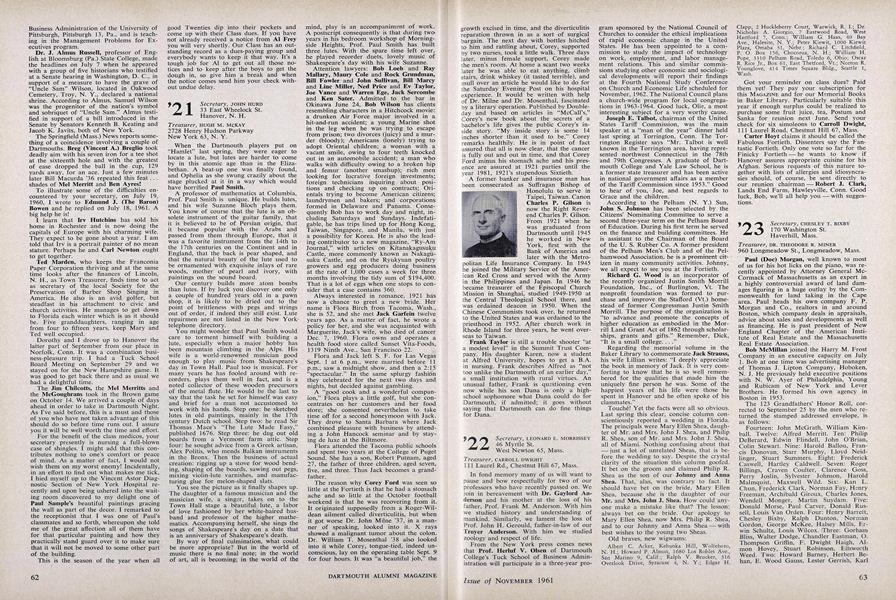
A former banker and insurance man has been consecrated as Suffragan Bishop of Honolulu to serve in Taipei, Taiwan. Canon Charles P. Gilson is now the Right Reverend Charles P. Gilson. From 1921 when he was graduated from Dartmouth until 1945 he worked in New York, first with the Bank of America and later with the Metropolitan Life Insurance Company. In 1945 he joined the Military Service of the American Red Cross and served with the Army in the Philippines and Japan. In 1946 he became treasurer of the Episcopal Church Mission in Shanghai, studied 1949-1950 at the Central Theological School there, and was ordained deacon in 1950. When the Chinese Communists took over, he returned to the United States and was ordained to the priesthood in 1952. After church work in Rhode Island for three years, he went overseas to Taiwan.
Frank Taylor is still a trouble shooter "at a modest level" in the Summit Trust Company. His daughter Karen, now a student at Alfred University, hopes to get a B.A. in nursing. Frank describes Alfred as "not too unlike the Dartmouth of an earlier day," a small institution with rural virtues. An unusual father, Frank is questioning even now while his son Dana is only a highschool sophomore what Dana could do for Dartmouth, if admitted; it goes without saying that Dartmouth can do fine things for Dana.
Secretary, 33 East Wheelock St. Hanover, N. H.
Treasurer, 2728 Henry Hudson Parkway New York 63, N. Y.
More From This Issue
-
 Feature
The Cold War and Liberal Learning
November 1961 -
 Feature
Chairman's Report
November 1961 -
 Feature
A New Center for Mathematics
November 1961 -
 Feature
HOW THE "IVY LEAGUE" GOT ITS NAME
November 1961 -
 Feature
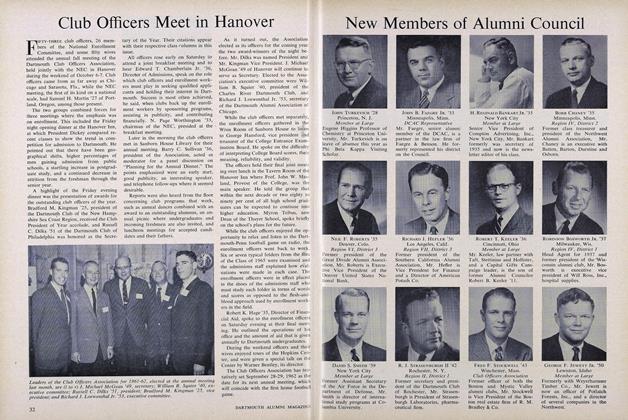
Club Officers Meet in Hanover
November 1961 -
 Feature
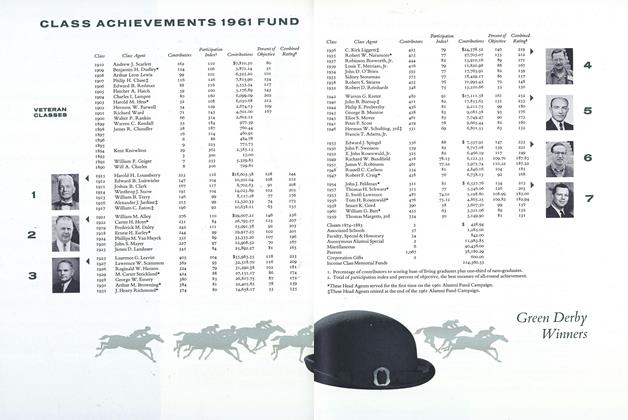
LASS ACHIEVEMENTS 1961 FUND
November 1961