1921
As a military necessity in 1945, America shared in the killing of 250,000 civilians of the 800,000 population on Okinawa. How would you expect the Ryukyuans to feel about Americans in 1965, only 20 years later? Let Bishop Charles Gilson speak, no newcomer to Pacific and Oriental civilizations. On what might be called an overgrown American military base, he expected that they would show resentment, but they are courteous and quiet. If we nearly destroyed Okinawa, by rebuilding it we have blessed survivors with prosperity. Have we bought their good will with hard cash? No. Their integrity and sweetness of spirit seemingly cannot be corrupted by materialistic standards. It is noteworthy, however, that the islanders so close to Communist China are realistic enough to know what would happen to them without American military protection.
In Vancouver, Cliff Corbet has absolutely no news, nor have his children. Cliff is trying to liquidate his business without losing his shirt. Making a promotional ski movie near Jackson, Wyo., his son Barry '58, the mountain climber who received international publicity for scaling Mr. McKinley, the highest in North America, 20,300 feet, fell and severed the ligaments in his one good knee. (He ruined the other the first year at Dartmouth.) Surgeons operated, and a blot clot in his lung nearly killed him. Shortly after, his wife Muffy presented him with twins, a boy and a girl. Cliff's other son Burke is working on a new vehicular tunnel crossing the St. Lawrence at Montreal similar to the one he helped construct under the Fraser River near Vancouver.
An expert on steamships, Bob Kendall, once of Seattle, is now an expert on Mexico. Want to retire and live there like a prince? He can tell you about Mexican bonds paying 8.73% after deducting 3% Mexican income tax on the interest and a Mexican investment trust fund paying 9% with no Mexican tax. He does not recommend Majatlán, a seaport, too hot and humid six months a year, but Guadalajara, a city of more than 200,000, is so cool and dry that he has settled there in a two-bedroom furnished apartment.
In the three-year drought Bob Burroughs has been the admiration and envy of New Hampshire apple growers, and 60 inspected last summer his Hackleboro Fruit Farm, which has its own natural nine-acre pond. From government surplus, Bob's 500-gallon pumper has been running eight hours a day. It uses five gallons of gasoline an hour and does not require extra help. Bob owns 1,661 apple trees, and all but 198 are bearing fruit. Last year's crop was 17,000 bushels, too many for Bob himself to pick by hand.
After a Sahara sort of summer, GordonMerriam "whose Maine blueberry crop was a failure, is tempted to try Mediterranean luck with figs, lemons, limes, and pineapples.,
Dr. Ben Tenney is doing some medical writing with fiction as a sideline. His friends are urging him to write his autobiography. Though his life seems to them active and vital, he denies that it is particularly colorful or dramatic. Fancy that! Chief of Surgery in the South Pacific during World War II! He is glad that he has, adjusted so well to retirement, for as physician he has watched many persons fall apart at 65 because they lack intellectual and artistic stimuli. Particularly hard hit are military men; out of uniform they are no longer saluted. In civilian life they discover that their youthful dreams about retirement turn out to be mirages in the desert of old age.
Retired from Director of Leahi Hospital, Dr. Hastings Walker rejects the sentimental and patronizing appellation of Senior Citizen as he does research on the early history of medicine in Hawaii, especially tuberculosis, a life-time specialty.
Dr. David Seegal has taken seriously British and American editorials that men in their sixties should compose sonnets. Preferring couplets and quatrains, he, after proper ratiocination and lucubration, has composed lines "To A Timid Freshman, Or, Sex and the Parietal Rules."
You'd live happier, man of anxiety By taking catnaps with Miss Propriety. — Primus III
The Class has professional writers. Prof.Rudi Blesh, an authority on jazz and modern art, has a new volume coming out soon. Doug Storer uses many media for written and spoken words. In doing a book on Alaska, Corey Ford is sorry for October, his English setter, who is not permitted to accompany him to California and Alaska for research. From The Reader's Digest Harland Manchester earns more than ten cents a word for articles on his specialty, how science affects modern business. Dana Lamb also earns money for his books on fishing, and he gives it away to poor Labrador fishermen. Learned articles keep emerging from the studies of Ellis Briggs, Bob Elsasser, Bord Helmer, and Erling Hunt. HaroldBowen reads esoteric papers to eclectic societies. Joe Folger calls himself an amaetur, but Nantucketers consider him a pro as he writes genealogical notes on Folgers, Gardners, Coffins, and Bunkers.
Harold Braman, who is expanding his ALUMNI MAGAZINE articles about Dartmouth music and musicians into a book, has a bigger job with the Hanover Consumer Cooperative Society. As president, he has been commended because of the last financial statement. Sales for 1965, $617,448.50. up 9.4%. Sales for 1965 may exceed $1,300,000, up 11% from 1964.
Al Dunn is reviving past enthusiasm: etching, linoleum block printing, miniature sculpture, oil paintings, Dunn Genealogy, rebuilding a grandfather's clock, and reparation of bindings of a leather-bound Dickens rescued from a Washington ash can.
Hewitt Moore is proud of his son David, who, given the Woodstock (Vt.) Christian Church organ in sad repair, dismantled it, and in a Pomfret hay barn put it together again. It is 20 feet tall, 14 wide, and 13 deep, with 1,250 pipes to be set into 26 racks, 31 stops, 25 foot pedals, and uncounted pieces of tracker strips mounted in a lattice work of controls. Handicaps were 15 years of accumulated dust, misuse, a field mouse, a red squirrel, a nervous heifer, and an inquisitive bull.
President of Canadian Facts Company, Ltd., since 1943, Jack Graydon, now Chairman of the Board, has sold out his interest to younger men. He will stay on, however, with well defined but less burdensome responsibilities. Olive is pleased because at their Georgian Bay Cottage he will be able to cultivate some bass so taciturn that they never open their mouths.
How should a business celebrate an important anniversary such as its 40th? Ask Jack Campbell, who founded The Personal Book Shop, a tiny room on the basement level at 33 Newbury St.. Boston. Before long the personal service extended to Brookline, Cambridge, and Newton, and by 1956 when the firm went completely out of the retail business, Jack expanding to 21 branches had become a wholesaler with an inventory of more than a million books. He decided to celebrate not with balloons and champagne, not with pen and pencil sets to all customers, not with a gigantic anniversary sale. No, rather by a check for $40 to each employee with Jack paying the additional $10 to the government for taxes.
Vice president of Hearst Magazines, Harry Chamberlaine, is facing problems so tough that he can hardly sleep nights. He is starting a completely new venture, the Latin American edition of Good Housekeeping, involving more than a dozen countries, all sensitive and unique. The deadline for advertising and editorial is December 15 and for publication, March. Complications are delicate and far-reaching: international advertisers in the United States, a sales staff, translators, and editors. As our international traveller with a nice command of Spanish, Connie Keyes, would say, "Le basta al día su proprio afán." But Harry has the last word, "Estoy muy afanado, e todo va bien."
Secretary, Box 925 ' Hanover, N. H.
Treasurer, 12 W. Mystic Ave., Mystic, Conn. 06355
Bequest Chairman,
More From This Issue
-
 Feature
The Wheelock Dream, Sparsely Realized, Is Still a Force in the Life of the College
October 1965 -
 Feature
A Good Summer Press
October 1965 -
 Feature
SUMMER TEMPO IS GO-GO-GO
October 1965 -
Feature
Newly Elected Members of the Alumni Council
October 1965 -
 Article
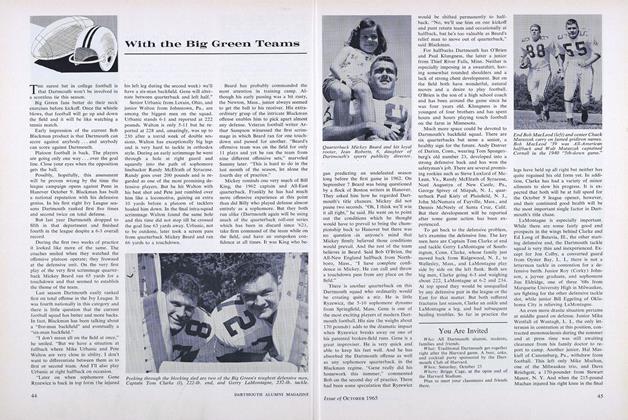
With the Big Green Teams
October 1965 -
 Article
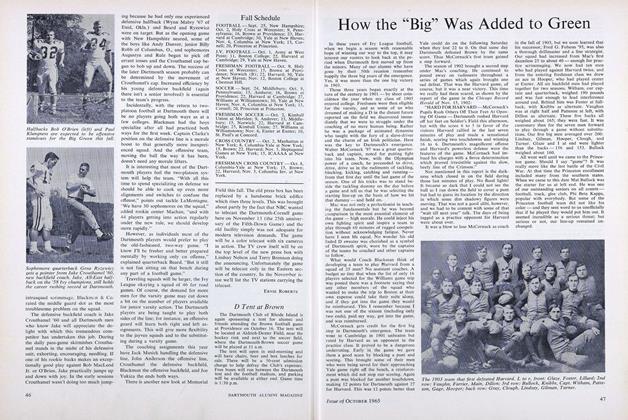
How the "Big" Was Added to Green
October 1965