Art Collector and Author
The most remarkable quality about RICHARD H. RUSH '37— a man who has achieved many remarkable successes - is that he is willing to share his secrets.
Author, financier, economist, collector, and now professor of finance at American University's School of Business, Dr. Rush has told others "how to" in: Art As An Investment (1961), A Strategy of Investing for Higher Return (1962), The Technique of Becoming Wealthy (1963-dedicated "To our country, the United States of America, where democracy and free enterprise make wealth-building possible for every individual") and Antiques As An Investment, to be published by Prentice Hall this spring.
His books are authoritative but very readable, because as one reviewer aptly complimented, "He uses first-hand experiences, but doesn't pad his batting average."
But by any standards this utility infielder's average puts him in the major leagues:
After earning an M.C.S. at Tuck in 1938 he got an M.B.A. at Harvard, topping his class, then set, and still holds, a record there by completing his D.C.S. in ten months more. He was a Littauer Fellow at the Harvard School of Public Administration in 1941 and 1942.
Harvard made him six offers to stay and teach, but there was a war on and he decided to postpone that career. This is his first year teaching, though he claims it is his first love. He heads the Department of Finance, Management and Investment, teaching about three courses a semester, and still manages about a dozen speaking engagements a year.
The payoffs of hard work and long hours are something he learned from J. Paul Getty when he served as his Washington representative. Rush says that Getty, whom he visits annually, still works about eighteen hours a day. Getty also taught him the tremendous benefits to be gained from accurate forecasting, seeing business opportunities, then having the courage to act on that information quickly.
"One of the best ways to become wealthy is through ownership and operation of one's own business," he says. "And to know when to sell out."
In the course of his varied career, Rush has also been president of the North American Acceptance Corporation in Washington and director of the aircraft division of the National Security Resources Board. This government post led to his serving as adviser to President Truman.
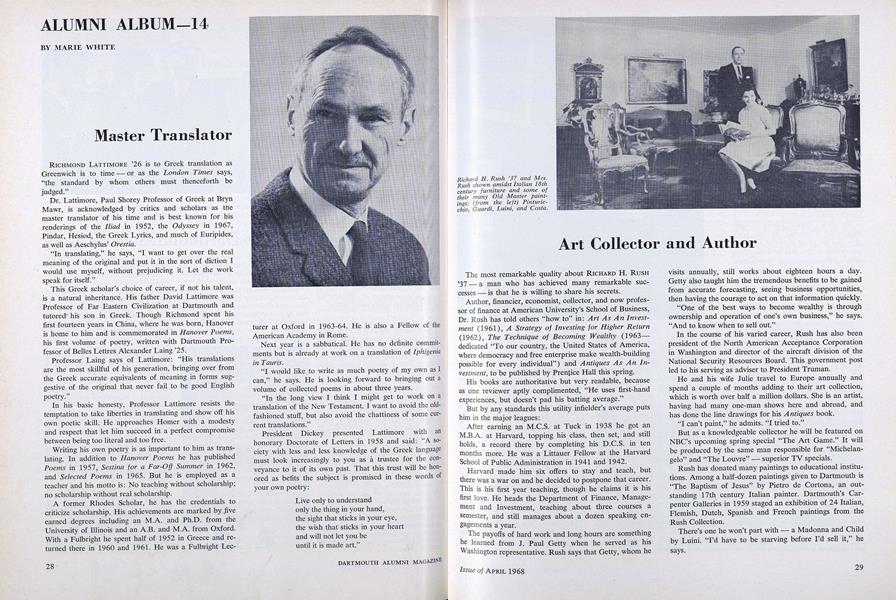
He and his wife Julie travel to Europe annually and spend a couple of months adding to their art collection, which is worth over half a million dollars. She is an artist, having had many one-man shows here and abroad, and has done the line drawings for his Antiques book.
"I can't paint," he admits. "I tried to."
But as a knowledgeable collector he will be featured on NBC's upcoming spring special "The Art Game." It will be produced by the same man responsible for "Michelangelo" and "The Louvre" - superior TV specials.
Rush has donated many paintings to educational institutions. Among a half-dozen paintings given to Dartmouth is "The Baptism of Jesus" by Pietro de Cortona, an outstanding 17th century Italian painter. Dartmouth's Carpenter Galleries in 1959 staged an exhibition of 24 Italian, Flemish, Dutch, Spanish and French paintings from the Rush Collection.
There's one he won't part with - a Madonna and Child by Luini. "I'd have to be starving before I'd sell it," he says.
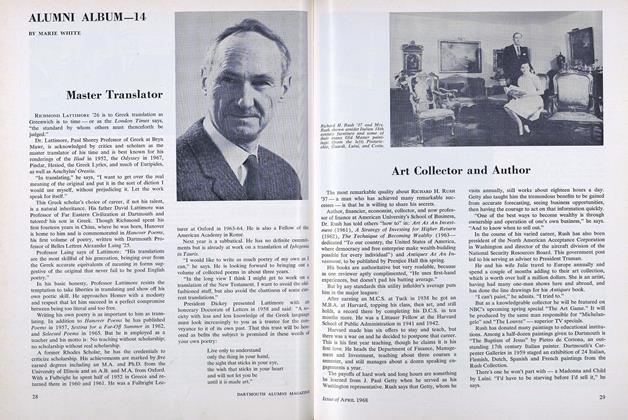
Richard H. Rush '37 and Mrs.Rush shown amidst Italian 18thcentury furniture and some oftheir many Old Master paintings: (from the left) Pinturicchio, Guardi, Luini, and Costa.