Scholarship Aid at Record Level
For its general interest we print here a brief report recently prepared by Robert K. Hage '35, Director of Financial Aid
A LARGER number and higher percent age of members of the Class of A JL 1972 are receiving scholarship aid from the College than of any previous class: 280 men or 34% of a class of 819. This compares with 267 (32%) in the Class of 1971 and 220 (28%) in the Class of 1970 at the time of matriculation. In addition, 40 other members of the Class with demonstrated need were offered loans and/or jobs without scholarships.
Some men in the above count, and some not receiving any aid from the College, have scholarships and loans from sources outside of the College. While information on outside awards is never really reliable (and it is difficult in many cases to determine whether the recipients of such awards need aid by our exacting standards) it would not be unreasonable to assume that somewhere between 42 and 44% of the Class of 1972 are receiving the financial aid they need from Dartmouth and from sources outside of Dartmouth. The latter include ROTC Scholarships, National Merit Scholarships, corporation scholarships, state scholarships and loans, and awards from high schools and community organizations.
Every student in the Class with known need has been taken care of - though it goes without saying that many students and their families think we have been less than generous in our analysis of their need! This is not the same as offering aid initially to all applicants with demonstrated need. At the time the notices of admissions and financial aid were sent out, 40 men were put on the financial aid waiting list. All of the 29 who asked for reconsideration were offered aid; but the 11 who did not ask for such reconsideration and went elsewhere inevitably included some who would have come to Dartmouth had we awarded them aid initially.
When the scholarship budget for the 1968-69 year was approved, it was not anticipated that we could help as many men in the Class of 1972 as we did. To stretch our funds over as large a group as possible we increased our summer earning expectation from $350 to $400 and we met the first $800 of need (instead of the normal $600) with self-help (jobs and loans) in a larger number of cases than ever before. Thus, despite an increase of $175 in college charges, our average freshman stipend went up only $20 ($1570 versus $1550) from that of the previous year. (It is only fair to say that even without the steps taken above to stretch our funds the average stipend would not have gone up by the full $175 increase in charges, for those increases tend to bring additional men into the scholarship group with small awards, thus diluting the average.)
It is not likely that we can continue to increase expectations from student earnings - summer, term-time and future (i.e. loans) - and still remain competitive. It is difficult to tell what effect our policies this past year had on the acceptance rate of proffered financial aid (we had 60% acceptance versus 61% acceptance a year ago) but it is clear that some colleges are moving in the other direction and that there is a trend toward reducing self-help expectations for students from economically disadvantaged backgrounds. Another factor which will affect the number of students we can help next year is that we (along with the other Ivies) plan to increase from $550 to $600 the budget for books, clothing, laundry, amusements and incidentals, in order to be more realistic.
TOTAL AID EXCEEDS $2 MILLION
We are appending a table comparing the significant financial aid statistics of the past three years and projecting those figures for the current year. A few highlights:
(1) Financial aid to undergraduates, administered by the Office of Financial Aid, will exceed $2,000,000 during the current year, broken down as follows: an estimated $1,460,000 in scholarships; $380,000 000 in long-term loans; and $200,000 in term-time employment which is directly assigned through this office.
(2) The dollar value of loans to undergraduates and the number of undergraduates so helped have declined for the second successive year. This does not result from any lessening of the role of "selfhelp" in aiding students, but rather from the availability of direct low-cost educational loans through state agencies under the federal Guaranteed Loan Program. For families with "adjusted incomes" of less than $15,000, these loans have had terms comparable to those of National Defense loans for most borrowers and we have actually encouraged students to take them. Congress has recently made GLP loans more costly to students by reducing some of the interest subsidy and it is thus anticipated that the use of the College-administered loan funds (including National Defense and Dartmouth Educational Association loans) will be increased to some extent during the current year and even more in the future.
(3) The percentage of the scholarship budget met by unrestricted funds last year (42%) equals the 1964-65 figure as the highest in the past 15 years and will inevitably go up by several percentage points this year. For it has been the College's policy to increase the scholarship budget as charges increase, and current gifts and endowment income earmarked for scholarship purposes do not keep pace with increased scholarship expenditures during periods of steadily rising costs.
MISCELLANEOUS
Student Employment: The past year saw little change in the .student employment picture. Approximately $15,000 more was available in federal College Work-Study funds than in 1966-67, but this went primarily into- summer employment opportunities. Term-time employment assigned directly by the Office of Financial Aid in 1967-68 (Dartmouth Dining Association, College Work-Study, and campus agencies) totaled $187,000; other term-time employment paid for through the Comptroller's Office amounted to $105,000; and it is estimated that students are paid another S100,000 during the College year from funds which do not pass through the College's hands - for a grand total of $392,000 in termtime earnings.
Personnel: During 1968-69 the Director of the Office of Financial Aid is on leave with the Alfred P. Sloan Foundation, working on a program to strengthen the admissions and financial aid operations of a group of predominantly Negro colleges in the south. William C. Quimby '52, Assistant Director, is serving as Acting Director during the year. Jay C. Whitehair '55, formerly Assistant Dean of the College, became Assistant Director of the Office of Financial Aid in August 1968. John H. Carpenter '64 became Assistant to the Director in June 1968 to succeed Michael Slive '62, who was named Assistant Director of Athletics.
Aid to Foreign Students: Because of unexpected attrition among the foreign students offered admission in September of 1967, the 1967-68 scholarship expenditures for undergraduate foreign students (excluding Canadians) dropped slightly below those of 1966-67. Thirty-eight foreign undergraduates received $92,500 during 1967-68, compared with 42 receiving $96,610 in 1966-67. The Committee on the Freshman Class is in the process of reviewing policy on the admission of foreign students.
Financial Aid to Undergraduates Estimated1965-66 1966-67 1967-68 1968-69Scholarships from Dartmouth Amount awarded $1,079,630 $1,138,565 $1,311,660 $1,460,000 How financed Earmarked income 678,136 718,330 760,133 Unrestricted funds 401,494 420,235 551,527 % Unrestricted funds 37% 37% 42% Number freshman awards 221 220 267 280 % of all freshmen 28% 28% 32% 34% No. undergraduate awards 854 826 879 925 % of all undergraduates 27% 27% 28% 29% Average scholarship award 1,264 1,378 1,492 1,580 College charges Tuition, fees 1,800 1,925 2,075 2,200 Average room and board 935 950 1,025 1,075 2,735 2,875 3,100 3,275 Loans Administered by Dartmouth Source National Defense 320,400 275,295 267,335 288,000 Dartmouth Educational Assn. 66,715 79,615 81,135 90,000 College loan funds 33,420 1,350 700 2,000 Total 420,535 356,260 349,170 380,000 Number Loans with scholarships 685 675 641 680 Loans without scholarships 152 93 69 100 Total 837 768 710 780 Average loan 502 465 492 487 Scholarships and Loans from Dartmouth Number receiving either or both 1,006 919 948 1,025 % of all undergraduates 32% 29.5% 30.4% 33%
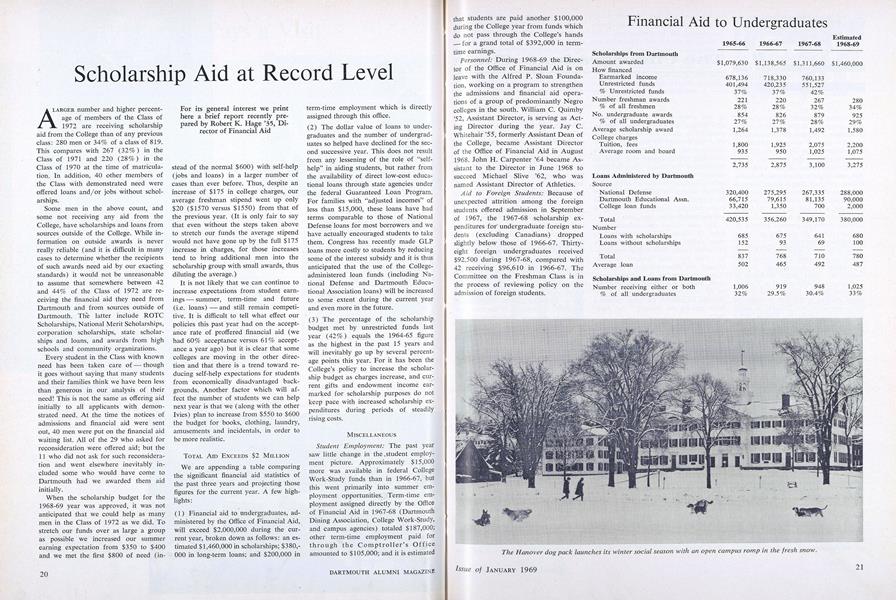
The Hanover dog pack launches its winter social season with an open campus romp in the fresh snow.