Erskine Caldwell Pays a Visit
ERSKINE CALDWELL, who is referred to as the world's best-selling living novelist, was at Dartmouth from October 10 to November 15 as author-in-residence at Baker Library. He taught no formal classes but instead attended to his own literary work and had wide ranging contact with undergraduates. "Each student, like each writer, has an interest of his own," explains Mr. Caldwell, "and you can only get at it and talk about it person to person."
In addition to the meetings with students in his Ticknor Room headquarters in Baker Library, Mr. Caldwell participated in a number of English Department courses and had a busy schedule of informal evening meetings with fraternity and dormitory groups.
To interested young writers, he explained that to succeed "in this writing business," you have to serve an internship and learn "to use your tools first." He noted that he "went through it, practicing and practicing for seven years without ever getting anything published." In writing, as in other professions, he sees work as the key to success.
Now the author of more than 320 editions ranging from Tobacco Road (1932), God's Little Acre (1933) and other early works to In the Shadow of the Steeple (1967), Mr. Caldwell is represented in Baker Library by a special collection started with his help nearly thirty years ago. The Erskine Caldwell Collection now contains more than 800 volumes and includes nearly 150 typescripts and working drafts of his novels and short stories, as well as proofs of numerous titles and his personal papers generally. Of particular interest in the collection is his corrected and edited typescript of TobaccoRoad.
Although a Southerner by birth and upbringing, Mr. Caldwell has traveled widely in a restless quest to know America. He says he was conditioned to a life of movement by his minister father who took his family from parish to parish. Through traveling he feels he gains perspective. He first wrote successfully about the South when he was living on a friend's abandoned farm in Maine.
He feels that Dartmouth provides an ideal atmosphere in which a young writer can develop his talent. "Being in college is like being in a sanctuary. You're isolated in a good kind of way, which is what a writer has to have."
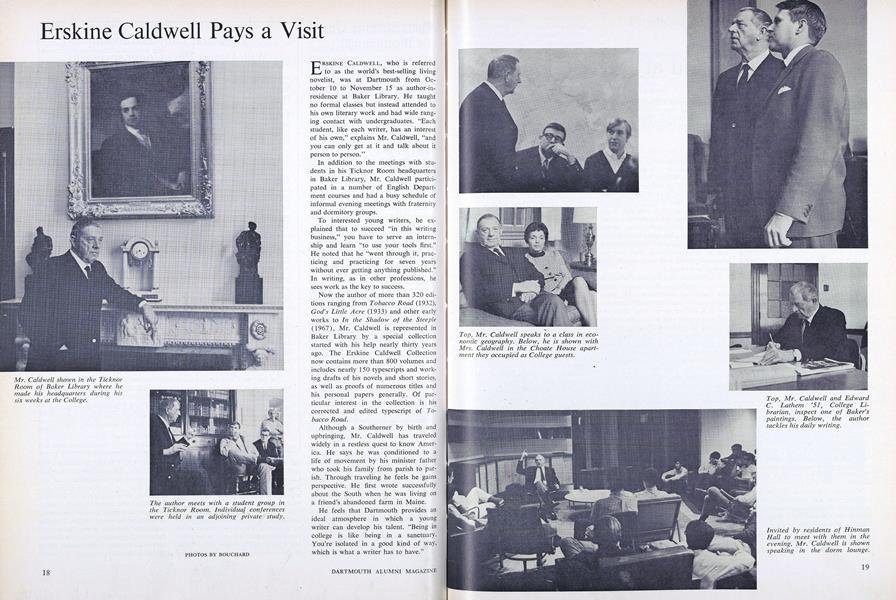
Mr. Caldwell shown in the TicknorRoom of Baker Library where hemade his headquarters during hissix weeks at the College.
The author meets with a student group inthe Ticknor Room. Individual conferenceswere held in an adjoining private study.
Top, Mr. Caldwell speaks to a class in economicgeography. Below, he is shown withMrs. Caldwell in the Choate House apartmentthey occupied as College guests.
Top, Mr. Caldwell speaks to a class in economicgeography. Below, he is shown withMrs. Caldwell in the Choate House apartmentthey occupied as College guests.
Invited by residents of HinmanHall to meet with them in theevening, Mr. Caldwell is shownspeaking in the dorm lounge.
Top, Mr. Caldwell and EdwardC. Lathem '51, College' Librarian,inspect one of Baker'spaintings. Below, the authortackles his daily writing.
Top, Mr. Caldwell and EdwardC. Lathem '51, College' Librarian,inspect one of Baker'spaintings. Below, the authortackles his daily writing.