Clayt Claflin: Incomparable Character
There are probably a few thousand Dartmouth men who will remember an absolutely incomparable character from their Hanover days. Until his forced retirement in 1965 he was in locoparentis for students in Hitchcock, Topliff, and New Hampshire Halls. He did a lot of our dirty work and thereby gave us more time to make messes for him. He gave advice, often unsolicited, never unwelcome, usually on the mark. He was tacitly outgoing, unpretentiously humorous, expert in one-upmanship. We kidded him and insulted him, but there was no way we could put him down. We thought a lot of him.
Clayt Claflin died on May 26 while working in the Buskey Building in Hanover. After living in Lyme for 72 years in good health his unexpected death was surprising. Most of us thought he'd live to be a hundred.
Clayt knew his value to Dartmouth students, and acted unceremoniously and effectively as our janitor/adviser. When I first walked into Hitchcock with my parents in tow in September 1963, Clayt was standing in the stairway watching the new freshmen pass in review. To my father he said, "My name is Clayton Claflin and I'm going to be taking care of this big guy as long as he'll stay."
Most of us were big guys to him; although he was only about 5'4", his proportions deserve (and defy) description. Clayt was endowed with the biggest and most solid stomach I've ever seen on a man his size (we immortalized the man and the stomach in a Carnival snow- sculpture in the year of his retirement). His pants were often in danger of falling; and he was forced to be most vigilant in maintaining their uncertain position underneath his stomach. Along with his distinguishing profile he acquired and kept other trademarks—thick glasses, a wide-brimmed straw hat, and a sawed-off six-iron he used as a walking stick.
In Hitchcock Hall where student rowdiness and slovenliness were common, Clayt saved many students from fines or punishments. He covered for us, usually after asking whether we were capable of similar atrocities at home. We often doubled his workload with gigantic, nocturnal waterfights or wall-scarring hall hockey; yet I cannot remember a single act of destruction that got a student in trouble if Clayt got to it first.
Once, while visiting him in his superbly well-stocked office (which was equally disorganized) I came upon a "green slip" which he had to file with B&G to justify the cleaning of the commons room rug. It said simply, "Somebody puked, or vomited. Not a boy from Hitchcock."
Clayt enjoyed participating in commons-room sessions, usually giving just a laughing "hmmph" or a short comment. However, if asked a leading question or two, he would offer enough history to supplement Lord's History of DartmouthCollege. "Let's see now, it was back in the winter term of thirty-nine—wait a minute—no, I guess it was forty . . ." was a typical lead-in to an event that had long ago stuck in his mind. Take the time somebody appeared with a shotgun, pointed it at Clayt's feet and said, "All right, you little bum—dance!" After an impromptu jig, he was led off to a roomful of graduation-bound seniors, a keg of beer, and a farewell celebration. Clayt's recollection of such stories was phenomenal. He even kept a small file of the original typewritten dormitory rosters, dating back to the thirties, which helped to maintain memories of hundreds of students he knew and loved. The only admission he would make to ever having been fooled was in the year of his retirement. With the collaboration of his wife Gladys, we sent him a notice on college stationery that he would receive a retirement certificate in a small evening ceremony at the Hopkins Center. He arrived, greeted not by college officials but by ninety Hitchcock residents and a surprise party. Clayt was a most honored guest, and nobody there, including himself, looked forward to his retirement.
After leaving Dartmouth, Clayt lived his last seven years in good health, maintaining his wit and his even disposition, working on his home-craftsmanship, and staying active on a part-time job in Hanover. We will miss him because he was a good guy, just as we missed him when we graduated or moved away. Cliches, lofty eulogies and regrets are inappropriate for a man like Clayt Claflin.
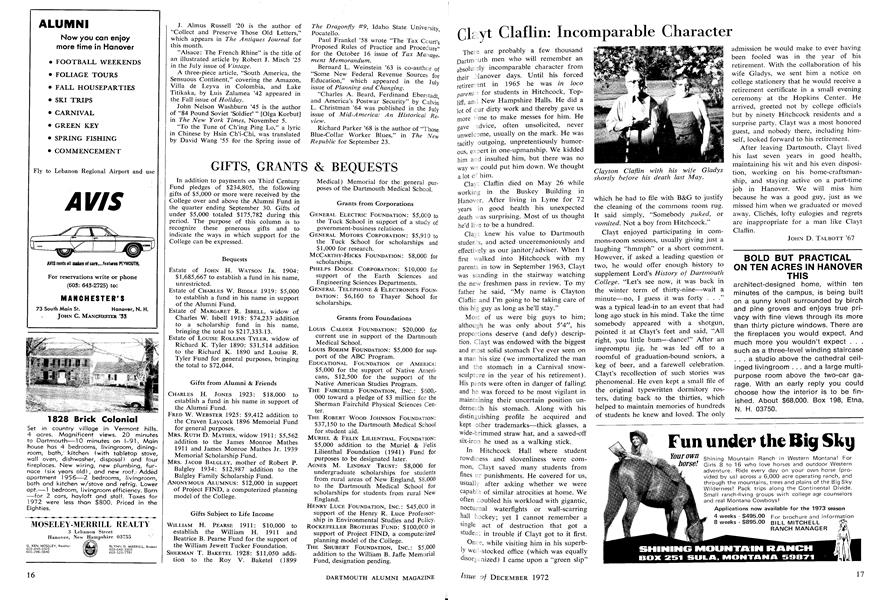
Clayton Claflin with his wife Gladysshortly before his death last May.