NROTC Commissioning
On June 10, sixteen members of the Class of 1972 were commissioned Ensigns in the Naval Reserve during ceremonies in Webster Hall. The commissioning exercises, next to last for Dartmouth's Reserve Officer Training Corps, marked the end of formal ROTC instruction on the campus.
Ten juniors in the program, having accelerated their ROTC study and completed courses required by the Navy, will be commissioned next June, following this summer's training cruise and completion of their senior year.
Gilbert R. Tanis '38, Director of Continuing Education and Liaison Officer for ROTC, was the speaker at the commissioning ceremony. He noted the College's long-time ties with the Navy, the fine records of the graduating cadets, and their role as reserve officers in the years ahead. Excerpts from his address follow:
"First some history. I thought it would be fitting this morning to note that during World War II one of the largest V-12 programs in the nation was operated on this campus. A small book entitled Navy at Dartmouth, which was written by Professor Emeritus Ray Nash, mentioned the size of Dartmouth's unit in terms of 2000 men.
"Immediately following the close of the war the program in which you have been engaged was established. During its 27 years some 1000 men have been commissioned into the Navy and Marine Corps.
"It might also be fitting to note that during World War II there was a ship known as the Dartmouth Victory. A transport was named for Rogers Blood '44, who lost his life during the war, and a third ship was named after none other than Dartmouth's founder, Eleazar Wheelock.
"One clue to the selection of these names occurred to me when I learned that James V. Forrestal, a non-graduate of the College in the Class of 1915, was Under Secretary of the Navy from 1940 to 1944 and Secretary from 1944 to 1947. One of his associates, John L. Sullivan '2l, served as Assistant Secretary of the Navy for Air from 1945 to 1946, Under Secretary from 1946 to 1947, and Secretary of the Navy from 1947 to 1949. I would add that another alumnus, Levi Woodbury, 1809, whose name you will recognize on one of our dormitories, served as Secretary of the Navy from 1831 to 1834....
"Now, what can you gain from the Navy? I should like to refer to one item: leadership....
"Leadership, as I understand it, is an unusual mix of intelligence, will, knowledge, judgment, and experience. Will and innate intelligence were once referred to by General Marshall as "gifts of the Gods." Knowledge and judgment, on the other hand, come from hard work and experience. I submit to you that one of the great opportunities you will have in the next four years is the opportunity to gain this experience in the art of leadership. After all, the business of an officer is the leadership of men....
"There are those who would say that 1972 marks the end of a quarter century of the Cold War. If this be true, and I like to think that it is, it is a wonder to behold and we should pause for a prayer.
"But this does not mean that our international problems are at an end. For example, James Reston wrote as follows just prior to President Nixon's trip to Russia: 'Moscow has not yet accepted the notion that it has more to gain by cooperating with the United States than by opposing it, but at least it is prepared to make limited agreements which do not tip the balance of power against it. One day the two major powers may take a wider view of their responsibilities and try to work together for the neutralization of critical areas like Korea, Vietnam, the Middle East, and Central Europe, but despite visible progress in the last year, that time has not yet come.'
"Willie Brandt, Chancellor of West Germany, spoke along similar lines at Harvard last week when he said, 'In this phase of change, America's presence in Europe is more necessary than ever. To build the structure of peace in Europe, we need the United States, its commitment, its guarantee, and its cooperation ... we need understanding for our partners on both sides of the Atlantic.'
"I interpret these quotations to mean that while the Cold War may have ceased and a new balance achieved among powers, it is a fragile balance and one that must be preserved.
"But while this balance of power is being preserved it would be my hope that the time would be used to move forward with the creation of a larger world order in which national sovereignty will be limited for the greater good of all....
"What does this have to do with those of you being commissioned today? During your next four years you will not only be contributing toward the maintenance of this fragile balance of power which means so much to the peace of the world, but you will be providing time for the working out of a larger world order.
"On behalf of your parents and your College and all of us, I would like to say thank you for the service you are about to undertake."
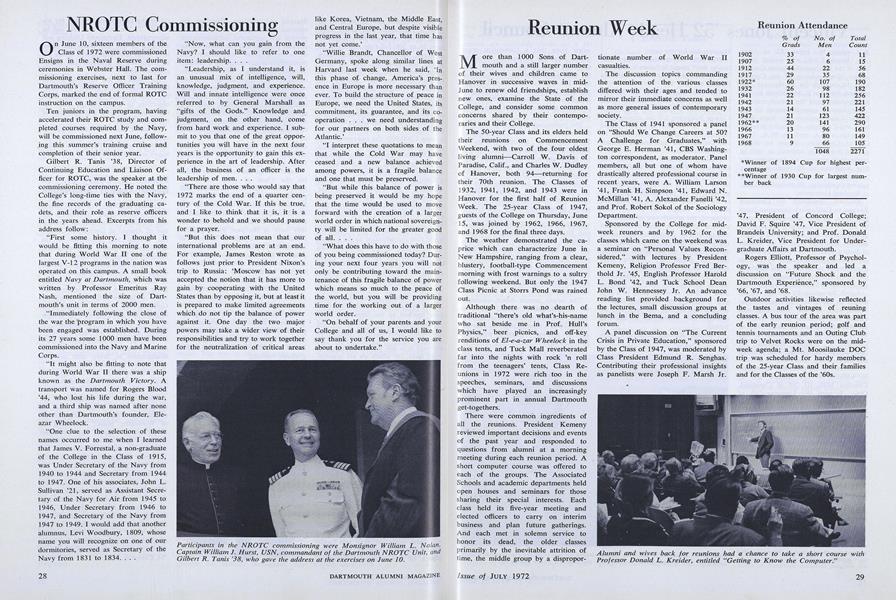
Participants in the NROTC commissioning were Monsignor William L. Nolan,Captain William J. Hurst, USN, commandant of the Dartmouth NROTC Unit, andGilbert R. Tanis '38, who gave the address at the exercises on June 10.