1934'S 40th
A total of 226 people, including 121 men of Class applauded during Reunion Alan Hewitt's reminiscences of undergraduate days, excerpts from which appear below:
"Isn't it true? Every generation makes the same complaint: 'These days, the kids have everything done for them. They're soft, that's what they are. They don't know what we suffered!' But we remember, don't we, how rugged it was, when we were kids. Jog with me, down memory lane, across the Bridge of Sighs, and into the Vale of Tears.
"The depression class. We came to Hanover in the year following the terrible Wall St. crash of'79 Herbert Hoover was our beloved presi- dent — until Franklin Delano Roosevelt took over . Roosevelt's first inauguration came some three weeks after Winter Carnival in our Junior Year. About 10 days before Carnival, that feller Hitler was named Chancellor of Germany. (Oh yes, I looked it up.)
"FDR promptly declared a bank holiday.... Ten cents... still bought a chocolate milk at Allen's, and that meant two tall glasses' worth, because there was a whole glassful left over in the container.
"Life in those dorms was primitive, wasn't it, compared with today? Freshman year, in Middle Fayer, there was a white-haired janitor named Rick. (Stan Silverman insists his name was Jerry.) Well - Eleazar made the beds every day, took a few swipes at the desk and other objets day, with a dust rag, brought in a vacuum cleaner with its long hose hooked up to a compressor or whatchamacallit in the basement. And there was a trunk room in the basement. - What was a "trunk," Grandpa? - Say, do you remember those wooden contraptions with which we Freshmen, in September, started on our way to back trouble as we carried trunks upstairs and then down for the upper classmen? Going to college with trunks in those days! Isn't it embarrassing, now?
"But today's students aren't supervised, as we were. They are free to make their own beds. - Or not.
"We had to be content with such primitive ways of getting the news — before there was a "Today Show," or helicopter traffic reports on radio. When I shot out, 7:15 to 7:30, for a fast breakfast, before an 8 o'clock class — six days a week both semesters of Freshman year — The Daily Dartmouth and that morning's New YorkTimes somehow were already outside my door. It was rugged, wasn't it? Having to stoop down in plus fours and golf sox to pick them up? The Times had raised its price to 3c by then.
"Radio at Dartmouth in 1930? The time of WBZ and WBZA to the glory of Westinghouse, UEAF at 711 Fifth Avenue, WJZ in Aeolian Hall, and WOC, the Palmer School of Chiropractic, Davenport, Iowa! We were warned in advance about the College's 220 D.C. current. I came with my family's cast-off 2-foot long battery-operated 5-tube Atwater Kent with RCA speaker. It couldn't pick up anything in 'he morning anyway, and nothing much except Montreal in the evening — because Spud Bray wouldn't allow you to rig an outdoor antenna to a chimney or a tree.
What did we do for music, then? Just listened to orthophonic, crackable, breakable shellacs, on hand-cranked portable phonographs with miserable volume that wouldn't carry even halfway to the next dorm with the window open!
Remember the old post office, next to First Nash, in the Musgrove building on the corner of Allen Street? Local first-class mail was 2¢, and the penny postcard cost one cent. Some of us sent laundry home from there by parcel post, because it was cheaper than having it done in Hanover.
Some of you grandfathers may have forgotten that the U.S. Mails then utilized a 19th century artifact called "trains." That's T-R-A-I-N-S. There was this thing called a railroad — the Boston and Maine? — that had parlor cars and dining cars and even Pullman sleeping-cars for passengers. Research has confirmed my memory of four trains a day in each direction between the Junction and Boston, six daily down to Springfield and on to New York, with con- nections to the West at Greenfield and at Springfield.... Extra trains? Well, at the start of Christmas vacation, three special trains were lined up at the Norwich-Hanover station.
"What technological miracles science has given us since then. Now, mighty two-engine planes offer 2 flights a day to New York... and perhaps three in Tinker Toys to Boston — weather permitting — and there are always the gracious rear-of-the-bus amenities of Greyhound. In 1974, the one extant daily train between New York and White River takes a restful one hour more for the journey than it did 40 years ago.
"As I near the end of this catalogue of suffering, don't wipe away your tears. Go ahead, wallow in self-pity as you wonder how we could have afforded those meal tickets at The Wigwam and The Campus Cafe. $5.50 worth of gourmet meals for $5. And what did that buy? Only 10 lunches and dinners each. (Less than a loaf of bread today in my neighborhood.) Honestly, I cannot remember if it was the custom to leave the waitress a tip. Possibly a nickel in cash?
"But our greatest hardship by far was tuition. The College recently announced that it must boost next year's fee by $405. Think of it! They will add $405 to the present charge. 44 years ago, tuition fee for the whole academic year was a walloping $400.
"The kids today just don't realize how tough it was, getting up that kind of money for an education. That's right; we did go to Dartmouth for an education. Think of some of those professors we had...
"Would you say that any of them made the least impression on our tender little growing minds? And that was Dartmouth teaching!
"Oh yes, we suffered and we had a lot to gripe about, but I have a question. If those four years we spent in Hanover were such a (expletive deleted) waste of time, then why the (inaudible) did we come back now for a 40th Reunion. You know what/think. We had a ball!
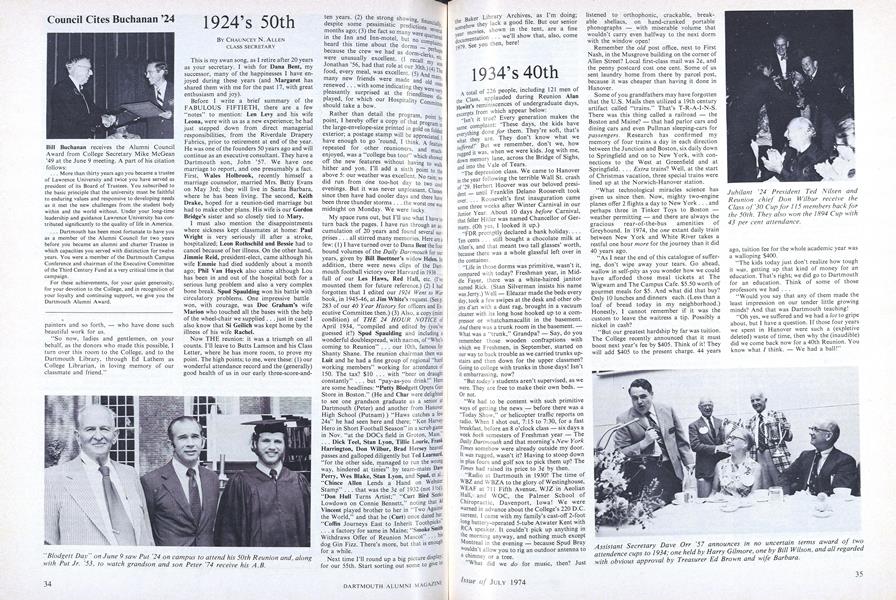
Jubilant '24 President Ted Nilsen andReunion chief Don Wilbur receive theClass of '3O Cup for 115 members back forthe 50th. They also won the 1894 Cup with43 per cent attendance.
Assistant Secretary Dave Orr '57 announces in no uncertain terms award of twoattendence cups to 1934; one held by Harry Gilmore, one by Bill Wilson, and all regardedwith obvious approval by Treasurer Ed Brown and wife Barbara.