Frost, Mencken, And Webster's Socks
The best browsing in Baker isn't all in the stacks.
Exactly four years from now, on January 29, 1991, the staff of Baker Library's Special Collections department will take out of storage seven packing crates, contents unknown. Accompanied by press and selected dignitaries, the librarians will open the boxes and reveal what they hope will be the writer H.L. Mencken's most important papers.
"Or, knowing Mencken, they could literally contain his dirty laundry," says Philip Cronenwett, the man into whose care, as curator of manuscripts and chief of Special Collections, the papers (or laundry) will be delivered. Within the oak-panelled Treasure Room of Baker Library, the Mencken material will join some very distinguished (and occasionally bizarre) company, including:
• George Washington's orderly book.
• A sixteenth-century document bearing the only known contemporary portrait of the Spanish conquistador Francisco Pizarro.
• The legal brief for the Dartmouth College case.
• The notebooks of Robert Frost.
• The corrected manuscript of a 1940 radio playlet by Aldous Huxley starring Bette Davis and Spencer Tracy.
• Papers of the novelist Erskine Caldwell including the original manuscript of Tobacco Road.
• The most comprehensive records in existence of the Battle of Antietam.
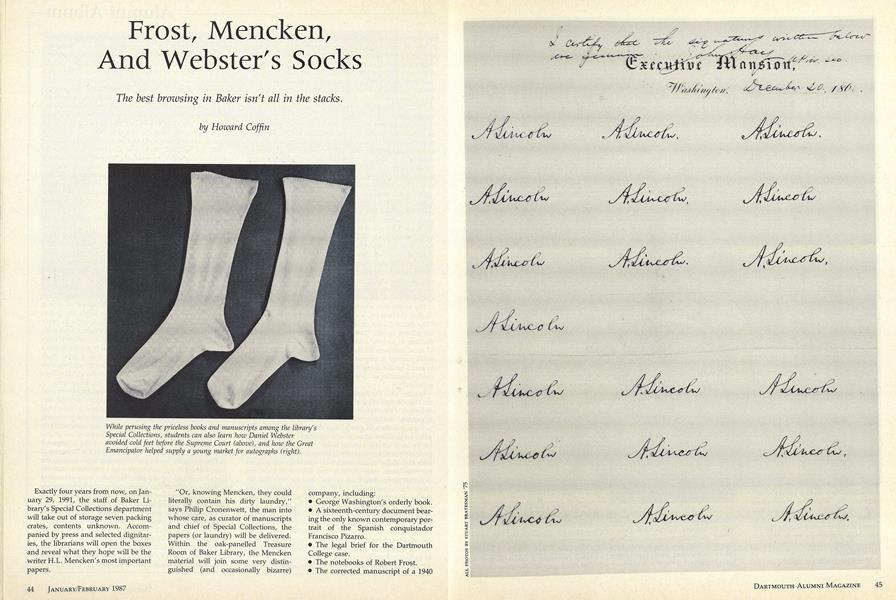
• A single piece of paper bearing 19 signatures of Abraham Lincoln.
• An unpublished - and perhaps
never-to-be-published - novel by Samuel Beckett.
• The personal library of one of England's major poets, Rupert Brooke.
Perhaps the most expected part of Special Collections consists of treasures relating to the College's early history the Charter, correspondence by Eleazar Wheelock, and the like. But, thanks to the generosity of alumni and friends of Dartmouth, Baker Library casts far afield for other memorabilia, much of it priceless. In fact, Cronenwett, an avid fly fisherman, likens the acquisition process to fishing. "Some institutions cast nets. We use a fly rod," he says. "It's not how many you catch, it's what you catch."
And behind each good catch is a story.
Will Armageddon Destroy Mencken's Papers?
According to curators familiar with the Mencken papers, Cronenwett says, before the writer died in 1956 he expressed a fear of the atomic bomb and worried whether his papers would survive. So while he bequeathed papers to libraries in his beloved Baltimore and New York City, he also stated that Dartmouth should receive one third. Apparently he hoped that remote Dartmouth would be spared Armageddon.
When the crates are opened on the 35th anniversary of Mencken's death, Dartmouth will make his papers almost immediately available to the College's undergraduates. Few institutions allow students such access. But according to Cronenwett, Dartmouth sees its collections as part of the teaching process. "The whole idea is to provide materials on which students can base their research," he says. Thus it is not uncommon to see students seated in the room with manuscripts valued in five and six figures spread before them.
A Sinful Man of Letters
One of Cronenwett's favorite items in Special Collections is a small book of Latin prayers. The book was created around 1600 for King Philip III of Spain by a Dominican monk named Diego de Barrada. The volume is in its original binding, which shows signs of heavy use. The 88 pages of prayers consist of thousands of tiny letters, each of which was cut by hand as an individual stencil. Colored silk is inserted between pages, making the stencilling easy to read. "The task must have taken years," says Cronenwett. "It. must have atoned for a considerable sin."
An Explorer's Last Words
Baker Library houses one of the world's finest collections on papers that record exploration of the Arctic. Included is a diary of George W. Rice, a participant in the ill-fated Lady Franklin Bay arctic expedition of 1881- 84. Of the group's compliment of 24 persons, 19 died. Rice's diary records the execution of a man for stealing food from his comrades. His last entry, in surprisingly firm hand, notes that he is in failing health and says he is unlikely to survive. Rice died the night the entry was made, mainly from his exertions in trying to save fellow crew members.
Frost by the Foot
According to Cronenwett, Dartmouth holds the world's finest collection of Robert Frost papers. "Most institutions count their Frost manuscripts one by one," says the librarian. "We count ours by linear feet." Measured in terms of boxes packed together on shelves, Frostiana stretches for 12 feet. The heart of the collection was given by Frost's longtime secretary, Kathleen Norrison, who felt the College to be an appropriate repository for the poet's work. Frost attended Dartmouth as a freshman. Among the College's holdings are 44 of the 50 notebooks that Frost used to draft and redraft his poetry. The collection alows undergraduates to trace the evolution of the poems firsthand.
History's Most Matter-of-Fact Love Letter
In the spring of 1848, Congressman Abraham Lincoln sent a letter to his wife back home in Springfield, Illinois, which read in part: "I write this letter in the post office, surrrounded by men and noise, which together with the fact that there is nothing new, makes me write so short a note. Affectionately, A. Lincoln." Dartmouth owns the letter.
Eyewitness Accounts of a Bloodbath
The Civil War Battle of Antietam, fought on September 17, 1862, was the bloodiest day in American military history. A quarter-century after the battle, amateur historian John M. Gould wrote to every survivor of Antietam he could locate and asked him to recreate his actions of the day and record them on a map. Most complied, and the resulting papers were later donated to Dartmouth. They are the most frequently requested documents in Special Collections the most comprehensive history of the battle that gave Lincoln the political momentum he needed to issue his Emancipation Proclamation.
Like all of the items in Special Collections, the Antietam papers are stored in a climate-controlled environment and kept in acid-free boxes or envelopes. The library operates a small shop for restoring manuscripts thanks in part to funds provided by the class of '46.
George Washington's Arithmetic: Part I
At age 13, the father of our country undertook a school lesson in his elegant handwriting. He wrote on a small piece of paper titled "Mensuration of Solids": "If a block of marble be a foot long 19 inches broad and 14 inches thick how many solid feet does it contain." At the end of a column of figures his answer appears: "16 and 15/24 Solid Feet."
"I haven't the foggiest idea whether that's correct, " Cronenwett admits.
George Washington's Arithmetic: Part II
One of the great treasures of Special Collections is Washington's Orderly Book, kept by an aide at the Continental Army's New York City headquarters during the early days of the Revolutionary War. One entry reads: "The colonels or commanding officers of regiments are to make out their pay abstracts for the month of May, these are to be carefully examined by the brigadiers under whom they serve, and by the paymaster general, before the warrants are brought to be signed by the general, they are then to deliver them in and receive payment."
Not a very exciting day at headquarters though the date was July 4, 1776. "It also shows the Army was seriously behind in its payroll," observes Cronenwett.
A Conqueror's Prow
Only one contemporary portrait of Pizarro, the Spanish conqueror of Peru, is known to exist. It appears in the corner of a document, a grant in arms dated May 14, 1542, directed to one Nicolas de Almacan of Arequipa, Peru. The portrait in the illuminated border shows Pizarro to have a rather prominent nose.
The extremely rare document is the gift of Mark Lansburgh '49, who has given the College many treasures including the celebrated "Dartmouth Fragment/' which Cronenwett believes may be the oldest piece of written music in the western hemisphere.
His Own Worst Critic
The College owns the only manuscript which happens to be the only copy of a novel by Samuel Beckett titled Dream of Fair to Middling Women. The book has never been published.
"And if Beckett has his way, it never will be," Cronenwett says. "He apparently does not think much of it. Dartmouth students may read the novel, though to publish even excerpts is forbidden. The manuscript is part of a substantial collection of Beckett papers given by the writer's friend Lawrence Harvey, a Dartmouth professor of French and Italian.
Paper Chase
These days, Cronenwett is especially interested in obtaining papers that relate to the history of computing. "Several of the most important people in the history of computing are on Compus," he notes. "It seems natural that we would want to preserve their work for posterity."
The search for new treasures is important to Baker Library's reputation, according to chief librarian Margaret Otto: "You can find most of our books in other major libraries. But only here do you find our collections."
While perusing the priceless books and manuscripts among the library'sSpecial Collections, students can also learn how Daniel Websteravoided cold feet before the Supreme Court (above), and how the GreatEmancipator helped supply a young market for autographs (right).
If Mencken did indeed pack his dirty laundry off to Dartmouth, he would not lackprecedent. Baker Library also contains a greasy World War I jumpsuit that reeksof petrol, socks that once belonged to Daniel Webser-as well as a cat in the Hat watch (left), the crown for the Winter Carnival Snow Queen top) and heconch shell used by Eleazar Wheelock to call his students to class (above).All are part of a realia collection of objects that explain the lives of people Two items recall Dartmouth's literary tradition: an old suitcase bearing theinitials "RF" (said to have been owned by a famous New England poet) and a trophy inscribed, "Thursday Afternoon Poets Award for Outstanding Stupidity.
The only known contemporary portrait ofPizarro shows that the conqueror ofPeru owned a rather prominent nose.
Dartmouth owns the three volumes of Audubon's Birds of America that once belonged toDaniel Webster. He failed to make payment, so a fourth volume was never delivered.
"Knowing Mencken, the boxes couldliterally contain his dirty laundry."
"Our books are in other major libraries.But only here do you find our collections
Howard Coffin, former associate director ofthe Dartmouth News Service, is now newsdirector of the University of Vermont. Heis an avid collector of American historicautographs and documents.
More From This Issue
-
 Feature
On the Warpath
January | February 1987 -
 Feature
"Love in a Cold Climate" and Other Cures for the Winter Blahs
January | February 1987 -
 Article
Dartmouth Authors
January | February 1987 -
 Article
Evalyn Hornig: Helping students formulate career success
January | February 1987 -
 Article
Ross Sandler '61: New York City's King of the Road
January | February 1987 -
 Class Notes
1982
January | February 1987