On the Warpath
Battle tested and photojournalist Jim Nachtwey shoots the shots heard round the world
It was late in April 1983. Jim Nachtwey was marching through the pinecovered hills of northern Nicaragua on assignment for Time magazine with a detachment of contra commandos. For ten days he had been photographing the guerrillas as they launched hit-andrun operations against Sandinista-controlled farms and villages.
Meanwhile, in Washington, D.C., the president of the United States was planning his own Central American offensive. Stung by criticism of his policies in the region, Ronald Reagan had decided to convene a special meeting of both houses of Congress to rally support. High on his list of priorities was continued support for the contras.
On the day of the speech, one of the guerrilla commandantes took Nachtwey aside and told him he had heard a radio report of the president's plan to endorse the cause. The photographer knew instantly that he had a dramatic scoop, if only he could get the photographs to Time before the magazine's deadline two days away.
Time picture editor Arnold Drapkin knew it, too. Resigned to the likelihood that his photographer was incommunicado in the field, Drapkin was engaging in some last-ditch attempts at telepathy, hoping Nachtwey might come out of the hills long enough to ship his film.
Guided by more pragmatic instincts, Nachtwey had already embarked on an Indiana Jones-style odyssey to deliver the pictures in person. The first leg: a rib-ratting, all-night ride out of Nicaragua into Honduras in a contracommandeered pickup truck. The next day, Thursday, he arrived in the Honduran capital of Tegucigalpa and booked a flight to New York via Miami. Before leaving, he put a call through to Drapkin, who readied his troops.
Nachtwey arrived at Time in the early hours of Friday morning - deadline day carrying his rolls of Ektachrome and Kodachrome. By 4:30 a.m., the Ektachrome was processed at the magazine's lab and edited, but the Kodachrome had to be sent out. Satisfied with his first batch of images, Nachtwey ducked off to a hotel for a three-hour snooze. He returned to find that the last batch had yielded some gripping images, including one dramatic close-up of four contras carrying American-made rocket launchers that Drapkin had selected to open the lead story. Drapkin was elated. Nachtwey was pleased. Mission accomplished.
Six months later, Nachtwey submit- ted several of the contra pictures [along with pictures taken in Lebanon during the Shuf Mountain wars in 1983] to the Overseas Press Club's annual compe- tition and the National Press Photog- raphers Association's Pictures of the Year contest. In April 1984, he became the first photographer ever to win both the NPPA's Magazine Photographer of the Year award and the OPC's Robert Capa Gold Medal in the same year.
I first met Jim Nachtwey in the fall of 1966, at Dartmouth College. We were freshmen. He majored in art history and political science, and aside from a fondness for bashing heads on the rugby pitch, you'd never guess his quiet, thoughtful demeanor would lead him out of the shade of the ivy and into the heat of combat photography. Now when we see each other, it's for a fishing expedition to some cold whooshing stream we like to think is teeming with trout.
Though Nachtwey and I have talked many times about his life as a war photographer specifically, where he's going, who's doing the fighting, what the stakes are we never really discussed why he does it. He's not eager to talk about it. He says he relies on his pictures to do that for him.
Looking at Nachtwey's photographs, one is immediately struck by the number of violent places he has visited. For the last four years, he's been on assignment almost continuously in Lebanon, Israel, Northern Ireland, the West Bank, Gaza, El Salvador, and Nicaragua. He been nicked in the leg by a land mine in El Salvador, struck in the face by mortar fragments in Lebanon, and smashed in the arm by a rock in the Brixton section of London. He has huddled for days with protesting Israeli settlers on a sun-scorched rooftop in Yamit, mucked a contra canoe over dryseason sandbars and shark-infested channels in Nicaragua, and survived 48 hours of heavy seas in an open 18-foot boat with Moskito Indian commandos.
Nachtwey makes little of these occupational hazards. I mention them because to most of us, bodily comfort has a direct bearing on how we do what we do. Not Nachtwey, though. His sense of well-being is inseparable from his own exacting expectations for his pictures. "Study each image," he says as we begin poring over his prints at the New York offices of his agent, Black Star. "Each one, if it's good, will have its own narrative. When I make them I try to close everything else off."
Closing off everything else is something Nachtwey does better than anyone else I know. After getting his first taste of duck-and-run photography as a free-lancer covering the Boston busing crises, where he suffered a blindside bashing at the hands of a few South Boston lads, his adrenaline was tapped, perhaps forever. He vowed to become a full-time photojournalist, and the closing off began in earnest. First to go were any plans for a sedentary existence. "I've always thought getting married and having children would be extremely fulfilling," he says. "It's just that there's no time for that the way my life is. That may change someday, but for now my commitment's to my work."
He's also excluded from his thoughts any questions about his suitability for the profession. "It's funny," Nachtwey says. "When I started in this business I thought that I could do it and be good at it not in a conceited way, but in the sense of it being a natural thing for me."
Having determined that to succeed he needed a rigorous apprenticeship, Nachtwey moved to New Mexico and started work for the Albuquerque Journal in 1976. "I wanted to learn the basics," he remembers. "My plan was to plug along, make the big mistakes, and get them out of my system." Between mistakes and before moving back east to New York in 1980, he managed to win an NPPA regional award for best news photography.
For the first three years in New York, he lived out of suitcases and cardboard boxes, renting or borrowing floor space in the homes of friends who would have him. The first pictures he showed around rodeo photographs from New Mexico made a lasting impression on Susan Vermazen, associate photo editor at New York mag- azine. "It was like looking at a carousel from Mars," she recalls. "Mildly interesting, but basically unusable." Newsweek senior photo editor Jim Colton remembers them, too, and recalls telling Nachtwey something on the order of "I'll be sure to call you when the rodeo comes to town."
Things got on track when he signed with Black Star and landed his first international assignment in 1981. It was in Belfast during the Irish Republican Army hunger strikes, and the 32-yearold photographer paid his own way until Newsweek decided to help him.
The urge to be part of the big story has propelled him ever since. In 1983, on a fall fishing trip in Montana, I was navigating our car over back roads after a full day on the water. Nachtwey was holding his portable shortwave radio out of the window trying to catch the British Broadcasting Corporation's evening news. When things took a turn for the worse in Lebanon, so did Nachtwey's attitude toward our trip. He knew he was in the wrong place (even though he hadn't had a vacation in well over a year), and being in the right place is one of those instincts editors prize in photojournalists.
Says Drapkin: "I don't know many people as serious about their work as Jim." Bill Pierce, a staff photographer for Time and a veteran of more wars than Nachtwey, remembers three occasions in Belfast when plastic bullets flew by Nachtwey's face and crashed through the planking of a wood fence a foot away. "We all get caught up in certain situations," Pierce says, "but the uniqueness of Jim's insanity is that he'll wait not just for any picture but for a good picture." Newsweek's Colton says it flat out: "Jim may not look like the kind of mad dog who dodges bullets, but he's probably the best color news photographer I know."
More so, perhaps, than any of his colleagues, Nachtwey is able to capture the strangely poetic movements and emotions of people who live at the center of warfare. Using almost archetypal symbolism, he composes his images with an artistic precision that enriches the drama of the events he records.
The consistent excellence of Nachtwey's work also reflects the twin constants in his approach to making pictures: hard work and no play. In a profession known for after-hours tension-busting around the bar, Nachtwey who doesn't smoke and almost never drinks is a rare sighting. "When I work in Central America, I seldom take a day off," he says. "I need my strength and stamina to get the job done, and I usually have dinner, think about what I've done, and get ready for the next day."
It was in Central America that I got my first glimpse of Jim Nachtwey the photographer. By his standards it was not much of an outing. The assignment was to shoot a portrait of Salvadoran president Jose Napoleon Duarte for People, but as it turned out, Duarte was unavailable the day of the scheduled shoot. People associate editor John Saar wanted to use the time to visit the priest who hosted the first peace talks between Duarte and guerrilla leaders in the town of La Palma, just 75 kilometers north of San Salvador.
About 35 kilometers into the journey, our Salvadoran cab driver turned around and solemnly announced that we were entering la zona libra. Nachtwey, who had exercised the photographer's perogative on preempting the shotgun seat, smiled at me and said that with any luck we might run into a few muchachos (guerrillas). Instead we topped a hill to find ourselves fact to face with a heavily armed foot patrol of government soldiers. First there was a line of them on the right side of the road, sweating as they marched in the midday sun; then there was a gauntlet. The cab slowed down and moved cautiously between them.
We were almost through when a soldier with red hair and an irritated look stepped in front of us and aimed a very large machine gun at the windshield. Another man, apparently in charge, walked around to the driver's window and asked where we were going. The driver looked at Nachtwey uncomfortably, then answered, "La Palma."
The soldier immediately stepped over to my backseat window and demanded to see my identification. His machine gun hung from his shoulder in such a way as to draw a bead between my eyes. As I handed him my press credential, it was hard not to think how easy it would be for things to go wrong. What if the soldier's girlfriend had thrown him out the night before? What if another cab ten minutes earlier had kicked up a pebble that hit him in the knee? Or maybe he'd just been shot at?
Casting a glance at Nachtwey, I could see that composure-under-fire was the desired if not the most natural reaction. "The secret' he would say later, "is to use your apprehension to heighten your awareness of movement around you. You can't let the fear paralyze you. You want the adrenaline working to make you more, not less, ready to react."
We made it through the checkpoint without additional incident. As we got nearer La Palma, the driver had to swerve several times to avoid mounds of corn that had been spread out on the road to dry. The slalom reminded Nachtwey of a few broken field runs he'd made in Lebanon.
"One time a Lebanese army APC [armored personnel carrier] had taken a direct hit from a Druse cannon in the Shuf mountains," he recalls. "I ran out on a hillside covered with boulders, dashing from rock to rock to photograph the rescue of the wounded, only there weren't any. Every guy inside was dead, most of them badly torn up, one with only half a body.
"Later during that same battle I was stuck next to a couple of APCs that had been knocked out by still more artillery fire. I had been counting on getting a ride back to the Lebanese army lines. As shells started coming in closer and closer to my position, I knew I had to get out. The problem was the 150 unprotected yards back to the lines. I counted the incoming explosions. They came in like waves, several at a time, because the gunners paused to reload. That's when I took off, running like crazy. When I got back to the lines, I turned and watched a shell drop directly on the path I'd run. That was the fourth time I'd seen that in five days. I was lucky."
Near the outskirts of La Palma, we came upon two muchachos seated by the side of the road. They stood up and motioned with their machine guns for us to stop. One of them held a gun on the cab while the other leaned in the driver's window and asked where we were going. This time Nachtwey an- swered. The guerrilla nodded and asked if we had seen any government troops. He said we had. When the guy asked what kinds of guns they were carrying, Nachtwey shrugged and said, "No se."
As a journalist whose life as well as his reputation rides on his ability to remain objective, Nachtwey is militant about not letting himself be used as a tool by either side in any conflict. Once on a contra patrol, a young soldier turned to him and asked if he'd like him to start firing at a Sandinista position to provide a photo opportunity. Nachtwey explained emphatically that his job was to record what happened, and never at least knowingly to be a catalyst. His reputation for nonpartisanship allowed him to go out on a Sandinista patrol less than a month later.
Trying to pin down what holds him captive to his work, Nachtwey says, "For me it's important to see and try to understand what happens in war and why there are wars. Maybe I want to find out how I'd react in certain situations. I'm not sure. But to witness, communicate, and maybe even act as some sort of conscience really compels me."
That clarity of purpose is what helps unleash the startling vulnerability in so many of the faces Nachtwey photo- graphs. He is a trusted presence not a friend, but a fellow human being sharing what's coming down, at least for the moment, and who will accurately reflect, not manipulate, what he sees.
"When you're looking at Jim's pictures," says Susan Vermanzen, "you're not seeing what so-and-so looks like, you're seeing what he is like."
It is a thematic, not a geographic, focus, fueled by an unflagging affinity with the staggered but still-standing spirit he sees in all the world's troubled areas. Because he can't escape his feelings about the horror and sadness he photographs, and because he nurtures the hope inside that somehow his pictures will make a difference, he speaks with considerable passion about the people he photographs.
"You could say that they are all part of the same story about human dignity and the struggle to have what every human being deserves," Nachtwey says. "When you see the powerless stand up to the powerful, when you see an old Palestinian who's had his refugee camp obliterated, sitting on the sidewalk playing with his granddaughter, it's heartbreaking yet exhilarating. In America, where others have already fought many of these battles for most of us, it is hard to imagine such a struggle."
Yet because he know better than most the dangers of overattaching himself to a cause or an ideology, Nachtwey is quick to temper his progressive ardor with self-reminders that he's just like any other man plying his trade.
Still, the difference between "doing a job" and "making a difference" is an anxiety without professional bounds. It gnaws especially at combat photographers. For them, the blood and the suffering are not a television concoction. For the rest of us on the sidelines, with an electronic screen or newspaper as a go-between, distance from the din can muffle the sound and homogenize the horror, but when you're up against it every day, how long can you go on just reporting the facts?
"I'm in photojournalism for the long run," Nachtwey says. "I'm not sure how long I can continue to do 90 percent of my work at war. It seems the odds are bound to catch up with me. But I'm not burning out, nothing like it. I hope I'm getting better all the time."
Friend and fellow photojournalist Pierce is not so upbeat. "I'm not in the slightest bit worried about Jim's photography," he says. "I'm worried, number one, about his ass, and number two about his soul, and in that order. If your ass is blown off, so much for the soul. There are a lot of important assignments where people don't fire at you and I'd like to think that Jim will be there."
Nachtwey got such an assignment not long ago, to cover the famine in sub-Saharan Africa. He traveled from Ethiopia to the Sudan, Chad, and on across the continent for National Geographic. Though he's quick to point out the similarities with war assignments photographing innocent people at mortal odds with their environment he did profess to finding the work extremely rewarding, and he appreciated thoroughly the opportunity to shoot an important story without having to worry about being killed at the same time.
Because he was able to move around without tight military restrictions, he also began to consider the possibilities of making photo essays aimed at encapsulating more than just a battle or a war of the struggle to survive. "I started thinking about using photography to communicate the visual essence of a whole range of human endeavors in countries around the world," he says.
Not long ago the editors of NationalGeographic dispatched Nachtwey on a special three-month assignment to Nicaragua. Just as he was preparing to leave, he got word from the Overseas Press Club that he had won his second consecutive Robert Capa Gold Medal, this time for photographs he made of Eden Pastora's contras and their costly but first-ever victory over the Sandinistas at San Juan del Norte in southern Nicaragua.
Would he tell the contras how the pictures of them won the contest?
"Nope," he says, before flashing a slightly restrained smile. "I would not want to encourage them."
This feature on photographer Jim Nachtwey '70, written by his classmate DenisO'Neill, appeared in American Photographer in September 1985. O'Neill, a former writer and producer for WGBH-TV inBoston, is now a screenwriter in Hollywood, where there is TV and film interestin the dramatization of one of Nachtwey'scombat adventures.
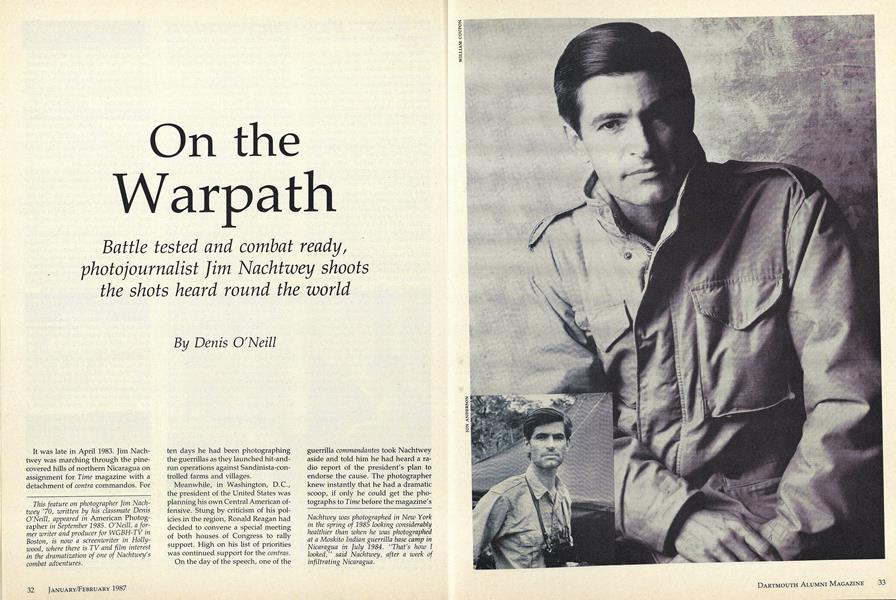
Nachtwey was photographed in New Yorkin the spring of 1985 looking considerablyhealthier than when he was photographedat a Moskito Indian guerrilla base camp inNicaragua in July 1984. "That's how Ilooked," said Nachtwey, after a week ofinfiltrating Nicaragua.
On his first overseas assignment, Nachtwey photographed the tumult surroundingthe 1981 IRA hunger strikes in NorthernIreland. Left: A British soldier takes coverduring a Belfast street battle outside ayoung girl's apartment. Right: A youthhurls a Molotov cocktail in Londonderryfollowing a funeral for an IRA hunger striker.
Above left: Nachtwey photographed a Sandinista celebration after the party's triumphin a 1984 election. Right: As a young Salvadoran gazed apprehensively at government troops entering his village, Nachtweyframed the scene against the background ofthe boy's bomb-struck home.
Above: In El Salvador in 1984 Nachtweytook this telling portrait of a governmentsoldier wounded in a rebel ambush. Right:In 1983 in Managua, Nicaragua, a childplayfully swung from the barrel of an abandoned tank that had once belonged to Somoza's national guard.
The Dartmouth Alumni Magazine spoke to Nachtwey in September 1986 whilehe was in New York, between assignmentsand recovering from a knee wound he received during a riot in South Korea whenhe was hit by a tear gas cannister fired bya combat policeman. He was scheduled toleave a few weeks later for Berlin on anassignment for a German magazine. Whenasked about his "latest adventure," hespoke of crossing the Palk Strait in May1986 with some Tamil separatist guerrillasin open fishing boats. The guerrilla unitwas "blown out of the water" by membersof the Sri Lankan navy who were patrollingthe Strait. Nachtwey escaped and afterthree weeks of hiding returned to safetywith the help of another group of Tamilguerrillas. "Just another war story," saidNachtwey.
More From This Issue
-
 Feature
Frost, Mencken, And Webster's Socks
January | February 1987 -
 Feature
"Love in a Cold Climate" and Other Cures for the Winter Blahs
January | February 1987 -
 Article
Dartmouth Authors
January | February 1987 -
 Article
Evalyn Hornig: Helping students formulate career success
January | February 1987 -
 Article
Ross Sandler '61: New York City's King of the Road
January | February 1987 -
 Class Notes
1982
January | February 1987
Features
-
 Feature
Halsey Charles Edgerton '06
OCTOBER 1967 -
 Feature
The Future of Liberal Arts Education at Dartmouth
JUNE 1972 -
 Feature
ALUMNI FUND PLANS FOR 1959
DECEMBER 1958 -
 Feature
MiSSING IDOL:KOM AGAIN?
December 1973 -
 Feature
A four-and -a-half-ounce magic totem pole
June 1976 -
 Feature
"Veni, Vidi, victus sum."
JUNE/JULY 1984


