Prof's Choice
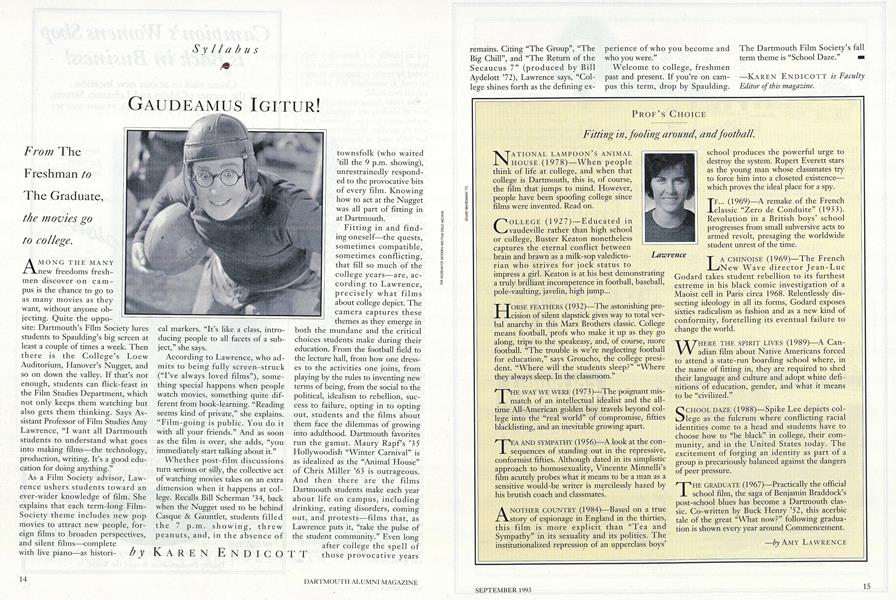
Fitting in, fooling around, andfootball.
NATIONAL LAMPOON'S ANIMAL HOUSE (1978)—When people think of life at college, and when that college is Dartmouth, this is, of course, the film that jumps to mind. However, people have been spoofing college since films were invented. Read on.
COLLEGE (1927)—Educated in vaudeville rather than high school or college, Buster Keaton nonetheless captures the eternal conflict between brain and brawn as a milk-sop valedictorian who strives for jock status to impress a girl. Keaton is at his best demonstrating a truly brilliant incompetence in football, baseball, pole-vaulting, javelin, high jump...
HORSE FEATHERS (1932)—The -astonishing precision of silent slapstick gives way to total verbal anarchy in this Marx Brothers classic. College means football, profs who make it up as they go along, trips to the speakeasy, and, of course, more football. "The trouble is we're neglecting football for education," says Groucho, the college president. "Where will the students sleep?" "Where they always sleep. In the classroom."
THE WAY WE WERE (1973)—The poignant mismatch of an intellectual idealist and the alltime Ail-American golden boy travels beyond college into the "real world" of compromise, fifties blacklisting, and an inevitable growing apart.
TEA AND SYMPATHY (1956)— A look at the consequences of standing out in the repressive, conformist fifties. Although dated in its simplistic approach to homosexuality, Vincente Minnelli's film acutely probes what it means to be a man as a sensitive would-be writer is mercilessly hazed by his brutish coach and classmates.
ANOTHER COUNTRY (1984)—Based on a true story of espionage in England in the thirties, this film is more explicit than "Tea and Sympathy" in its sexuality and its politics. The institutionalized repression of an upperclass boys' school produces the powerful urge to destroy the system. Rupert Everett stars as the young man whose classmates try to force him into a closeted existencewhich proves the ideal place for a spy.
IF... (1969)—A remake of the French classic "Zero de Conduite" (1933). Revolution in a British boys' school progresses from small subversive acts to armed revolt, presaging the worldwide student unrest of the time.
LA CHINOISE (1969)—The French New Wave director Jean-Luc Godard takes student rebellion to its furthest extreme in his black comic investigation of a Maoist cell in Paris circa 1968. Relentlessly dissecting ideology in all its forms, Godard exposes sixties radicalism as fashion and as a new kind of conformity, foretelling its eventual failure to change the world.
WHERE THE SPIRIT LIVES (1989)—A Canadian film about Native Americans forced to attend a state-run boarding school where, in the name of fitting in, they are required to shed their language and culture and adopt white definitions of education, gender, and what it means to be "civilized."
SCHOOL DAZE (1988)—Spike Lee depicts college as the fulcrum where conflicting racial identities come to a head and students have to choose how to "be black" in college, their community, and in the United States today. The excitement of forging an identity as part of a group is precariously balanced against the dangers of peer pressure.
THE GRADUATE (1967)—Practically the official school film, the saga of Benjamin Braddock's post-school blues has become a Dartmouth classic. Co-written by Buck Henry '52, this acerbic tale of the great "What now?" following graduation is shown every year around Commencement.
Lawrence
More From This Issue
-
 Feature
I Was A Freshman Trip Spy
September 1993 -
 Feature
Fifty-Five Out
September 1993 -
 Feature
The Next Bus Home
September 1993 -
 Feature
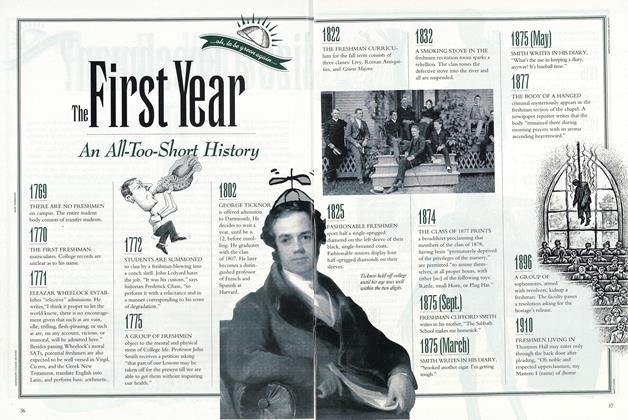
The First Year
September 1993 -
 Feature
How Do You Socialize a Freshman?
September 1993 -
 Cover Story
They have been called freshies, Pea Greeners, shmen a current phrase that cannot be uttered without sneering.
September 1993