Honey, They're HOME
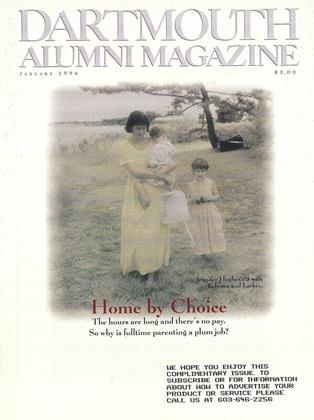
The hours are long and there's no pay.
So why is fulltime parenting a plum job?
Photographs hy Joe Mehling '69, tinting hy Kathl een O Connell
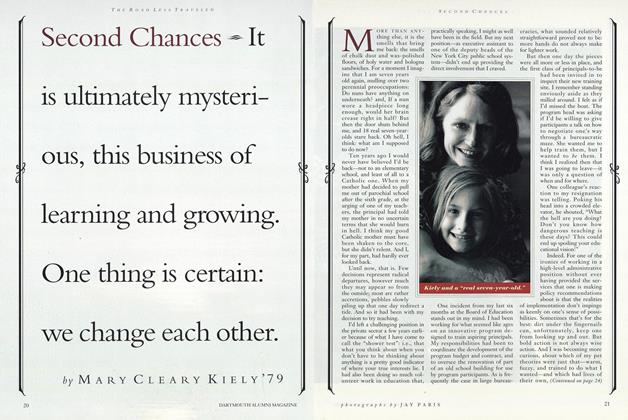
When I Mentioned to my colleagues two years ago that I planned to give up my job in elementary-school teaching to stay home with our baby, one of them who had no children of her own joked that the transition would be easy. "From 20 screaming eight-year-olds to one sleepy newborn?" she laughed. "It'll be a piece of cake." As it turned out, the transition was anything but easy.
I was exhausted, for a start: the dozy little cuddler of my imaginings never slept for more than two or three hours at a stretch for the first six months of her life.
I was frustrated: the efficient and energetic professional that I thought of myself as being proved incapable, most days, of accomplishing much more than feeding and changing and comforting and entertaining a single baby.
And I was frequently quite lonely. Between my husband's 12- to 14-hour workdays and the seemingly interminable blizzards of that winter of 1994, which kept me from getting out to meet other mothers, I often had no face-to-face contact with other adults all day long. It was little wonder that by the time our daughter, Bridget, was five or six months old, I had a whole new appreciation for what my mother had accomplished in staying home with six children. I was also considering going back to work.
A year and a half later, however, I'm glad I didn't. Our daughter has metamorphosed into a delightfully vibrant, curious, and enthusiastic toddler and, in the rare quiet moment that I get with her, I reflect that nothing adequately prepared me for how much I would love this little girl. While I still have times when I long to be able to focus on any task for more than five or ten minutes without being interrupted, or to be able to do a job and have it stay done, I know that those things can wait. The time will come, soon enough, when Bridget will spend, and choose to spend, most of her time in the care and company of others.
While I would, without question, choose to stay home with our daughter again, I recognize that fulltime parenting is not for everyone. Single parents, for example, and couples tor whom a second income is a true financial necessity never really have an option. Other parents honestly feel that they would be unhappy at home most of the day. Still others prefer working parttime or working fulltime but with flexible hours.
Of all the family/work options available to parents today, however, fulltime parenting seems particularly subject to misconceptions. One is that women today who choose to stay home with their kids are reverting socially into a kind of domestic prison. Not only does this miss the fact that at-home mothers—whether of the 1950s or of the 1990s—have always led more complex lives and made more valuable contributions to society than is often publicly acknowledged. It also ignores the reality that for many contemporary mothers, staying home to care for one's children is not a permanent commitment. In the 1990s, an at-home mother today is often a working mother tomorrow, and vice versa.
Here's what seven Dartmouth women and men, from the classes Of 1976 through 1984, have to say about the whys and wherefores, up and downs, of being home by choice.
Ann Fritz Hackett '76
Son Conor was six and daughter Kelly was four when Ann Fritz Hackett, Dartmouth's first alumna Trustee, left her partnership in a management consulting firm to become a stay-at-home mom in McLean, Virginia. Her daughter Caitlin was born the following year.
Pregnant Pause
We were living in London and I was doingan extensive amount of transatlantic travel,spending an average of one week a monthaway from my family. At one point I actually had to spend six weeks apart from them.Then Sally, a close friend from high school,died of leukemia, leaving a child of mydaughter's age. I knew how important myhusband and children were to me; hut Sally'sdeath forced me to recognize that I was notspending my time accordingly. I had madea lot of trade-offs over the years, mostly infavor of my professional career, and I realized it was time to change that.
Ups
A child is only one, or three, or six for a short time, and now I'mnot missing any of that.
We tend to have this idea that babyhood is the most importanttime for parents and children to be together. But one of the greatsatisfactions for me right now is being able to be here when Conorand Kelly come home from school. I've found that kids aren'twilling to wait until it's convenient for you to tell you what's happened in their day. You hear about it when it's on their minds.
One of the reasons that I don't miss working in managementconsulting is because I've been so active in other commitmentsoutside the home: serving on the Dartmouth Board, doing consultingprojects from home, writing, and getting involved in our children'sschools.
Downs
When I was about to go on maternity leave with my first child andwas undecided about whether I would return to my job, the people I got the most pressure from were other women. "You were thefirst female partner at the firm, you're a role model, you're doingthis and that, you absolutely have to come back!"
While I was actually home on that maternity leave, I found itvery difficult when people, meeting me for the first time, would ask,"What do you do?" I found myself bowing to other people's expectations. I would say things like, "Well, I'm a management consultant and oh, by the way, I just had a child. I'm home on leaveright now."
The Bottom Line
I don't give a lot of weight, anymore, to those very real pressuresto define oneself primarily by one's paid employment, but it tookawhile for me to get to that point. Life really is a series of phasesfor most women—many of us will be in and out of the paid workforce a number of times—and I'm happy to see broader acceptance of that notion.
Nancy Kepes Jeton '76
Son Eric was two when husband Peter '76 was transferred to Aus tralia with the Bank of Boston in 1989. Facing the difficulty of obtaining an Australian work permit and the complications of arranging a second American adoption, Nancy, an urban planner, opted for fulltime parenting. The Jetons successfully adopted Hannah, now five, and then moved from Sydney to Tokyo to Boston to Paris.
Pregnant Pause
We more or less stumbled into the decision that I would stay homefor some undefined time. The success of our family s choice of a"global-nomad" lifestyle depends greatly on the anchor providedby an at-home parent. Moving around as much as we have—atone point we settled into nine different addresses in 15 months!we feel that our kids deserve the security of knowing that someone they can count on will be at home for them every day.
Ups
Helping our kids adapt to new environments has reinforced our conviction that the most effective way to instill our values is by ourdaily example, with the at-home parent as the primary role model.helping me shovel out snowbound elderly neighbors, forexample, Eric and Hannah share in caring for other people. Trying to find our way in a new city using rudimentary foreign language skills, they realize that curiosity brings rich rewards, includingnew friends and the knowledge that it's okay to make mistakes.By taking the time to read together every day, we share a love oflearning and help to ignite the magic of imagination. Of course,Peter and I could share these values with them if we both worked,but we'd have fewer opportunities to reinforce them and would belargely dependent on other caregivers whose values might differ.
Downs
I do worry, sometimes, about potential negative effects of my at-home decision. For example, I wonder whether I could be stunting the development of independence and a sense of self-reliancein my kids. Will I be able to choose the right time—for myself andfor my kids—to reenter the workforce? When Ido seek a paid jobagain, will potential employers believe that my most essentialskills are intact, and that what I have learned through parentingand household management is transferable? How far behind willI really be in professional technology, vocabulary, and practices?Will I be able to catch up within a reasonable period?
The Bottom Line
At this point I have settled quite comfortably into doing whatfeels right for me instead of being guided by the expectations ofothers. I've come to accept that my personal sense of scale is rathercozy and that I do my best work in small groups and small environments. I honestly can't conceive of a better application formy Dartmouth education right now, than to be helping build afoundation for the lives of two curious, compassionate citizens ofthe world.
Jeff Weeks '78
Jeff Weeks resigned his position as a math professor at Ithaca College in 1990 to care fulltime for his newborn son, Adam, "when Adam started nursery school at age three, Jeff began teaching one math course per semester at Middlebury College, where his wife, Nadia, worked. Jeff taught mornings and took care of Adam afternoons. The family now lives in Canton, New York, where Nadia teaches at St. Lawrence. Jeff consults via e-mail for the Geometry Center in Minneapolis and remains an at-home dad.
Pregnant Pause
My parents thought it was a terrible idea. They were sympathetic to the idea that someone should stay home with the child,but—a double standard very much at work here they wouldhave preferred that it be my wife, so that my career wouldn't becompromised. Even my wife thought it was unnecessary for meto stay with our son. She would have been happy to sign him upfor day care instead, though she has been supportiveof my choice.
It's often hard to explain your own choice withoutbeing perceived as implicitly criticizing the choices ofothers. I think that the love and care a child gets at homecan't he replicated in a day-care center. Another partof the motivation was selfish: I wanted to enjoy a lotof time With Adam when he was young, and thatwouldn't have been possible with a 60-hour-per-weekacademic job.
Ups
Being a parent is more than just changing dirty diapers.We pass on our culture to our children, and take primary responsibility for shaping their worldview. Eventually kids move off on their own, but we're the oneswho get them started.
Downs
A frustration with my current setup is having virtuallyno free time. Since I only work on Geometry Center projects until three p. m. during the week, I usually haveto put in additional time on Saturday and Sundaymornings. I wish I could just take the whole weekendoff to have more time with my wife.
The Bottom Line
All this is a small price to pay for the opportunity to bean at-home dad and have a satisfying career. I consider myself lucky.
Leonard Weiser-Varon '78
Leonard Weiser-Varon's wife, Amy, was at the end of her maternity leave from a Boston law firm in 1987 when she suggested he make use of his law firm's gender-neutral parentalleave policy that granted associates up to a year's unpaid leave without loss of seniority. Amy convinced Len that he should seize the opportunity to spend time at home with their firstborn, Aaron. Len's being at home, Amy suggested, would also ease her own discomfort about going back to work. By the time their daughter Anna was born in 1990, Amy had become a fulltime mother.
Pregnant Pause
When I told the partner in charge of my department that I plannedto take a paternity leave to care for Aaron, our then five-monthold son, he nodded and asked, "How many weeks?Two?" When I said, "Five months," the partner tried to talk meout of it. His principal argument was that I'd go stir crazy. I heldmy ground.
Ups
Unstructured time is a boon when one is used to an overscheduledlife. The demands made by Aaron were generally understandableand simple relative to those Iconfronted in my workaday life.The main reward in staying athome with our son, however,was the heightened feeling ofconnectedness to him. He isnow eight years old, and thatspecial connection has neverweakened.
Downs
Even though Aaron was thebest of company, I found theexperience socially isolating.Because of the temporary natureof my at-home status, not tomention my non-mom status,I did not attempt to hook upwith other at-home adults inour neighborhood. I also foundthe transition in adrenaline levels from the workplace to homedifficult. I had no doubt aboutthe value of what I was doing,but after the first few months Ifound myself getting impatientwith the relatively timeless paceand with the absence of day-to-day goals and deadlines.
The Bottom Line
As the husband of a feministwho chose to stay home, andas a feminist by osmosis, Ithink women, no less than men,are entitled to work throughtheir parenting years if theywish to do so. Reasonable accommodations should be madeby all employers. By the sametoken, women who opt to stayat home should be respected;their choice is, these days, a difficult, courageous, generally underappreciated, and invaluablecommitment to those one has brought into the world.
Jennifer Hughes 79
After she and her husband, Doug, had a child, Rebecca, in 1990, Jennifer Hughes suspended her consulting business, Hughes Communications, for a year. She tried to continue it on a parttime basis after that, but was unhappy with the results. That was three years ago. Jennifer has since given birth to a second daughter, Larkin.
Pregnant Pause
When I graduated from Dartmouth, I had the naive belief that bythe time I ever started thinking about children (which seemed soremote as to be largely impossible), most of the major issues—suchas ease of access to high-quality child care, widespread job sharing and parttime opportunities, and a system for enhancing easeof re-entry to the job market—would all be ironed out. After all,I thought, the days of bra-burning were long gone, women couldbe found in all the major professions, and the glass ceiling was supposedly beginning to crack.
My first job was in a large law firm. There were exactly threewomen partners: two divorced, and one never married.
Then I became a marketing consultant. It's a service business,and the hours just weren't flexible enough. I needed to be seamlessly and totally available for my clients when they needed me.Clients don't want to know about your personal scheduling problems! I would have needed a fulltime child-care person to be ableto work parttime. So I decided to stay home fulltime.
Ups
Working outside the home offered more of an intellectual challenge,while working at home is more of an emotional challenge. Working outside, one gets a sense of completion and positive feedbackas each project ends, while inside there is almost never a sense ofcompletion and very little feedback and support. Instead there areunparalleled moments of pure joy and wonder. I have been particularly fascinated by the way children's language develops, andI wouldn't have wanted to miss witnessing that incredible process.
Downs
Even though I get out a fair amount and have been very active ina number of volunteer activities in the BayArea, I tend to feel less confident in socialsituations with new people than when I wasin the midst of my consulting business.
The Bottom Line
Have you ever noticed hour eager mothersof our generation—both those at home andthose with paid jobs—are to ask you whatdecisions you've made about staying home,your outside activities, and the amount ofchild care you use? I think that our generation of mothers is fascinated by how otherparents are juggling things, because theywant to know if there's someone, anyone,out there who's actually got it all workingsmoothly, all at the same time. The reality for most of us is something more improvisational: making one choice now and,as the situation changes, making anotherchoice later.
Mary Thomson Renner '82
In 1993 Boston-based Mary Thomson Renner was increasingly frustrated with her children's-clothing manufacturing business and her hectic life. Mary, married to Peter Renner '78, opted to become a fulltime mom to newborn Maggie and Madeline, two. During that time Mary has been a trustee of the New England Aquarium, trustee of the Boys and Girls Camps, and a member of the Dartmouth Alumni Council.
Pregnant Pause
My office was in our home, and because ofthe nature of my work I was always underreally tight deadlines. I was constantly saying to the girls, "Come on, come on, comeon!" Eventually I got tired of rushing themjust to keep up with my business schedule.I found myself thinking about the time weactually have with our kids, the four or fiveyears before they go off to school fulltime,and it really isn't that much. I didn't wantthat time to be filled with stress and anxiety for them. I also wanted to know that ifsomething came up spontaneously with ourchildren, I could drop everything and go. SoI opted to discontinue my business.
Ups
I do really like being able to stay with thekids when they're sick. Some of the mostcomforting memories from my own childhood are of being picked up at school by mymother whenever I was ill.
I also like the fact that I'm more relaxednow, that I can help friends when they getin a bind, and that I don't feel like a wreckwhen my husband gets home at night.
Downs
I'm not as patient as I expected I would be.
The Bottom Line
I look at friends in corporations and lawfirms who are fighting to have their rightsrespected, and I can see where they're coming from. But I can also see where the employers are coming from. Businesses andprofessional organizations have to havesome ability to plan, and I think that sometimes we expect too much of them. I believeit's fair to ask employers to try out situations and to be open-minded about working with employees in an effort to meetboth their needs. But it's a give and takeon both sides, and sometimes a mutuallysatisfactory arrangement just can't be arrived at.
I'll probably never go back to a reallystructured work environment. My planright now is to get a degree in graphic design and then go out on my own.
Linda TuckIsaacson '84
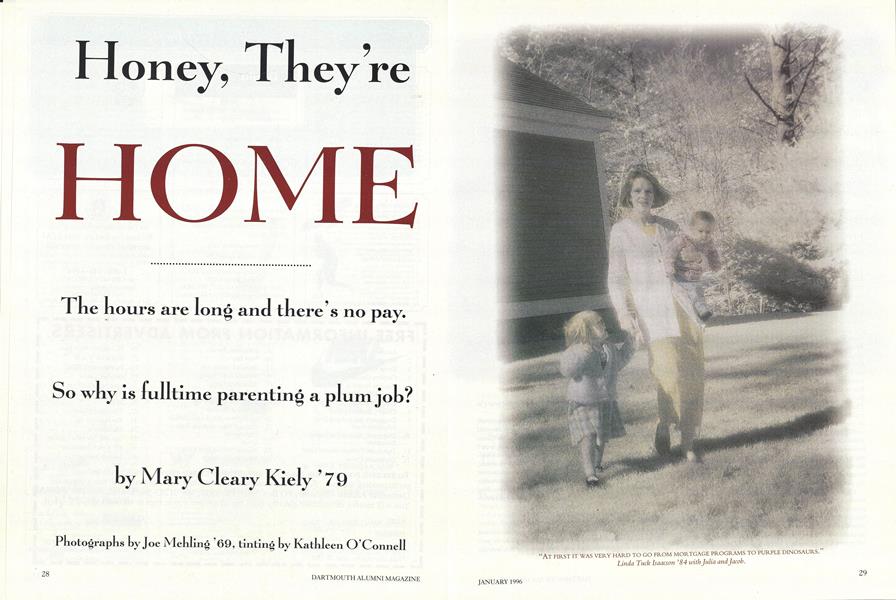
Linda Tuck Isaacson '84 worked as a manager of a mortgage company in Cumberland, Maine, during her first pregnancy. She liked her job so much that she never even considered staying home fulltime. "I was so sure that I would return to work for three days a week that, when I was only three months' pregnant, I actually made a deposit on a day-care slot," she says. That all changed after Julia was born in March 1993. By the time Jacob was born two years later, Linda married to John Isaacson '84 was a confirmed at-home mom.
Pregnant Pause
Julia was a very colicky baby, and whenit came time for me to go back to work, Ijust couldn't leave her. She was extremelysensitive and wouldn't let anyone but mehold her, so the prospect of leaving her withstrangers was not at all appealing.
Since then, of course, Julia has becomemore independent and has developed verypositive relationships with the baby-sitterswe use. Still, I've found that I really likebeing totally in tune with her, being ableto predict both how she is likely to react indifferent situations and what needs to bedone to keep her on level ground. I'm ableto do this, I think, mostly because Juliaand I have spent so many hours togetherduring the past two years.
Ups
The two things that have surprised memost about staying home, are, first, that Iam here at all and, second, that I enjoy itso much.
Downs
At first it was very hard to go from constantly thinking about mortgage programsand clients to dealing with nothing but babyfood and purple dinosaurs. Both types ofwork are exhausting, but while my mortgage accounts could be left at the office,motherhood is a constant! The two roles areso incredibly different that I believe individuals have to figure out what feels rightto them when deciding whether to workoutside during the child-rearing years.
The loss of independence involved in being a fulltime parent can be an ongoingfrustration, particularly when one is dealing with an infant. But there are ways tocope with that. I think parents who stayhome have to make a serious and consciouseffort to get some time away by themselves.They need to continue with their own interests and hobbies and get some adult stimulation just to rejuvenate and to feel complete, and to avoid developing tunnel vision.It's not only good for the parents; it's alsogood for the kids, because a re-energizedparent is a more patient one.
The Bottom Line
For a very long time I felt guilty about nothaving a paid job, mostly because our society tends to make women of our generation feel that we should have a career outside the home going at all times, no matterwhat. I feel much more relaxed about thewhole situation now, though. I know thatby staying home with our children, I amgiving them the very best I can.
It's worth it.
Dartmouth's first female Rhodes Scholar, MARY CLEARY KIELY left a lucrative job inthe insurance industry to become an educationadministrator. She left thatjob to teach. And sheleft that work for full time mothering. Her laststory for us, "How Not to Be a RhodesScholar," appeared in the October issue.
"AT FIRST IT WAS VERY HARD TO GO FROM MORTGAGE PROGRAMS TO PURPLE DINOSAURS." Linda Tuck Isaacson '84 with Julia and Jacob.
"THERE IS VERY LITTLE FEEDBACK AND SUPPORT. INSTEAD THERE ARE UNPARALLELED MOMENTS OF PURE JOY AND WONDER. Jennifer Hughes '19 with Rebecca and Larkin.
"THERE IS VERY LITTLE FEEDBACK AND SUPPORT. INSTEAD THERE ARE UNPARALLELED MOMENTS OF PURE JOY AND WONDER. Jennifer Hughes '19 with Rebecca and Larkin.
Source: 1994 Department of Labor Statistics
"THE MAIN REWARD IN STAYING HOME WITH OUR SON WAS THE HEIGHTENED FEELING OF CONNECTEDNESS WITH HIM. Leonard Weiser-Vavon '78 with Aaron.
"I HONESTLY CAN'T THINK OF A BETTER APPLICATION OF MY DARTMOUTH EDUCATION RIGHT NOW." Nancy Kepes Jeton '16 with Peter Jeton '76, Eric, and Hannah.
"I HONESTLY CAN'T THINK OF A BETTER APPLICATION OF MY DARTMOUTH EDUCATION RIGHT NOW." Nancy Kepes Jeton '16 with Peter Jeton '76, Eric, and Hannah.
Source: 1993 Census Bureau data