Multiculturalism's Hidden Hand
In an excerpt adapted from his new book, The End of Racism,conservative pundit Dinesh D'Souza '83 argues that cultural relativism prevents academia from seeking truth.
If MULTICULTURALISM IN AMERICAN COLLEGES and universities was, as many of its advocates insist, nothing more than a program for teaching young people about other cultures, merely a broader alternative to "monoculturalism," then it would be uncontroversial. Who could be against hundreds of thousands of undergraduates going beyond Plato and Shakespeare and energetically grappling with the Analects of Confucius, the Muqaddimmah of Ibn Khaldun, and Rabindranath Tagore's Gitanjali?
The reason for the controversy over multiculturalism is that, in practice, it offers a specific paradigm for understanding both Western and non-Western cultures. Similarly, it provides an ideological lens for studying conflicts about race, gender, arid sexual orientation in the United States. Consequently, the multicultural debate is a civil conflict within the West about competing ways to understand ourselves, and the world beyond.
As the name suggests, "multiculturalism" is a doctrine of culture. There are many cultures, and they are all presumed to be on an equal plane. No culture is superior or inferior to any other. The standards for evaluating a culture must come from within that culture. No culture may rightly impose its values on another. For all their variety, virtually all contemporary approaches to multiculturalism are united in their commitment to cultural relativism. In particular, they are vehement in their denial of Western cultural superiority.
That cultural relativism is the "hidden hand" guiding multicultural pedagogy is suggested by a controversy a few years ago in which No bel laureate Saul' Bellow was quoted saying, "Show me the Proust of the Papuans and I'll read him." Reflecting! widely held view, literary scholar Mary Louise Pratt termed that statement "astoundingly racist."
Why? Not because Bellow said that the Papuans do not have the capacity to produce their own Proust; he simply suggested that, as far as he was aware, they had not. Yet Bellow's remarks, by hinting at the possibility of Western cultural preeminence, deny to other cultures what philosopher Charles Taylor terms "the politics of equal recognition." As Taylor correctly describes it, the multicultural paradigm holds that "true judgments of value of different works would place all cultures more or less on the same footing."
Since each culture has its own scale of values, and all cultures are equally worthy of recognition and respect, advocates of multiculturalism stress that there are no timeless or universal truths that transcend the boundaries of space and time. "The truths any of us find compelling will all be partial, which is to say they will all be political," writes literary scholar Stanley Fish. At its deepest level, multiculturalism represents a denial of all Western claims to truth.
Yet in the world and within the United States, all cultures are not on an equal footing. Globally it is the nations of the West and increasingly the countries of Asia which enjoy scientific, technological, and economic predominance. Since cultural and racial groups are presumed equal in their capacity and potential, advocates of multiculturalism are committed to the view that the nations which are most advanced got that way by stealing the wealth of the nations which are underdeveloped, and that groups that are succeeding in America owe their gains to a history of oppressing groups that are falling behind. As Michael Omi and Howard Winant write in Racial Formationin the United States: "The broad sweep of U.S. history is characterized not by racial democracy but by racial despotism, not by trajectories of reform but by implacable denial of political rights, dehumanization, extreme exploitation and policies of minority extirpation."
This ideological vision accounts for the apparent double standard of contemporary multiculturalism, which is merciless in its chronicle of the historical crimes of the West—slavery, the subordination of women, the persecution of homosexuals, and so on—while it is virtually uncritical of the equivalent or greater offenses of other cultures. For example, virtually every college student knows that whites practiced slavery' in this country, while I have discovered during my campus travels that very few students know that American Indians also practiced slavery, and did so long before Columbus arrived on these shores. Either their teachers themselves are ignorant of this, or in this age of diversity education they are reluctant to inform them of this fact for fear of being regarded as spoilers at the multicultural picnic.
The consequence for students is a distorted picture of their own culture and of other cultures. After all, slavery was a universal institution, and female subjugation and hostility to homosexuals are the norm in most Third World countries. By contrast, the crusade for the abolition of slavery was a uniquely Western enterprise, and more recently, feminism and equal rights for homosexuals are also distinctively Western movements. So multiculturalism in practice suppresses the liberal tradition of the West even as it camouflages the illiberal tradition of non-Western cultures.
Ultimately it is cultural relativism itself that becomes the issue. Advocates of multiculturalism are right that none of us approach other societies as a cultural tabula rasa; our perspective is necessarily shaped and perhaps clouded by our prior beliefs. But does this mean that we have no way to transcend these biases and approach the ideal of objectivity? If so, then multiculturalism is an illusion because other cultures constitute inaccessible and incommensurable worlds, and Westerners can do no better than project their own values onto the cultures they appear to be studying.
Ironically the assumption that other cul- tures are self-contained and untranslatable systems leads to the conclusion that it is a waste of time for outsiders to attempt the in- herently impossible project of understand- ing other cultures, If wesimply cannot know the Other, perhaps it makes sense to content ourselves "with the ethnocentric dictum: Know Thyself. Philosopher Richard Rorty has reached precisely this conclusion, arguing that Westerners should be unabashedly ethnocentric because they cannot be anything else. _ _
The vast majority of multicultural advocates reject Rorty's position, because it exposes multiculturalism as Eurocentric, whereas activists like to think of themselves as fighting Eurocentrism. The question then becomes: How can American students transcend Western assumptions and study other cultures "from within" when such an effort seems doomed at the outset? Multicultural advocates such as Renato Rosaldo, Richard Delgado, and lan Haney-Lobez typically answer that schools should recruit minority and Third World representatives who can provide much-needed black, Hispanic, Asian, and American Indian perspectives. In some cases, activists insist that it is inadequate for minority recruits to have the right skin color: they must also espouse progressive and left-wing views.
But how do we know that these individuals who have necessarily been hired by American criteria (university degrees, publishing records, even radical credentials) are truly representative of the indigenous systems of thought and belief in a particular culture? There is a good chance that they could represent marginal or unrepresentative factions within other cultures, or else they could be Eurocentric impostors.
Multicultural advocates typically skirt this problem by asserting that education does provide a bridge between cultures, and with proper training students can be taught to appreciate the equal worth of all cultures. "If we develop cultural consciousness and interculrural competence," Christine Bennett writes in Comprehensive Multicultural Education, "we may be able to understand that we might very well accept and even participate in such behaviors had we been born and raised in that society."
But this conclusion does not follow from its premises. If standards of judgment derive from within cultures, how can we arrive at an external standard of evaluation that permits us to place all cultures on an equal plane? How can we know that the moral codes of other cultures are valid for the people who live under them? Multicultural activists rely on the sleight-of-hand in which "I cannot know" becomes "I cannot judge" which becomes "I know that we are all equal." A skeptical confession of ignorance mysteriously: becomes a dogmatic assertion of cultural egalitarianism.
This is not to condone approaching other cultures with a presumption of inferiority. As Charles Taylor argues, "It makes sense to demand as a matter of right that we approach the study of other cultures with a presumption of their value. " Thus cultural relativism may provide a useful methodological starting point of humility and intellectual openness. Yet as Taylor points out, in evaluating other cultures "it can't make sense to demand as a matter of right that we come up with a final concluding judgment that their value is great or equal to others." Perhaps a careful examination of other cultures will reveal good reasons to be critical of other cultures, just as we are often critical of our own culture.
Indeed the first thing we notice when we study other cultures is that without exception they reject cultural relativism. Cultural relativism is a uniquely Western ideology. I hus it should come as no surprise that relativism provokes sharp resistance from people in other cultures. Imagine the legitimate anger of a Muslim who is cheerfully informed by a Western academic that Allah's teachings are true for him, when he deeply believes that they are universal principles. A relativist analysis of Islam as nothing more than a social adaptation reveals, in a new form, the old and perverse Western tendency not to take other cultures seriously as offering fundamental alternatives to Western notions of goodness and truth.
Moreover, as Leszek Kolakowski points out, it seems paternalistic to say that Islamic practices such as punishing thieves by cutting off their limbs represent legitimate judicial options—for those people. Such arguments, which imply that our kind of people deserve democracy and human rights but their kind of people do not, seem self-serving and destructive to the contemporary aspirations of millions of Third World peoples. As anthropologist Claude Levi-Strauss recognized, many Third World peoples are happy to acknowledge the temporary backwardness of their cultures as the basis for gaining access to Western ideas and Western technology and making a transition to modernity which they correctly identify with the West. Levi-Strauss writes:
The dogma of cultural relativism is challenged by the very people for whose moral benefit the anthropologists established it in the first place. The complaint the underdeveloped countries advance is not that they are being Westernized, but that there is too much delay in giving them the means to Westernize themselves. It is of no use to defend the individuality of human cultures against those cultures themselves.
Consequently a sincere effort to study other cultures "from within" requires a rejection of the Western lens of cultural relativism. Indeed an examination of great Islamic philosophers such as Al-Farabi and Ibn Sinha reveals that they believed in reason and revelation as the two mechanisms for discovering universal truths. These Muslim scholars studied the Greeks not because they were interested in diversity but because they were interested in truths which they believed extended across cultural boundaries. Consequently, multiculturalists who wish to take non-Western cultures seriously must take seriously their rejection of relativism. Otherwise a humble openness to other cultures becomes an arrogant dismissal of their highest claims to truth.
Students do need to be exposed to the great accomplishments of other cultures, as well as their influence on the West. Cultural relativism goes beyond this to insist that we should understand cultural differences without applying (inherently biased) standards of critical evaluation. Thus multicultural ism becomes a technique for celebrating differences without making distinctions. Specifically, it forbids at the outset the possibility that one culture may be in crucial respects superior to another. An initial openness to the truths of other cultures degenerates into a closed-minded denial of all transcultural standards. Seeking to avoid an acknowledgment of Western cultural superiority, relativism ends up denying the possibility of truth.
The claim of Western cultural superiority has, for the past several centuries, decisively rested on science and technology, which seem to offer an unrivaled access both to the laws of nature and to the material benefits of harnessing nature's power. Science is a major embarrassment to cultural relativism because it seems ridiculous to assert that each culture has its own equally valid claim to understanding physical laws. Whatever its social benefits in promoting group solidarity, either rain-dancing does or does not cause rain. Does it make sense to say that the earth is round for us, but other cultures may with equal legitimacy insist that theearth is flat?
At first glance this seems implausible, yet drawing on Thomas Kuhn's The Structure of Scientific Revolutions, some radical multiculturalists contend that even scientific principles only hold within cognitive paradigms and thus have no claim to accurately represent nature. African-American anthropologist Johnnetta Cole argues for a "new definition" of science which is "based on the multiplicity of equally valuable truths." Kuhn himself has repudiated terms such as "ethnoscience," as well as the extreme relativistreading of his work, insisting that he was merely describing how scientific revolutions happen, and not questioning the capacity of scientists to increase knowledge and predict and control external phenomena. And it strains incredulity to insist that the law of gravity and the law of non-contradiction are culture-bound.
If we grant, however, that Newton's theory of gravity is universally true, we must then consider the possibility of truths that are Western in origin but universal in their application. To this the thoughtful relativist usually responds by invoking the famous distinction between facts and values. According to this view—first advanced by positivists and made famous in this country by Max Weber—we can through scientific techniques know facts, but we have no rational basis for preferring the values of one culture (or individual) to those of another.
Yet the fact-value distinction also contains serious problems. Is the distinction itself a fact or a value? If it is a value, then we must conclude that it is arbitrary and there is no scientific basis for believing it. So how do we know that the values of different cultures cannot be meaningfully compared? Here relativists typically appeal to the diverse moral opinions of various cultures to demonstrate the relativity of values. Yet such surveys prove nothing, because undoubtedly similar surveys in various cultures would produce an equal diversity of opinions on such factual questions as E=mc² or whether human beings evolved from lower forms.
Advocates of relativism such as Stanley Fish usually win popular support for their case by attacking the straw man of "absolute truth." But not even science claims to have access to absolute truth. Indeed the entire system of scientific hypothesis and verification is based on the assumption that truths are partial and subject to future revision. We cannot say that evolution is absolutely true, but we can say that there is more evidence for Darwin than for Bishop Ussher. We cannot show that Einstein's physics is eternally true, but there is more evidence for Einstein than for Newton, just as there is more evidence for Newton than for Ptolemy. The absence of final knowledge does not mean that some claims are not better supported than others. There is no basis for concluding, as Fish does, that there is no basis for distinguishing between reason and belief.
If some scientific truths are considered valid on the grounds that they are more true than competing theories, why by the same token must we dismiss the possibility that political or moral propositions may be considered as permanent and universal (although not necessarily absolute) truths? It is true that hypotheses about nature can be tested in the scientific laboratory, but it is no less true that hypotheses about human nature can be tested in the laboratory of historical experience. Consider the central proposition of the Declaration of Independence—all men are created equal—which Abraham Lincoln declared "an abstract truth, applicable to all men and all times." A good case can be made that, based on what we know about human nature and various forms of government, we can be just as certain as we are of scientific propositions that government by popular consent is a better system than religious theocracy or political totalitarianism. Of course some Islamic fundamentalists might disagree, bat they are also likely to disagree about the theory of evolution. In short, they could be wrong on both counts, and truth about the natural and the social world becomes possible.
Cardinal Newman defined the purpose of a liberal education as one to "educate the intellect to reason well in all matters, to reach out towards truth, and to grasp it." Young people should learn ways to seek to distinguish truth from falsehood, beauty from vulgarity, right from wrong. Knowledge is both a matter of ascertaining facts as well as developing the tools to formulate "right opinion." To use Plato's famous image, we live our lives in a cave, deflected by the shadow of perspective and opinion, but it is the aspiration of an authentic ucation to help us move from opinion to knowledge, to climb out of the darkness into th e illuminating light of the sun.
DINESH D'SOUZA is John M. Olin Research Fellow at the American Enterprise Institute. His previous book, Illiberal Education, was on the New York Times bestseller list. He was a White Housesenior domestic policy'analyst in the Reagan administration. Beforegraduating Phi Beta Kappa from Dartmouth he was editor of theDartmouth Review,
If standards of judgment derive from within cultures, how can we arrive at an external standard of evaluation that permits us to place all cultures on an equal plane?
Multiculturalistswho wish to takenon-Westerncultures seriouslymust takeseriously theirrejection ofrelativism.


Features
-
 Cover Story
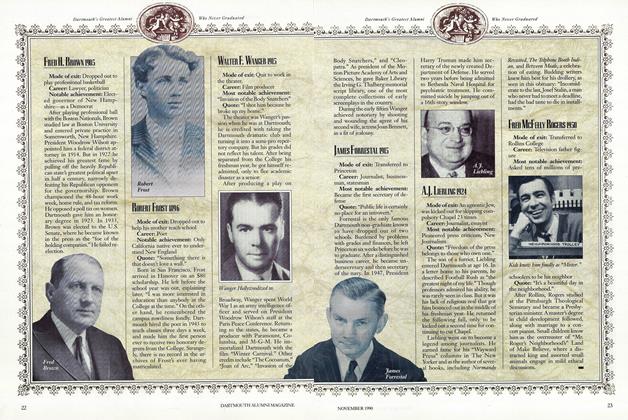
Robert Frost 1896
NOVEMBER 1990 -
 Cover Story
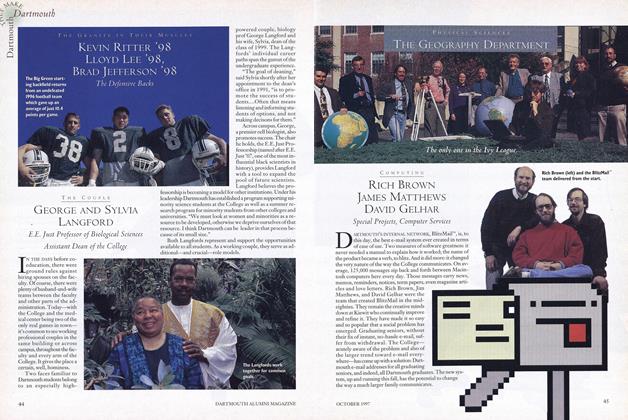
The Geography Department
OCTOBER 1997 -
 Feature
40 Years at the Helm
OCTOBER, 1908 -
 Feature
The Cult of Domesticity
SEPTEMBER 1997 -
 Feature
The Art of War
MARCH | APRIL 2018 -
 Feature
A winter of discontent, a day of perceiving differences
April 1979


