War and Remembrance
Nearly three decades after the Vietnam War, Dartmouth’s memorial finally finds a proper home on campus.
Nearly three decades after the Vietnam War, Dartmouth’s memorial finally finds a proper home on campus.
Nearly three decades after the Vietnam War, Dartmouth's memorial finally finds a proper home on campus.
ALMOST 30 YEARS HAVE PASSED since the United States withdrew its combat forces from Vietnam. That means, in turn, that almost two-thirds of Dartmouths living alumni had never experienced anything approximating a war before last September 11. Only then were they introduced to the kinds of wartime expressions of community that have traditionally shaped so much of our national sense of being and purpose.
This changed context surely justifies a story about the recent move of Dartmouth's Vietnam memorial, especially with Veterans' Day just past, but it is the memorial's very existence that really makes it newsworthy. After all, communities seldom build monuments for wars about which they disagree, and just as Dartmouth failed to memorialize the War of 1812 and the Mexican War—ones that Daniel Webster, class of 1801, and all New England opposed—so we might have expected never to find a Vietnam memorial at the College.
Surely the Vietnam War divided the Dartmouth community just as profoundly. Twenty-one alumni died in it, and their lost lives testify to their commitment; campus activists opposed the warwith equal fervor, though in less deadly ways. Sit-ins became commonplace, and on May 6,1969, anti-ROTC protesters went so far as to seize Parkhurst Hall while their pro-ROTC counterparts, one armed with a battle flag of the Kaisers Germany, rallied in support of their cause on the lawn outside. Long after graduation both groups returned for reunions, but once on campus they edgily kept their distance, each side mixing only with its own.
That was still the reality in 1976 when student Nick Sakhnovsky '78 approached Michael McGean '49, hoping that as secretary of the College McGean would fund a Vietnam memorial, a statue to be crafted by Sakhnovsky's friend and classmate Ted Arnold. A promising sculptor, Arnold saw it as his senior project, but he needed more funding than the class of 1978 had available. Since Sakhnovsky believed that Dartmouth's first duty as a civilized community was to honor its dead, he hoped that the College would make up the difference.
Although McGean had to turn Sakhnovsky down, he mentioned the idea
to his colleagues Steve Calvert and Jim Tonkovich, both members of the class of 1968. They immediately saw sponsorship of the statue as a perfect 10th reunion project for their class, and when the idea reached Ralph Manuel '58—dean of the College and a Navy ROTC veteran—he reacted in much the same way. After all, 1978 was a reunion year for him too. Remarkably, class officers then signed on with equal enthusiasm. Though they
remained bitterly split over Vietnam, like Sakhnovsky they saw the statue as a memorial not for the war but for "our guys." With funding thus arranged, all Arnold had to do was to pull it all off to everyone's satisfaction.
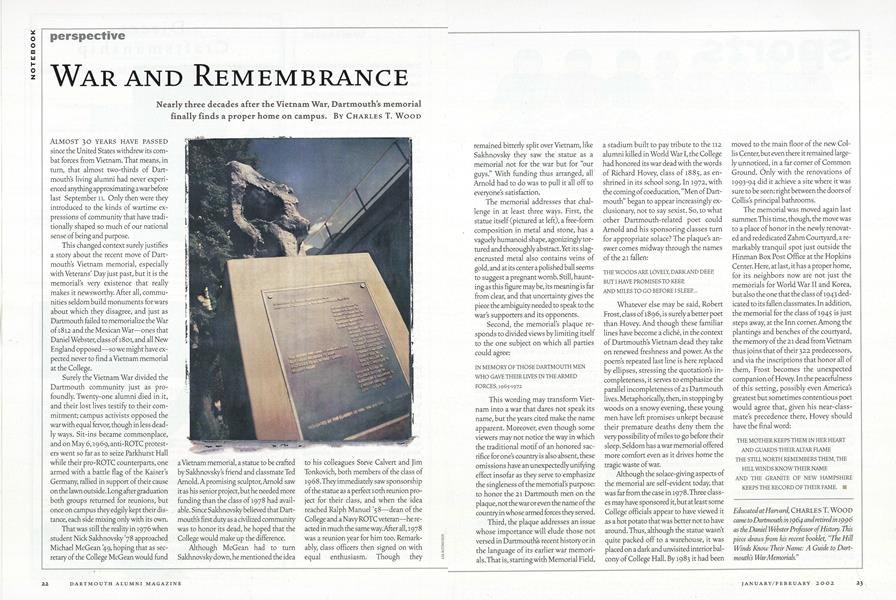
The memorial addresses that challenge in at least three ways. First, the statue itself (pictured at left), a free-form composition in metal and stone, has a vaguely humanoid shape, agonizingly tortured and thoroughly abstract. Yet its slagencrusted metal also contains veins of gold, and at its center a polished ball seems to suggest a pregnant womb. Still, haunting as this figure maybe, its meaning is far from clear, and that uncertainty gives the piece the ambiguity needed to speak to the wars supporters and its opponents.
Second, the memorial's plaque responds to divided views by limiting itself to the one subject on which all parties could agree:
IN MEMORY OF THOSE DARTMOUTH MEN WHO GAVE THEIR LIVES IN THE ARMED FORCES, 1965-1972
This wording may transform nam into a war that dares not speak its Vietname, but the years cited make the name apparent. Moreover, even though some viewers may not notice the way in which the traditional motif of an honored sacrifice for ones country is also absent, these omissions have an unexpectedly unifying effect insofar as they serve to emphasize the singleness of the memorial's purpose: to honor the 21 Dartmouth men on the plaque, not the war or even the name of the country in whose armed forces they served.
Third, the plaque addresses an issue whose importance will elude those not versed in Dartmouth's recent history or in the language of its earlier war memorials. That is, starting with Memorial Field, a stadium built to pay tribute to the 112 alumni killed in World War I, the College had honored its war dead with the words of Richard Hovey, class of 1885, as enshrined in its school song. In 1972, with the coming of coeducation, "Men of Dartmouth" began to appear increasingly exclusionary, not to say sexist. So, to what other Dartmouth-related poet could Arnold and his sponsoring classes turn for appropriate solace? The plaques answer comes midway through the names of the 21 fallen:
THE WOODS ARE LOVELY, DARK AND DEEP, BUT I HAVE PROMISES TO KEEP, AND MILES TO GO BEFORE I SLEEP...
Whatever else may be said, Robert Frost, class of 1896, is surely a better poet than Hovey. And though these familiar lines have become a cliche, in the context of Dartmouth's Vietnam dead they take on renewed freshness and power. As the poems repeated last line is here replaced by ellipses, stressing the quotations incompleteness, it serves to emphasize the parallel incompleteness of 21 Dartmouth lives. Metaphorically, then, in stopping by woods on a snowy evening, these young men have left promises unkept because their premature deaths deny them the very possibility of miles to go before their sleep. Seldom has a war memorial offered more comfort even as it drives home the
tragic waste of war. Although the solace-giving aspects of the memorial are self-evident today, that was far from the case in 1978.Three classes may have sponsored it, but at least some College officials appear to have viewed it as a hot potato that was better not to have around. Thus, although the statue wasn't quite packed off to a warehouse, it was placed on a dark and unvisited interior balcony of College Hall. By 1983 it had been moved to the main floor of the new Collis Center, but even there it remained largely unnoticed, in a far corner of Common Ground. Only with the renovations of 1993-94 did it achieve a site where it was sure to be seen: right between the doors of Collis's principal bathrooms.
The memorial was moved again last summer. This time, though, the move was to a place of honor in the newly renovated and rededicated Zahm Courtyard, a remarkably tranquil spot just outside the Hinman Box Post Office at the Hopkins Center. Here, at last, it has a proper home, for its neighbors now are not just the memorials for World War II and Korea, but also the one that the class of 1943 dedicated to its fallen classmates. In addition, the memorial for the class of 1945 is just steps away, at the Inn corner. Among the plantings and benches of the courtyard, the memory of the 21 dead from Vietnam thus joins that of their 322 predecessors, and via the inscriptions that honor all of them, Frost becomes the unexpected companion of Hovey. In the peacefulness of this setting, possibly even Americas greatest but sometimes contentious poet would agree that, given his near-classmates precedence there, Hovey should have the final word:
THE MOTHER KEEPS THEM IN HER HEART AND GUARDS THEIR ALTAR FLAME THE STILL NORTH REMEMBERS THEM, THE HILL WINDS KNOW THEIR NAME AND THE GRANITE OF NEW HAMPSHIRE KEEPS THE RECORD OF THEIR FAME.
Educated at Harvard, CHARLES T. WOOD came to Dartmouth in 1964 and retiredm 1996as the Daniel Webster Professor of History. Thispiece draws from his recent booklet, "The HillWinds Know Their Name: A Guide to Dartmouth'sWar Memorials."

More From This Issue
-
 Feature
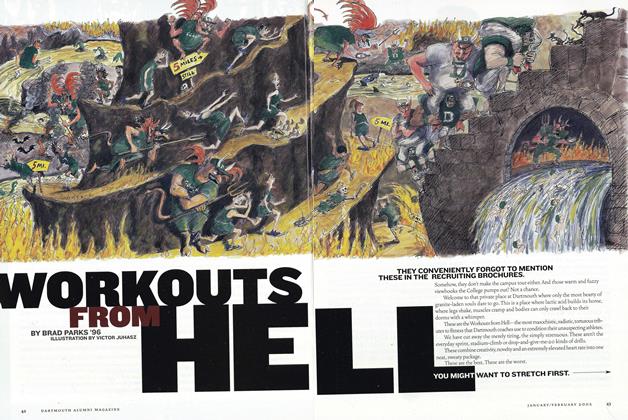
Workouts From Hell
January | February 2002 -
 Cover Story
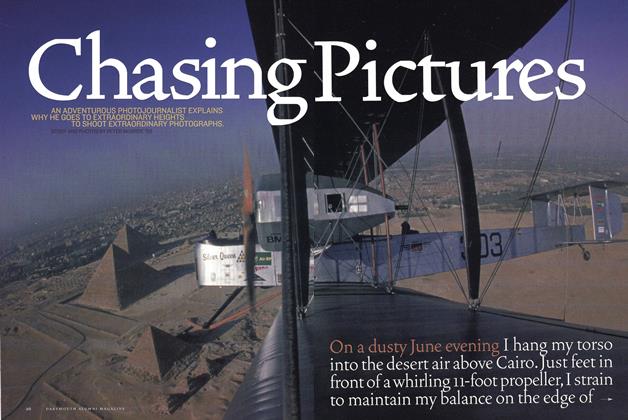
Chasing Pictures
January | February 2002 -
 Feature
The New New York
January | February 2002 -
Feature
Innocence Lost
January | February 2002 -
 Feature
A Mother's Dilemma
January | February 2002 -
 Feature
A Murmur of Normalcy
January | February 2002
CHARLES T. WOOD
-
 Letters to the Editor
Letters to the Editor
JUNE 1978 -
 Letters to the Editor
Letters to the Editor
September 1978 -
 Letters to the Editor
Letters
MAY • 1988 -
 Letters to the Editor
The Games Were Glorious
MARCH 2000 -
 Feature
mAgnA CARTA: Seventh Crisis of John Plantagenet
November 1973 -
 Feature
A Humanist Ponders the Future of Liberal Education
June • 1985

