Letters
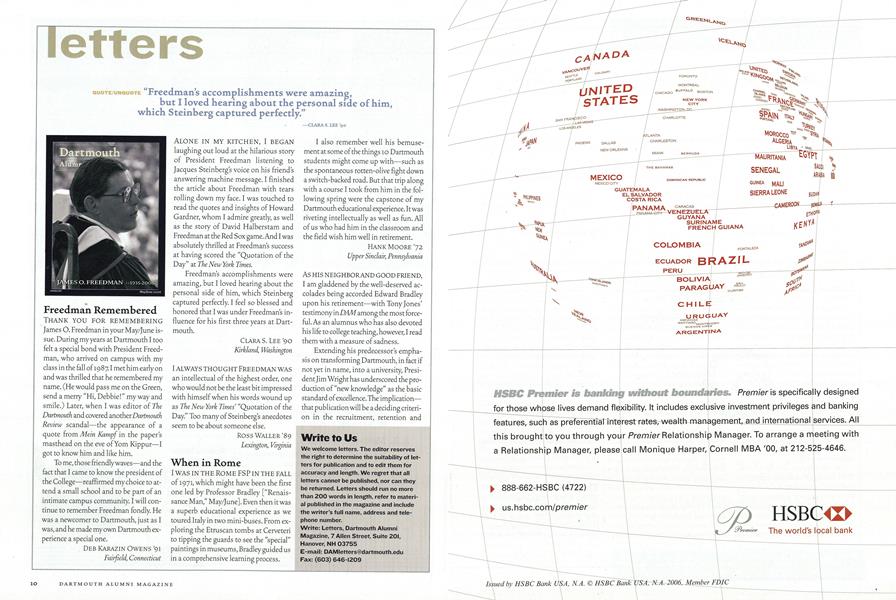
QUOTE/UNQUOTE: "Freedman's accomplishments were amazing, but I loved hearing about the personal side of him, which Steinberg captured perfectly." CLARAS. LEE '90
Freedman Remembered
THANK YOU FOR REMEMBERING James O. Freedman in your May/June issue. During my years at Dartmouth I too felt a special bond with President Freedman, who arrived on campus with my class in the fall of 1987. I met him early on and was thrilled that he remembered my name. (He would pass me on the Green, send a merry "Hi, Debbie!" my way and smile.) Later, when I was editor of TheDartmouth and covered another DartmouthReview scandal—the appearance of a quote from Mein Kampf in the paper's masthead on the eve of Yom Kippur—I got to know him and like him.
To me, those friendly waves—and the fact that I came to know the president of the College—reaffirmed my choice to attend a small school and to be part of an intimate campus community. I will continue to remember Freedman fondly. He was a newcomer to Dartmouth, just as I was, and he made my own Dartmouth experience a special one.
Fairfield, Connecticut
ALONE IN MY KITCHEN, I BEGAN laughing out loud at the hilarious story of President Freedman listening to Jacques Steinbergs voice on his friends answering machine message. I finished the article about Freedman with tears rolling down my face. I was touched to read the quotes and insights of Howard Gardner, whom I admire greatly, as well as the story of David Halberstam and Freedman at the Red Sox game. And I was absolutely thrilled at Freedman's success at having scored the "Quotation of the Day" at The New York Times.
Freedmans accomplishments were amazing, but I loved hearing about the personal side of him, which Steinberg captured perfectly. I feel so blessed and honored that I was under Freedman's influence for his first three years at Dartmouth.
Kirkland, Washington
I ALWAYS THOUGHT FREED MAN WAS an intellectual of the highest order, one who would not be the least bit impressed with himself when his words wound up as The New York Times' "Quotation of the Day." Too many of Steinbergs anecdotes seem to be about someone else.
Lexington, Virginia
When in Rome
I WAS IN THE ROME FSP IN THE FALL of 1971, which might have been the first one led by Professor Bradley ["Renaissance Man," May/June]. Even then it was a superb educational experience as we toured Italy in two mini-buses. From exploring the Etruscan tombs at Cerveteri to tipping the guards to see the "special" paintings in museums, Bradley guided us in a comprehensive learning process.
I also remember well his bemusement at some of the things 10 Dartmouth students might come up with—such as the spontaneous rotten-olive fight down a switch-backed road. But that trip along with a course I took from him in the following spring were the capstone of my Dartmouth educational experience. It was riveting intellectually as well as fun. All of us who had him in the classroom and the field wish him well in retirement.
Upper Sinclair, Pennsylvania
AS HIS NEIGHBOR AND GOOD FRIEND, I am gladdened by the well-deserved accolades being accorded Edward Bradley upon his retirement—with Tony Jones' testimony in DAM among the most forceful. As an alumnus who has also devoted his life to college teaching, however, I read them with a measure of sadness.
Extending his predecessors empha- sis on transforming Dartmouth, in fact if not yet in name, into a university, President jim Wright has underscored the production of "new knowledge" as the basic standard of excellence. The implication that publication will be a deciding criterion in the recruitment, retention and rewarding of faculty—merely confirms a policy that has already become practice. Had those who interviewed Bradley in 1963 had a perfect crystal ball and been bound by Wright's new knowledge code, they would not have hired him. What a loss that would have been for Dartmouth!
At least in the humanities, the motive for a college teacher should not be the manufacture of the sort of gewgaws that clutter the professional journals but vigorous pursuit of a life of the mind. Bradley stands as a model.
White River Junction, Vermont
Critical Skills
I WANTED TO APPLAUD DAM FOR featuring the Rockefeller Centers Civic Skills Training in the May/June issue ["Capitol Steps"]. A recent report by the Bridgespan Group finds that over the next decade, nonprofit organizations will need to attract and develop approximately 640,000 new senior managers the equivalent of 2.4 times the number currently employed.
While a number of factors contribute to this shortfall in leaders, including the growing number of nonprofit organizations and the retirement of managers from the baby-boomer generation, the lack of intermediaries that help to recruit and develop nonprofit managers further aggravates the deficit.
As the associate director of Civic Skills Training Matt Dunne states, nonprofits are "notorious for under-investing in the early stages of a persons career." Like the Civic Skills Training, my organization, New Sector Alliance, innovatively helps to inspire and prepare students for careers in the nonprofit and public sectors. By recruiting and training both graduate and undergraduate students to participate in professionally structured nonprofit consulting engagements, New Sector seeks to motivate and build the future leadership the social sector needs to succeed in the decades to come. Such efforts are critical to developing the next generation of nonprofit/public sector leaders.
Cambridge, Massachusetts
A Shining Light
I WOULD GUESS THAT NOT MANY other DAM features will gather the alumni interest that the Jaquith article [" 'D' is for Denial," Mar/Apr] has rightly generated. I salute Peter for not ever blaming Dartmouth for his addiction. Many have. I admire him for telling us how incredibly great citizens can achieve top billing in industry, law and medicine while being addicts. I also admire him for admitting to us that committed relationships, such as marriage, will fail under the blows of alcolho and drugs. I offer my right hand in congratulation that he has recognized and conquered the devil.
As a Dartmouth graduate who, in 1992 at age 56, with his wife adopted a newborn who was affected by methamphetamines, I can only say drugs, alcohol and all the rest of "modern America" have ramifications beyond the user. It is hurt ing more than just you. The yet-to-be born kid, like ours, represents the tail end of the problem. If you doubt me, ask any sixth-grade teacher who has been in the profession more than 20 years. These kids are coming. They are here. They are victimes. Our child, despite his great intelligence gence and handsome face, has methamphetamine-induced severe attention deficit/oppositional-defiance syndrome, which appeared at age 7. It is almost controlled on modern medications. If I were not a doctor, I cannot imagine where this kid (luckier than most, to be smart), who still has conduct disorder episodes, would be. It has taken more than a "village"—it has taken all our skills and forgiveness.
Thanks, Peter. You have shined a light on all of us. Your words are precious.
Twain Harte, California
Teaching Abroad
THANK YOU FOR THE ARTICLE, "Islands of Hope" [Jan/Feb]. It was a pleasure to see the education department and other alumni teachers being highlighted in our magazine.
When I attended Dartmouth and received my initial teaching certification I had the distinct feeling that becoming a K12 educator was not what a Dartmouth graduate was supposed to do. My family asked me why so much money should be spent if all I was going to do was teach. To me the reason seemed obvious.
After several years teaching in rural Alaska and now in the Middle East and Pakistan, I appreciate the challenges of teaching that make it a difficult road to follow. The Marshall Islands story showed these challenges, and how professor Andrew Garrod opened another door for Dartmouth students to explore the world of teaching and decide if this life is the one for them.
Aleppo, Syria
Thank Heaven
Thank you to Nell Shanahan '99 for writing about her experience as a hospital chaplain ["The Stages of Life," Mar/Apr]. She and her fellow chaplains ought to be praised for their selfless dedication to incredibly difficult work. It takes a special strength to be the last caretaker with a family member when a loved one dies. She is clearly gifted to fill that duty every day with compassion and dignity.
Charlottesville, Virginia
Elephant in the Room
ONE CANNOT HELP BUT ADMIRE the dedication and commitment to government service of Bobby Charles '82 ["Continuing Ed," Jan/Feb]. The earnestness with which he describes his contacts with Presidents Reagan, G.H.W. Bush, G.W. Bush and Secretary Powell is refreshing.
However, when Mr. Charles refers to George W. Bush as a "moral person" and as having an "agile mind," his impressions are at odds with the presidents public persona. I suppose that morality is a subjective concept, but many people would consider the smearing of political opponents such as John McCain and John Kerry or the socio-political divisiveness that the administration has engenered solely for political advantage, for example, to be immoral.
As for the agility of Mr. Bush's mind, maybe, but there is precious little evidence of it in the presidents unscripted utterances.
When Mr. Charles admits, "The Republican Party is missing the boat when it comes to the environment," one wonders whether he is suggesting simply a benign neglect or whether he would acknowledge that the Bush administration has engaged in an outright assault on the environment. There are an awful lot of people around the world who would characterize the Bush environmental record, particularly as it relates to global warming, as immoral.
Vineyard Haven, Massachusetts
Write to Us We welcome letters. The editor reserves the right to determine the suitability of letters for publication and to edit them for accuracy and length. We regret that all letters cannot be published, nor can they be returned. Letters should run no more than 200 words in length, refer to material published in the magazine and include the writer's full name, address and telephone number. Write: Letters, Dartmouth Alumni Magazine, 7 Allen Street, Suite 201, Hanover, NH 03755 E-mail: DAMletters@dartmouth.edu Fax: (603) 646-1209
QUOTE/UNQUOTE: "When I attended Dartmouth and received my initial teaching certification I had the distinct feeling that becoming a K-12educator was not what a Dartmouth graduate was supposed to do." DAN POLTA '94

Letters to the Editor
-
 Letters to the Editor
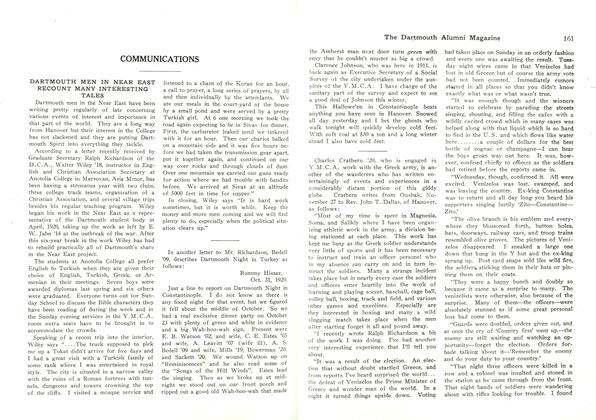
DARTMOUTH MEN IN NEAR EAST RECOUNT MANY INTERESTING TALES
January 1921 -
 Letters to the Editor
Letters
June 1941 -
 Letters to the Editor
LETTERS
June 1951 -
 Letters to the Editor
Letters to the Editor
April 1981 -
 Letters to the Editor
Letters
Sept/Oct 2000 -
 Letters to the Editor
Letters
Jan/Feb 2009


