Making Waves
Campus radio never gained a foothold until students secured the authority to run it themselves.
Campus radio never gained a foothold until students secured the authority to run it themselves.
Campus radio never gained a foothold until students secured the authority to run it themselves.
The president was skeptical. A faculty committee stood ready to nix the idea on the grounds that it might create a riot in the dorms. “We had to go in and face the most hostile group, which saw no reason to have a radio station at Dartmouth College,” Richard Krolik ’41 later recalled. “We collected all the evidence we could and we summoned forth the essays on freedom of speech and God knows what and we sat there and banged the table.”
President Ernest Martin Hopkins, class of 1901, had reason to be skeptical. Seventeen years earlier, in 1924, he had approved a proposal by the radio club to launch a student-run AM broadcast station at Dartmouth. It operated for about a year but was shut down after an incident in which profanity was accidently broadcast. It was 1941 before, reluctantly, Hopkins let students try again, this time under strict faculty control.
Subsequent stations have had a remarkable history, and many alumni regard their years at campus stations as more than just an extracurricular activity. Most of them went on to careers in fields other than broadcasting, but many feel their radio experience was vital in shaping their lives.
“WDBS was my most satisfying and productive classroom,” says Dave Dugan ’52. “WDCR did more for me than my Dartmouth education,” adds Charlie Smith ’73.
“It was good experience in making it in a man’s world, helping me gain confidence and assertiveness,” says Kathy DeGioia-Eastwood ’76.
KROLIK'S STATION, CALLED DBS, GOT OFF TO a strong start, but World War II intervened and in 1943 it was forced to shut down due to a staff shortage. Returning senior and former Navy pilot Robert Varney ’43 revived it in the spring of 1946. Two years later new College President John Sloan Dickey ’29, in a historic move that would shape the future of Dartmouth radio for 50 years, dissolved the faculty-dominated Radio Council and turned over operation of the station entirely to the students. Dickey remained a strong advocate of station independence for the rest of his 25-year tenure, giving Dartmouth students a unique laboratory in which they learned to run a real business, one with an influential voice in the community.
Students rose to the challenge, making DBS (now called WDBS) an increasingly professional operation. Among the leaders of this era were station manager John Gambling ’51, later a major New York radio personality, Don Hyatt ’50 (producer of acclaimed documentaries including NBC’s Project Twenty), Jim Rosenfield ’52 (president of CBS-TV) and Herb Solow ’53 (a TV executive responsible for Star Trek and Mission: Impossible). Shows included Jam for Breakfast, the long-running Music Till Midnight and Bedpan Alley, which featured music to soothe the residents of Dick’s House infirmary.
WDBS broadcast via a signal carried through the College’s electrical system. By the mid-1950s the College, faced with mounting bills to fix the campus-limited system, applied for a commercial AM license. This was strenuously opposed by WTSL, the only other station in the market, but the new WDCR-AM, 1340 on the dial, finally went live in 1958. Its first general manager, Ron Kehoe ’59, wrote a 17-page roadmap for the new station in which he concluded the station now had a duty to serve the community as well as the campus.
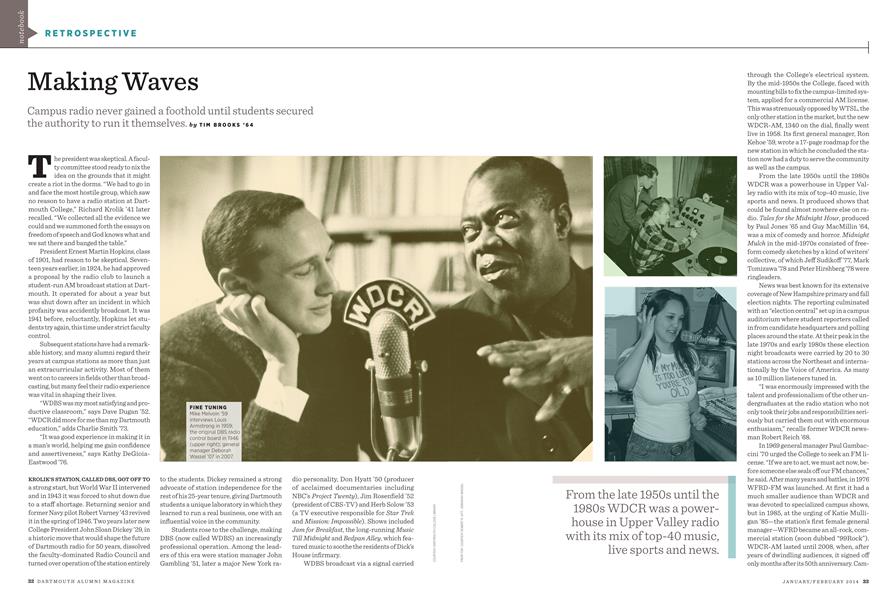
From the late 1950s until the 1980s WDCR was a powerhouse in Upper Valley radio with its mix of top-40 music, live sports and news. It produced shows that could be found almost nowhere else on radio. Tales for the Midnight Hour, produced by Paul Jones ’65 and Guy MacMillin ’64, was a mix of comedy and horror. Midnight Mulch in the mid-1970s consisted of freeform comedy sketches by a kind of writers’ collective, of which Jeff Sudikoff ’77, Mark Tomizawa ’78 and Peter Hirshberg ’78 were ringleaders.
News was best known for its extensive coverage of New Hampshire primary and fall election nights. The reporting culminated with an “election central” set up in a campus auditorium where student reporters called in from candidate headquarters and polling places around the state. At their peak in the late 1970s and early 1980s these election night broadcasts were carried by 20 to 30 stations across the Northeast and internationally by the Voice of America. As many as 10 million listeners tuned in.
“I was enormously impressed with the talent and professionalism of the other undergraduates at the radio station who not only took their jobs and responsibilities seriously but carried them out with enormous enthusiasm,” recalls former WDCR newsman Robert Reich ’68.
In 1969 general manager Paul Gambaccini ’70 urged the College to seek an FM license. “If we are to act, we must act now, before someone else seals off our FM chances,” he said. After many years and battles, in 1976 WFRD-FM was launched. At first it had a much smaller audience than WDCR and was devoted to specialized campus shows, but in 1985, at the urging of Katie Mulligan ’85—the station’s first female general manager—WFRD became an all-rock, commercial station (soon dubbed “99Rock”). WDCR-AM lasted until 2008, when, after years of dwindling audiences, it signed off only months after its 50th anniversary. Campus programming transitioned to the Internet. Meanwhile 99Rock has become a major player in Upper Valley radio, with ratings usually among the top-five stations. With its state-of-the-art studios, it continues to provide students with experience in radio broadcasting and business management.
The days of all-student control are over, however. A fulltime operations manager, Heath Cole, now runs 99Rock with a dedicated student staff. As onetime general manager Jordan Roderick ’78 (who with fellow techie Ted Bardusch ’76 built the original FM studios) once wrote, “No one would have bothered to do all that work if this were just a radio station. Dartmouth Broadcasting is one of the few organizations on campus that is made up entirely of dreams and hope and creative energy run amok.”
FINE TUNING Mike Melvoin ’59 interviews Louis Armstrong in 1959; the original DBS radio control board in 1946 (upper right); general manager Deborah Wassel ’07 in 2007
From the late 1950s until the 1980s WDCR was a powerhouse in Upper Valley radio with its mix of top-40 music, live sports and news.
TIM BROOKS, a former station staffer, is an author and former network television executive. He recently published College Radio Days: 70 Years of Student Broadcasting at Dartmouth College. He lives in Greenwich, Connecticut.

More From This Issue
-
 Feature
Man in the Middle
January | February 2014 -
 Cover Story
SOCHI HOPEFULS
January | February 2014 -
 COVER STORY
The Contenders
January | February 2014 -
 Feature
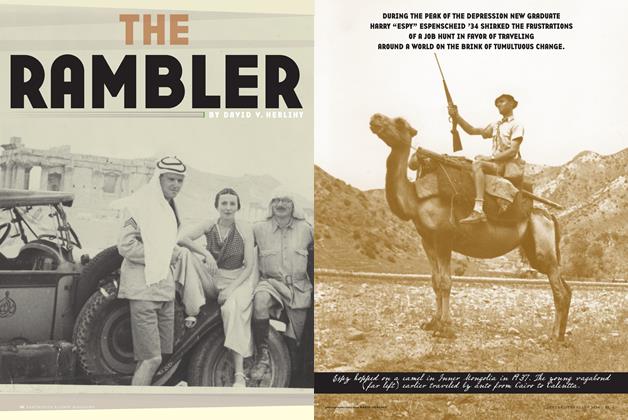
The Rambler
January | February 2014 -
 Cover Story
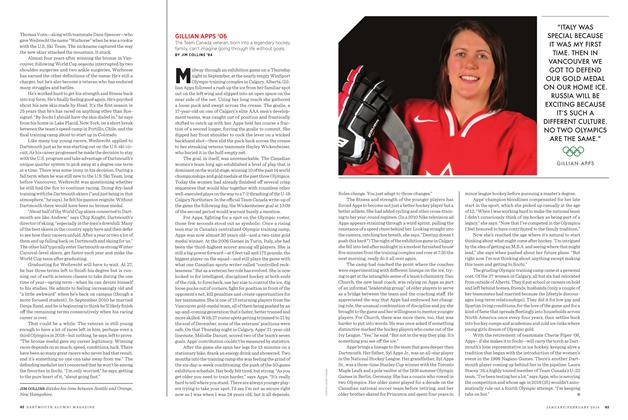
GILLIAN APPS '06
January | February 2014 -
 Cover Story
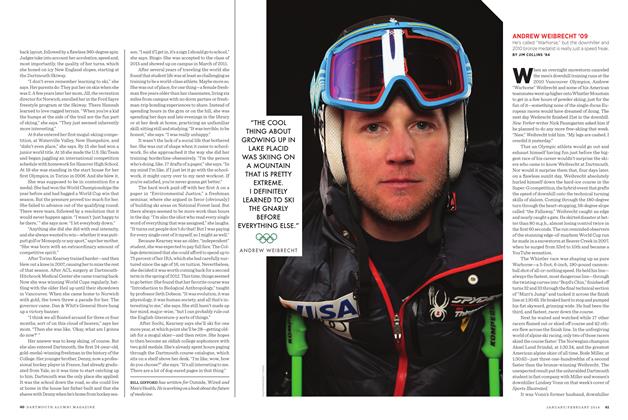
ANDREW WEIBRECHT '09
January | February 2014
Retrospective
-
 RETROSPECTIVE
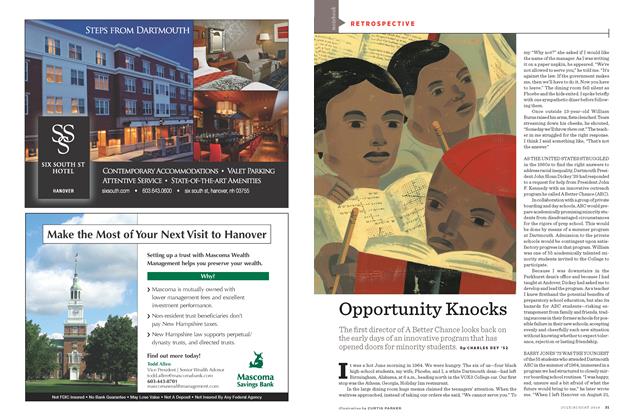
Opportunity Knocks
July | August 2014 -
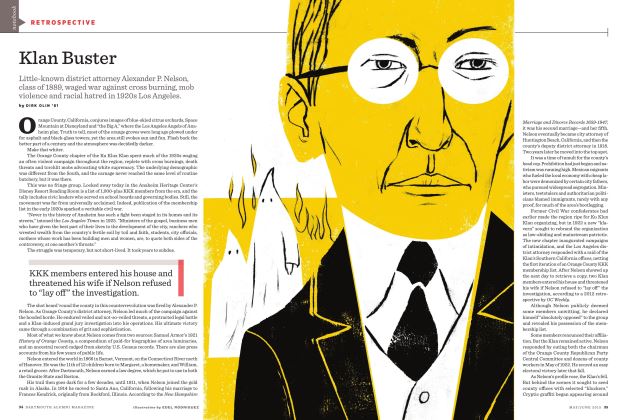 RETROSPECTIVE
Klan Buster
MAY | JUNE -
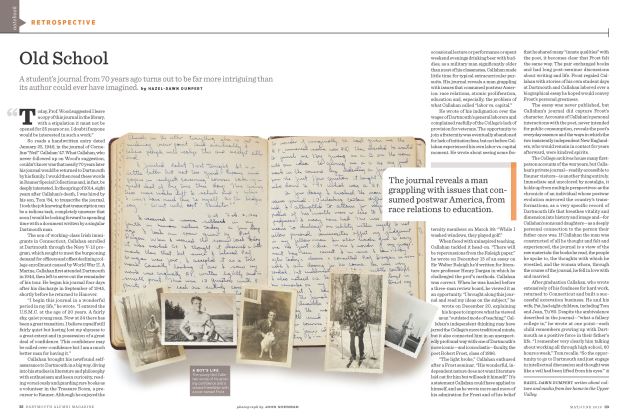 RETROSPECTIVE
Old School
MAY | JUNE 2016 -
 RETROSPECTIVE
Tales of the Nugget
NOVEMBER | DECEMBER 2016 -
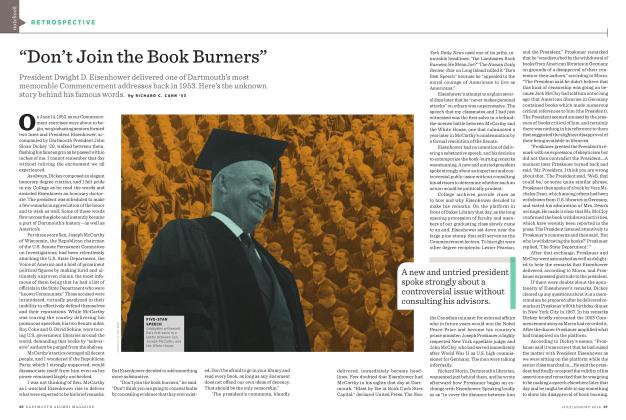 RETROSPECTIVE
“Don’t Join the Book Burners”
JULY | AUGUST 2016 -
 RETROSPECTIVE
Valediction
SEPTEMBER | OCTOBER 2016


