Grads
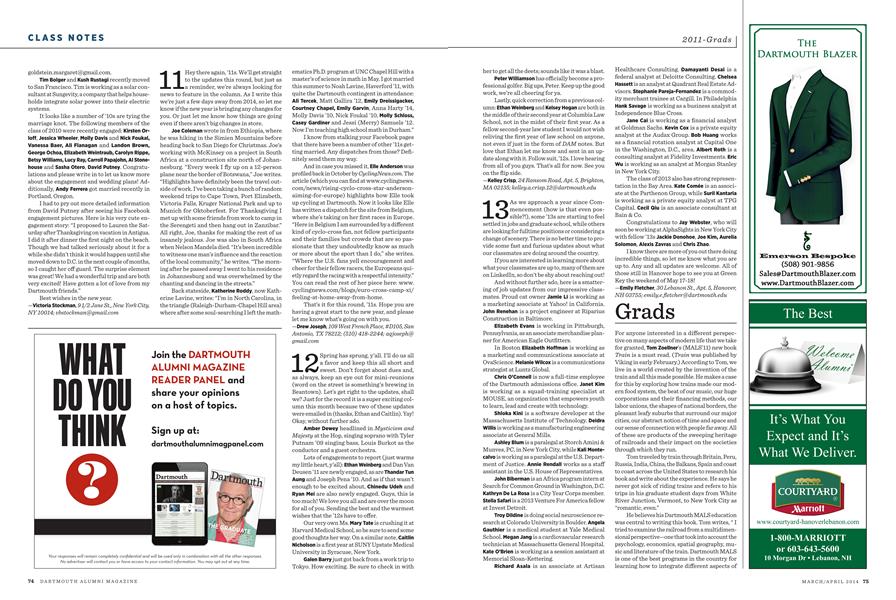
For anyone interested in a different perspective on many aspects of modern life that we take for granted, Tom Zoellner’s (MALS’11) new book Train is a must read. (Train was published by Viking in early February.) According to Tom, we live in a world created by the invention of the train and all this made possible. He makes a case for this by exploring how trains made our modern food system, the beat of our music, our huge corporations and their financing methods, our labor unions, the shapes of national borders, the pleasant leafy suburbs that surround our major cities, our abstract notion of time and space and our sense of connection with people far away. All of these are products of the sweeping heritage of railroads and their impact on the societies through which they run.
Tom traveled by train through Britain, Peru, Russia, India, China, the Balkans, Spain and coast to coast across the United States to research his book and write about the experience. He says he never got sick of riding trains and refers to his trips in his graduate student days from White River Junction, Vermont, to New York City as “romantic, even.”
He believes his Dartmouth MALS education was central to writing this book. Tom writes,“ I tried to examine the railroad from a multidimen- sional perspective—one that took into account the psychology, economics, spatial geography, mu- sic and literature of the train. Dartmouth MALS is one of the best programs in the country for learning how to integrate different aspects of knowledge into a coherent whole. The chair of the program, Don Pease, is a brilliant polymath who takes a keen interest in the work of his stu- dents, and he encouraged me to see some of the wide historical angles of the railroad within the American experience.”
Tom sees the train and its breathing loco- motive as a living symbol of sex, death, fear and romance. But it is also a serious economic engine in the modern world. China has spent more than $300 billion on a crash program to unite its prov- inces with freakishly quick bullet trains, while the United States struggles to build the perpetu- ally stalled high-speed line between Los Angeles and San Francisco. However, Amtrak has never seen stronger ridership. Tom explains why a rail renaissance is happening now and what it means for our future. He also discusses the environmen- tal benefits of trains for trade, traffic and energy.
In the book’s Kirkus review, Tom’s discussion of the descructive effect of excrement on the rail lines in India is mentioned, as well as his more lyrical description of riding through foggy north- ern England. The review ends with, “Great for fans of Paul Theroux’s railroad journeys. Except that Zoellner isn’t nearly as ill-tempered, and he has a better command of social history. A pleasure for literate travelers.”
If you are now ready to embrace your inner train, you can begin by reading Tom’s book.
Tom is the author of four previous nonfiction books, including Uranium, winner of the 2011 American Institute of Physics Science Writing Award, and A Safeway in Arizona: What the Ga- brielle Giffords Shooting Tells Us about the Grand Canyon State and Life in America. He is an associ- ate professor of English at Chapman University and lives in Los Angeles.
175 Greensboro Road, Hanover, NH 03755; (603) 643-3789; m.jane.welsh.adv98@ alum.dartmouth.org
More From This Issue
-
 Cover Story
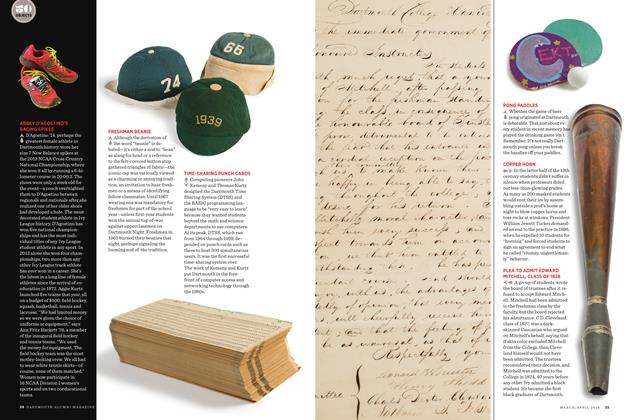
ABBEY D’AGOSTINO’S RACING SPIKES
March | April 2014 -
 Cover Story
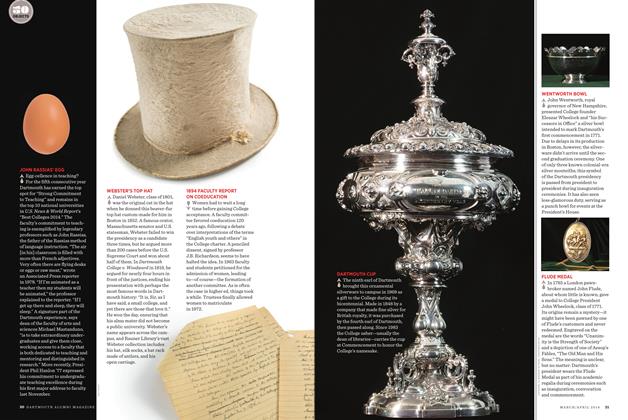
JOHN RASSIAS’ EGG
March | April 2014 -
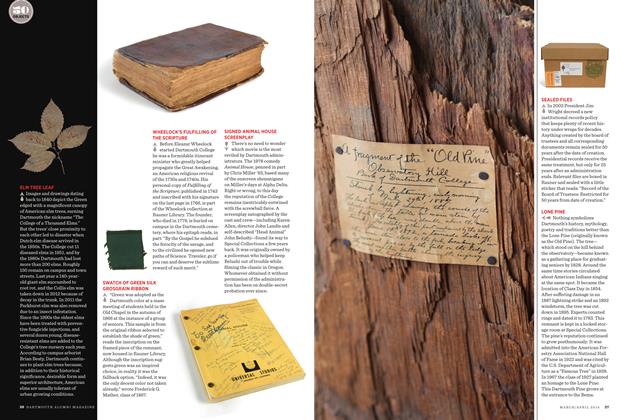 Cover Story
ELM TREE LEAF
March | April 2014 -
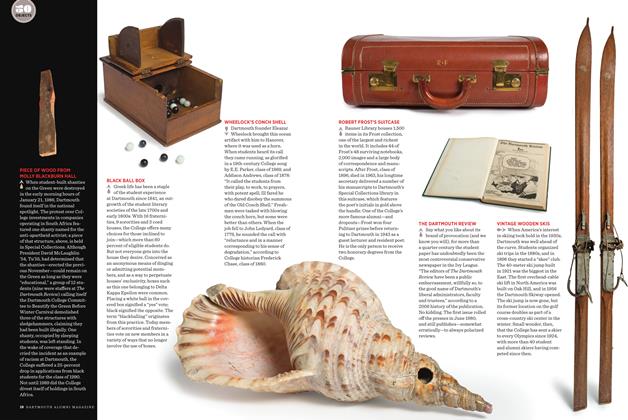 Cover Story
PIECE OF WOOD FROM MOLLY BLACKBURN HALL
March | April 2014 -
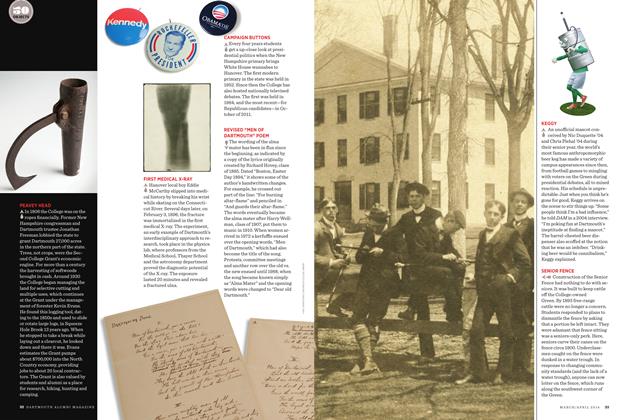 Cover Story
PEAVEY HEAD
March | April 2014 -
Cover Story
LONE PINE
March | April 2014