1964
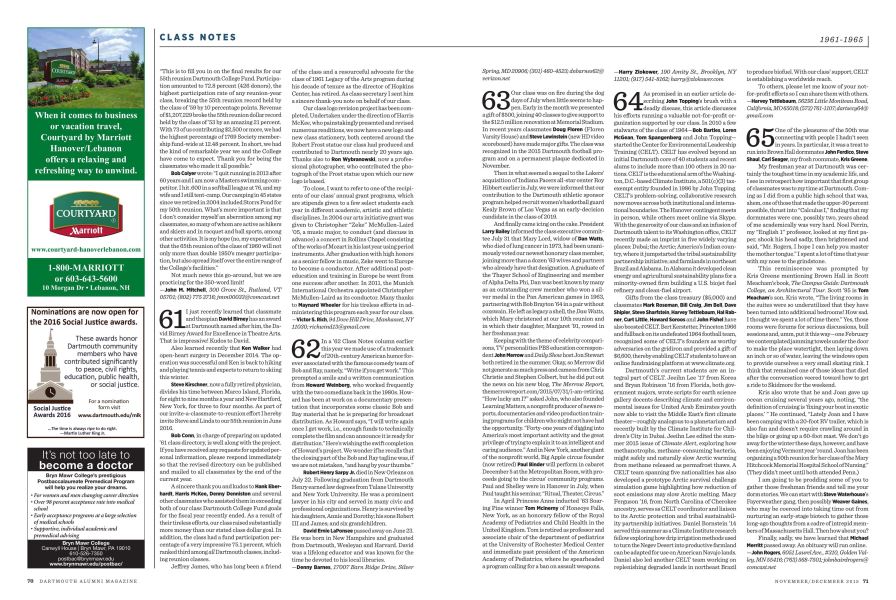
As promised in an earlier article de- scribing John Topping’s brush with a deadly disease, this article discusses his efforts running a valuable not-for-profit or- ganization supported by our class. In 2010 a few stalwarts of the class of 1964—Bob Bartles, Loren McGean, Tom Spangenberg and John Topping— started the Center for Environmental Leadership Training (CELT). CELT has evolved beyond an initial Dartmouth core of 40 students and recent alums to include more than 100 others in 20 na- tions. CELT is the educational arm of the Washing- ton, D.C.-based Climate Institute, a 501(c)(3) tax- exempt entity founded in 1986 by John Topping. CELT’S problem-solving, collaborative research now moves across both institutional and interna- tional boundaries. The Hanover contingent meets in person, while others meet online via Skype. With the generosity of our class and an infusion of Dartmouth talent to its Washington office, CELT recently made an imprint in five widely varying places: Dubai; the Arctic; America’s Indian coun- try, where it jumpstarted the tribal sustainability partnership initiative; and farmlands in northeast Brazil and Alabama. In Alabama it developed clean energy and agricultural sustainability plans for a minority-owned firm building a U.S. biojet fuel refinery and clean-fuel airport.
Gifts from the class treasury ($5,000) and classmates Mark Roseman, Bill Craig, Jim Bell, Dave Shipler, Steve Sharfstein, Harvey Tettlebaum, Hal Rab- ner, Curt Little, Howard Soroos and John Fishel have also boosted CELT. Bert Kerstetter, Princeton 1966 and fullback on its undefeated 1964 football team, recognized some of CELT’S founders as worthy adversaries on the gridiron and provided a gift of $6,600, thereby enabling CELT students to have an online fundraising platform at www.climate.org.
Dartmouth’s current students are an in- tegral part of CELT. Jeeihn Lee ’17 from Korea and Bryan Robinson ’16 from Florida, both gov- ernment majors, wrote scripts for earth science gallery docents describing climate and environ- mental issues for United Arab Emirates youth now able to visit the Middle East’s first climate theater—roughly analogous to a planetarium and recently built by the Climate Institute for Chil- dren’s City in Dubai. Jeeihn Lee edited the sum- mer 2015 issue of Climate Alert, exploring how methanotrophs, methane-consuming bacteria, might safely and naturally slow Arctic warming from methane released as permafrost thaws. A CELT team spanning five nationalities has also developed a prototype Arctic survival challenge simulation game highlighting how reduction of soot emissions may slow Arctic melting. Macy Ferguson ’16, from North Carolina of Cherokee ancestry, serves as CELT coordinator and liaison to its Arctic protection and tribal sustainabil- ity partnership initiatives. Daniel Bornstein ’14 served this summer as a Climate Institute research fellow exploring how drip irrigation methods used to turn the Negev Desert into productive farmland can be adapted for use on American Navajo lands. Daniel also led another CELT team working on replenishing degraded lands in northeast Brazil to produce biofuel. With our class’ support, CELT is establishing a worldwide reach.
To others, please let me know of your not- for-profit efforts so I can share them with others.
56295 Little Moniteau Road, California, MO 65018; (573) 761-1107; dartsecy64@ gmail.com
More From This Issue
-
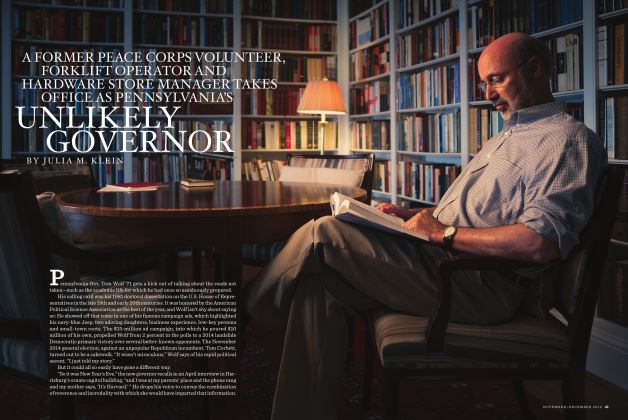 Cover Story
The Unlikely Governor
November | December 2015 -
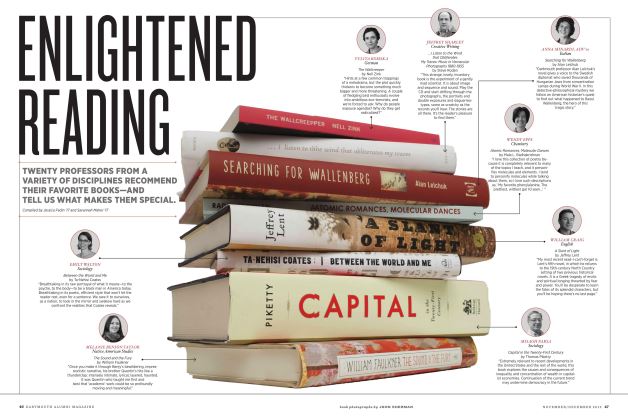 FEATURE
Enlightened Reading
November | December 2015 -
 FEATURE
Meanwhile, In Illinois
November | December 2015 -
 Feature
What a Racket!
November | December 2015 -
 Feature
Classnotes
November | December 2015 -
 Feature
Notebook
November | December 2015