Class of 1920
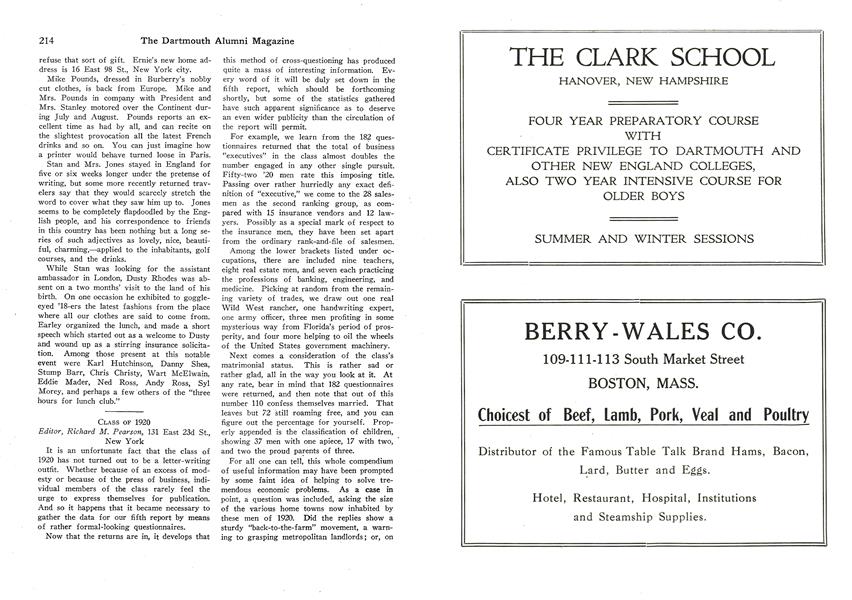
It is an unfortunate fact that the class of 1920 has not turned out to be a letter-writing outfit. Whether because of an excess of modesty or because of the press of business, individual members of the class rarely feel the urge to express themselves for publication. And so it happens that it became necessary to gather the data for our fifth report by means of rather formal-looking questionnaires.
Now that the returns are in, it develops that this method of cross-questioning has produced quite a mass of interesting information. Every word of it will be duly set down in the fifth report, which should be forthcoming shortly, but some of the statistics gathered have such apparent significance as to deserve an even wider publicity than the circulation of the report will permit.
For example, we learn from the 182 questionnaires returned that the total of business "executives" in the class almost doubles the number engaged in any other single pursuit. Fifty-two '2O men rate this imposing title. Passing over rather hurriedly any exact definition of "executive," we come to the 28 salesmen as the second ranking group, as compared with IS insurance vendors and 12 lawyers. Possibly as a special mark of respect to the insurance men, they have been set apart from the ordinary rank-and-file of salesmen.
Among the lower brackets listed under occupations, there are included nine teachers, eight real estate men, and seven each practicing the professions of banking, engineering, and medicine. Picking at random from the remaining variety of trades, we draw out one real Wild West rancher, one handwriting expert, one army officer, three men profiting in some mysterious way from Florida's period of prosperity, and four more helping to oil the wheels of the United States government machinery.
Next comes a consideration of the class's matrimonial status. This is rather sad or rather glad, all in the way you look at it. At any rate, bear in mind that 182 questionnaires were returned, and then note that out of this number 110 confess themselves married. That leaves but 72 still roaming free, and you can figure out the percentage for yourself. Properly appended is the classification of children, showing 37 men with one apiece, 17 with two, and two the proud parents of three.
For all one can tell, this whole compendium of useful information may have been prompted by some faint idea of helping to solve tremendous economic problems. As a case in point, a question was included, asking the size of the various home towns now inhabited by these men of 1920. Did the replies show a sturdy "back-to-the-farm" movement, a warning to grasping metropolitan landlords; or, on the other hand, did they indicate an even more pronounced swarming to the centers, of congestion? As a matter of fact, the response didn't seem to prove anything at all, for it denoted a very even division, with 25 living in the largest cities, as compared with 37 in the smallest towns. Forty-nine are mingled among the thousands in places ranging from 100,000 to 1,000,000 in population, while 56 live contented lives in the typical middle-sized cities and towns of 10,000 to 100,000.
There is something much more personal in the table of figures, showing the different kinds of homes that hold 20's families within their gates. Although it cannot be proved exactly how many have deeds in their possession, as compared with the signers of leases, the fact stands out that 88 of the class are living in houses and 13 more in bungalows. These householders have the edge on the apartmenthunters, whose total numbers but 62. Five men drop around to a club of one kind or another for their night's rest, while an equal number eat and sleep in boarding houses. Hotels, hospitals, and Y.M.C.A.'s claim two each.
Out in back of those houses and bungalows more often than not garages will be found but all bets are off on the kinds of cars that they contain. Yes, as you all anticipated, Mr. Ford's super-salesmen have outstripped all their competitors and disposed of 37 models, old and young, to the men of 1920. Buick, amid a din of cheers from Harry Noyes, Dana Eaton, and Wade Smith, holds second place with 24. Next in the parade come 15 Dodges, followed by nine Essexes, and six each, Hudson and Nash; then in dwindling numbers, almost all the other models on the motor mart. In case undue emphasis may appear to have been placed on the car at the top of the list, take heed of the fact that the class has also corralled three Stutzes, two Rickenbackers, and a Pierce-Arrow. The seven who quote themselves as drivers of baby-carriages probably constitute but a small fraction of this army of chauffeurs, but the one who boasts a "Combination" car is without doubt in a class by himself.
All these more or less intimate glimpses into the home life of 1920 point to steady progress up the path of prosperity. But, not stopping with that, the questionnaires mercilessly inquired what toll the five years' battle had taken. Truly the ravages of times have been heavy. Four men admit that they have lost weight; the heads of 22 have begun to shine; seven have donned glasses, and two are getting gray around the temples. And yet, if such figures seem appalling, consider the evidence for the other side; 27 bigger and stronger men, 10 with new and tenderly groomed mustaches, one marvelously less bald than he was, and one admittedly "looking younger."
Here is the way these Ponce de Leons retain their youth. Fifty-three of them play golf and 19 tennis; and such conservative sports are for '2O the well nigh exclusive types of recreation. To be sure, there remain eight Outing Clubbers in the class, who still go camping for the fun of it, while radio, horseback riding, hunting, fishing, and swimming can lay claim to some small degree of popularity. But for really distinctive hobbies we must turn to such isolated cases as flying, gem collecting, polo, Sunday school teaching, and leading bands at reunions. Each of these has its appeal for but one man in the class.
In thus outlining the onward march of 1920, there has been no attempt to present the accrued information with all its significant detail. There is, however, one statistical table that deserves publication in full wherever we can find space for it, and that is the class record for return trips to Hanover. Out of all the men returning questionnaires, only 20 have been unable to get back to Hanover at all since graduation. Thirty-eight have been back once, 31 twice, 14 three times, 15 four times, and 12 five times. Five times, remember, means once a year, but that is by no means the maximum. The roll-call shows nine men with six visits to their credit, five with seven, two with eight, two with nine, ten with ten and two with twelve. And, best of all, five men have been tearing back northward so consistently that they have lost all count. If we may think of the class simply as an integral part of Dartmouth, we may perhaps consider this item of greater significance than any or all the rest.
Editor, 131 East 23d St., New York
More From This Issue
-
 Article
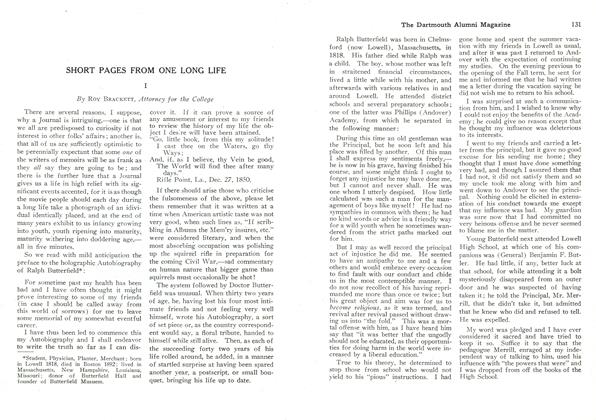
SHORT PAGES FROM ONE LONG LIFE
December 1925 -
 Article
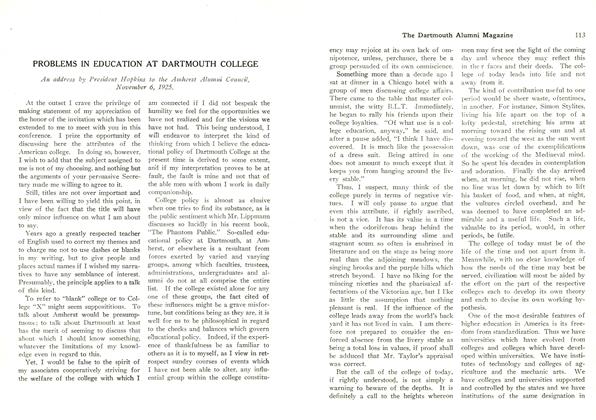
PROBLEMS IN EDUCATION AT DARTMOUTH COLLEGE
December 1925 -
 Article
SCRAPS OF PAPER
December 1925 -
 Article
Recent Reports in the Public Press
December 1925 -
 Article
ALUMNI ASSOCIATIONS
December 1925 -
 Article
FROM THE UNDERGRADUATE CHAIR
December 1925