REUNION AND DINNER OF THE WASHINGTON ASSOCIATION.
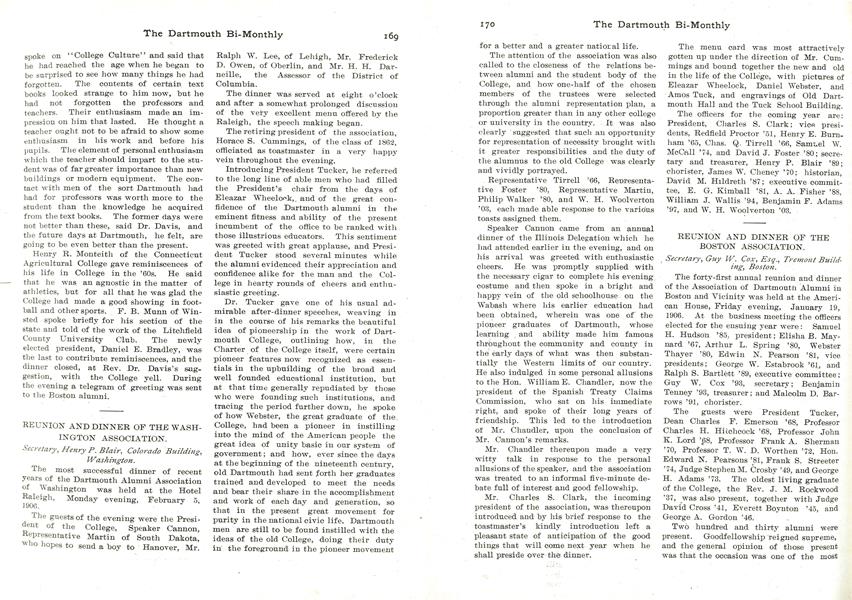
The most successful dinner of recent years of the Dartmouth Alumni Association of Washington was held at the Hotel Raleigh, Monday evening, February 5, 1906.
The guests of the evening were the President of the College, Speaker Cannon, Representative Martin of South Dakota, who hopes to send a boy to Hanover, Mr. Ralph W. Lee, of Lehigh, Mr. Frederick D. Owen, of Oberlin, and Mr. H. H. Dar-neille, the Assessor of the District of Columbia.
The dinner was served at eight o'clock and after a somewhat prolonged discussion of the very excellent menu offered by the Raleigh, the speech making began.
The retiring president of the association, Horace S. Cummings, of the class of 1862, officiated as toastmaster in a very happy-vein throughout the evening.
Introducing President Tucker, he referred to the long line of able men who had filled the President's chair from the days of Eleazar Wheelock,. and of the great confidence of the Dartmouth alumni in the eminent fitness and ability of the present incumbent of the office to be ranked with those illustrious educators. This sentiment was greeted with great applause, and President Tucker stood several minutes while the alumni evidenced their appreciation and confidence alike for the man and the College in hearty rounds of cheers and enthusiastic greeting.
Dr. Tucker gave one of his usual admirable after-dinner speeches, weaving in in the course of his remarks the beautiful idea of pioneership in the work of Dartmouth College, outlining how, in the Charter of the College itself, were certain pioneer features now recognized as essentials in the upbuilding of the broad and well founded educational institution, but at that time generally repudiated by those who were founding such institutions, and tracing the period further down, he spoke of how Webster, the great graduate of the. College, had been a pioneer in instilling into the mind of the American people the great idea of unity basic in our system of government; and how, ever since the days at the beginning of the nineteenth century, old Dartmouth had sent forth her graduates trained and developed to meet the needs and bear their share in the accomplishment and work of each day and generation, so that in the present great movement for purity in the national civic life, Dartmouth men are still to be found instilled with the ideas of the old College, doing their duty in the foreground in the pioneer movement for a better and a greater national life.
The attention of the association was also called to the closeness of the relations between alumni and the student body of the College, and how one-half of the chosen members of the trustees were selected through the alumni representation plan, a proportion greater than in any other college or university in the country. It was also clearly suggested that such an opportunity for representation of necessity brought with it greater responsibilities and the duty of the alumnus to the old College was clearly and vividly portrayed.
Representative Tirrell '66, Representative Foster 'BO, Representative Martin, Philip "Walker '80, and W. H. Woolverton '03, each made able response to the various toasts assigned them.
Speaker Cannon came from an annual dinner of the Illinois Delegation which he had attended earlier in the evening, and on his arrival was greeted with enthusiastic cheers. He was promptly supplied with the necessary cigar to complete his evening, costume and then spoke in a bright and happy vein of the old schoolhouse on the Wabash where his earlier education had been obtained, wherein was one of' the pioneer graduates of Dartmouth, whose learning . and ability made him famous throughout the community and county in the early days of what was then substantially the Western limits of our country. He also indulged in some personal allusions to the Hon. William E. Chandler, now the president of the Spanish Treaty Claims Commission, who sat on his immediate right, and spoke of their long years of friendship. This led to the introduction of Mr. Chandler, upon the conclusion of Mr. Cannon's remarks.
Mr. Chandler thereupon made a very witty talk in response to the personal allusions of the speaker, and the association was treated to an informal five-minute debate full of interest and good fellowship.
Mr. Charles S. Clark, the incoming president of the association, was thereupon introduced and by his brief response to the toastmaster's kindly introduction left a pleasant state of anticipation of the good things that will come next year when he shall preside over the dinner.
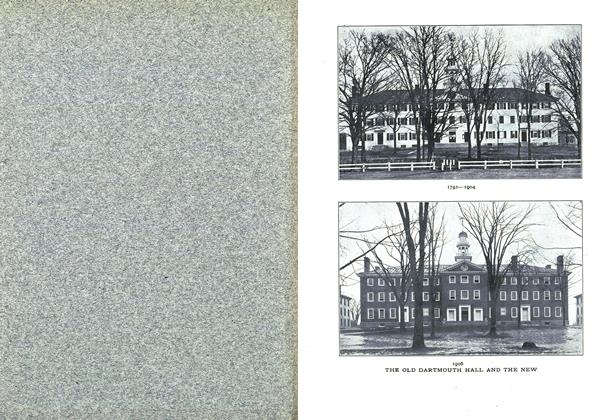
The menu card was most attractively gotten up under the direction of Mr. Cummings and bound together the new and old in the life of the College, with pictures of Eleazar Wheelock, Daniel Webster, and Amos Tuck, and engravings of Old Dartmouth Hall and the Tuck School Building.
The officers for the coming year are: President, Charles S. Clark; vice presidents, Redfield Proctor '51, Henry E. Burnham '65, Chas. Q. Tirrell '66, Samuel W. McCall '74, and David J. Foster '80; secretary and treasurer, Henry P. Blair '89; chorister, James W. Cheney '70; historian, David M. Hildreth '87; executive committee, E. G. Kimball '81, A. A. Fisher '88, William J. Wallis '94, Benjamin F. Adams '97, and W. H. Woolverton '03.
Secretary, Henry P. Blair, Colorado Building,Washington.
More From This Issue
-
 Article
THE ADMINISTRATION OF THE MODERN COLLEGE*
February 1906 -
 Article
THE practical workings of the preceptorial system
February 1906 -
 Article
PRECEPTORIAL INSTRUCTION AT PRINCETON
February 1906 -
 Article
THE RHODES SCHOLARSHIPS
February 1906 -
 Article
THE HEATING AND LIGHTING PLANT
February 1906 -
 Class Notes
SECOND ANNUAL MEETING OF THE SECRETARIES.
February 1906