CLASS OF 1856
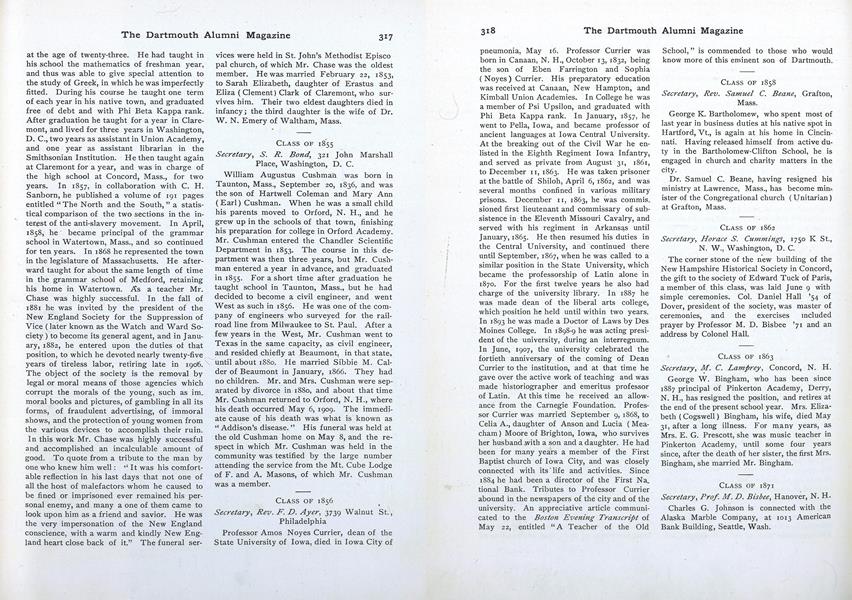
Professor Amos Noyes Currier, dean of the State University of lowa, died in lowa City of pneumonia, May 16. Professor Currier was born in Canaan, N. H., October 13, 1832, being the son of Eben Farrington and Sophia ( Noyes) Currier. His preparatory education was received at Canaan, New Hampton, and Kimball Union Academies. In College he was a member of Psi Upsilon, and graduated with Phi Beta Kappa rank. In January, 1857, he went to Pella, lowa, and became professor of ancient languages at lowa Central University. At the breaking out of the Civil War he enlisted in the Eighth Regiment lowa Infantry, and served as private from August 31, 1861, to December 11, 1863. He was taken prisoner at the battle of Shiloh, April 6, 1862, and was several months confined in various military prisons. December 11, 1863, he was commis, sioned first lieutenant and commissary of subsistence in the Eleventh Missouri Cavalry, and served with his regiment in Arkansas until January, 1865. He then resumed his duties in the Central University, and continued there until September, 1867, when he was called to a similar position in the State University, which became the professorship of Latin alone in 1870. For the first twelve years he also had charge of the university library. In 1887 he was made dean of the liberal arts college, which position he held until within two years. In 1893 he was made a Doctor of Laws by Des Moines College. In 1898-9 he was acting president of the university, during an interregnum. In June, 1907, the university celebrated the fortieth anniversary of the coming of Dean Currier to the institution, and at that time he gave over the active work of teaching and was made historiographer and emeritus professor of Latin. At this time he received an allowance from the Carnegie Foundation. Professor Currier was married September 9, 1868, to Celia A., daughter of Anson and Lucia ( Meacham) Moore of Brighton, lowa, who survives her husband with a son and a daughter. He had been for many years a member of the First Baptist church of lowa City, and was closely connected with its life and activities. Since 1884 he had been a director of the First Na. tionai Bank. Tributes to Professor Currier abound in the newspapers of the city and of the university. An appreciative article communicated to the Boston Evening Transcript of May 22, entitled "A Teacher of the Old School," is commended to those who would know more of this eminent son of Dartmouth.
Secretary, Rev. F. D. Ayer, 3739 Walnut St., Philadelphia
More From This Issue
-
 Article
ANNOUNCEMENT OF PLANS FOR INAUGURATION OF PRESIDENT NICHOLS
June 1909 -
 Article
NEW YORK'S RECEPTION TO PRESIDENT-ELECT NICHOLS
June 1909 -
 Article
SPEECH AT ALUMNI DINNER, OF PRESIDENT TUCKER
June 1909 -
 Article
THE CONFERRING OF DEGREES
June 1909 -
 Class Notes
REUNION OF 1859
June 1909 -
 Class Notes
LOCAL ASSOCIATIONS
June 1909