CLASS OF 1859
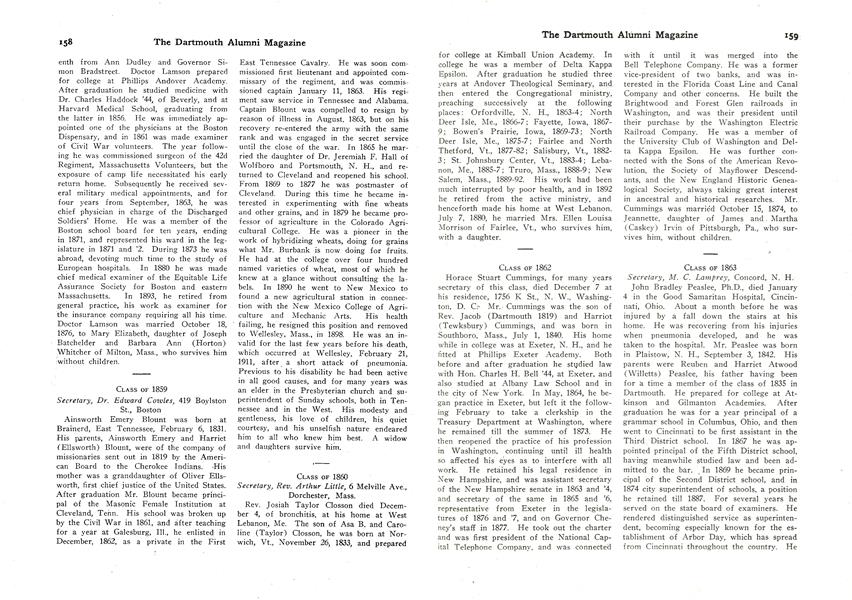
Ainsworth Emery Blount was born at Brainerd, East Tennessee, February 6, 1831. His parents, Ainsworth Emery and Harriet (Ellsworth) Blount, were of the company of missionaries sent out in 1819 by the American Board to the Cherokee Indians. His mother was a granddaughter of Oliver Ells worth, first chief justice of the United States. After graduation Mr. Blount became princi- pal of the Masonic Female Institution at Cleveland, Tenn. His school was broken up by the Civil War in 1861, and after teaching for a year at Galesburg, Ill., he enlisted in December, 1862, as a private in the First East Tennessee Cavalry. He was soon commissioned first lieutenant and appointed commissary of the regiment, and was commissioned captain January 11, 1863. His regiment saw service in Tennessee and Alabama. Captain Blount was compelled to resign by reason of illness in August, 1863, but on his recovery re-entered the army with the same rank and was engaged in the secret service until the close of the war. In 1865 he married the daughter of Dr. Jeremiah F. Hall of Wolfboro and Portsmouth, N. H., and returned to Cleveland and reopened his school. From 1869 to 1877 he was postmaster of Cleveland. During this time he became interested in experimenting with fine wheats and other grains, and in 1879 he became professor of agriculture in the Colorado Agricultural College. He was a pioneer in the work of hybridizing wheats, doing for grains what Mr. Burbank is now doing for fruits. He had at the college over four hundred named varieties of wheat, most of which he knew at a glance without consulting the labels. In 1890 he went to New Mexico to found a new agricultural station in connection with the New Mexico College of Agriculture and Mechanic Arts. His health failing, he resigned this position and removed to Wellesley, Mass., in 1898. He was an invalid for the last few years before his death, which occurred at Wellesley, February 21, 1911, after _ a short attack of pneumonia. Previous to his disability he had been active in all good causes, and for many years was an elder in the Presbyterian church and superintendent of Sunday schools, both in Tennessee and in the West. His modesty and gentleness, his love of children, his quiet courtesy, and his unselfish nature endeared him to all who knew him best. A widow and daughters survive him.
Secretary, Dr. Edward Cowles, 419 Boylston St., Boston
More From This Issue
-
 Article
ACADEMIC AND INDUSTRIAL EFFICIENCY
February 1912 -
 Article
It is to the younger alumni only that the Reverend Frank L. Janeway
February 1912 -
 Class Notes
CHICAGO ASSOCIATION
February 1912 -
 Article
THE THAYER SCHOOL OF CIVIL ENGINEERING
February 1912 -
 Article
GROWTH OF INDOOR AND OUTDOOR WINTER SPORTS-NEW LOCAL MAP
February 1912 -
 Class Notes
LOCAL ASSOCIATIONS
February 1912