JOHN COTTON DANA '78, LIBRARIAN AND CITIZEN
When a Dartmouth man reaches the top of his profession, and becomes known in his city as a force for good, his success should be made known to all Dartmouth alumni. Such a man is John Cotton Dana '78, librarian of the city of Newark.
Certain pamphlets of dubious veracity tell tales of Mr. Dana's undergraduate days. It would seem that he presaged his future career by winning a spelling match in the College Church. At the "Spring Athletics" he took first in the high jump, while his classmate, Lewis Parkhurst, was winning the three mile walk. In the '78 class report may be found his own account of the years immediately following graduation. He studied law but had to seek health in Colorado. Then followed, we infer, a fight for strength, long and discouraging, during which he did such work as came to hand, and much reading and thinking. He worked months in the rough with the Colorado Midland survey party, came east long enough to be admitted to the New York bar, but was forced west again, and was drifting toward teaching when he received appointment as librarian of the city of Denver. After nine successful years he went to Springfield, Mass., and four years later, in 1902, to Newark, N. J. Of his work the New York Sun remarked in 1913 that it "has got the notion that John Cotton Dana does a good many things for his city besides presiding adequately over a large collection of books. If there is any public or private enterprise in Newark that he does not make the institution he manages help along, it must be of no importance. If there is any intellectual appetite of the townspeople that the library does not seek to appease, it is not worthy of encouragement."
In a volume called "Libraries" Mr. Dana has just collected some of the papers and addresses he has written on library matters during the past twenty years. Viewed as a whole the book has certain very striking merits. It deals chiefly with the fundamentals of library work, with the relations of the library movement to existing social conditions, consequently it is neither technical in language, nor full of petty professional detail. The appalling flood of printed matter and the consequent growth of libraries is a thing of recent years. Mr. Dana has watched this .swelling flood, studied its social bearings, adapted his professional practice to his deductions, and in this volume given the world his belief and his practice. In it may be found the best existing description and interpretation of one striking section of our present social and economic structure. It seems fragmentary, but has a unity of basic belief. Of the style of the book it is enough to say that it faithfully reflects the character of a man who is well known to be clear-thinking, forceful, humorous, and a lover of art.
Mr. Dana says that he has been called a cynical optimist. He is inclined to take a slightly cynical turn toward many things. But it is a kindly, humorous cynicism, assumed largely to reduce his audience to a proper consciousness of sin. Thereupon his optimism at once asserts itself in his words, as it always has in his practice.
Among librarians Mr, Dana has long been known as something of a prophet. He has said that certain novelties in library work would become common, and they have. That they have is not a little due to his own insistent advocacy and example. Whether or not he actually originated these ideas, certainly he gave them publicity. Free access of readers to books, broadcast advertising of the library, adaptation of library service to the needs of business and industry, these he has done, we think, more than any man to bring about. Wholly of his own devising is the "Business Branch" of the Newark library — a branch library in the business section, designed solely to provide material for business men. It has achieved great success. In this book the chapters called "Relations of a:' Library to its City:" "Making the Library a-Business Aid;" "The Legitimate Field of the Municipal Public Library," give the best of his theory and practice.
Here and there among these addresses there is a direct challenge to the college. He has found that teachers do not know much about the art of reading—hence cannot teach children to do so. He would have the Colleges and Normal Schools see to it that such instruction is given to future teachers — instruction in the use of books, and in the separation of the valuable from the worthless in the flood of current print. He makes, however, no suggestion as to how this may be done. In another connection he says: "If one speaks of 'resources for students' in American libraries, you think at once of history, literature, philology and the mental picture is of long sets of proceedings of societies and of rare and ancient volumes. Slowly, with some reluctance, and only after vigorous suggestion, does one think of a 'student' as one who is busied with yesterday's books and this morning's journals and the advance sheets of pamphlets not yet issued."
Space is lacking to list many interesting matters touched upon in these essays. Nor is this the proper place in which to attempt to take issue with Mr. Dana upon professional points. There are, of course, many phases of library work upon which he does not touch. He says: "Some have said to me that it were better for mankind if in my own library work I put less emphasis on industries and more on culture and uplift — less on directories and more on Walter Pater and Henry Van Dyke." Those who do not know Mr. Dana would probably not realize from the scattered hints in this volume that he is, in fact, a lover of art, a connoisseur of prints and fine press work, and himself the power behind the Elm Tree Press at Woodstock, Vt., whence have come choice examples of the printer's art — and whence came also that gorgeous hoax "The Old Librarian's Almanac."
Mr. Dana's apologia for his volume supplies something of a key to his quite remarkable influence in Newark, for that which he urges we believe he has practiced. "In this volume," he writes, "I have not attempted to say definitely how the librarian of the future will adapt his practice to the new conditions. I have tried only to make it quite clear that the wise librarian will keep his mental manners plastic and his professional methods flexible. And perhaps here lies my chiefest reason for thinking that it may prove worth while to reprint these papers—that they quite urgently insist that, after an enthusiasm born of love of the calling, the one most essential attribute of the librarian, if he would be forever helpful and never an obstacle, is a profound belief that the end is not yet, that new conditions arise daily and that they can be wisely met only after a confession of ignorance, a surrender of all doctrine and careful and unprejudiced observations."
Nathaniel L. Goodrich, Librarian of Dartmouth College
Nathaniel L. Goodrich
-
 Books
BooksMOUNTAIN CLIMBING GUIDE TO THE GRAND TETONS,
November 1947 -
 Article
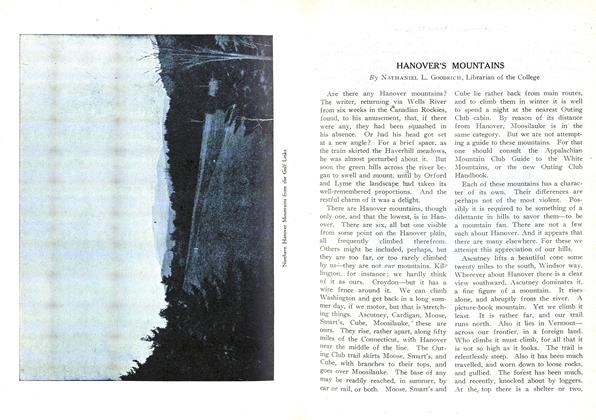
HANOVER'S MOUNTAINS
March 1925 -
 Article
THE NEW BUILDING FOR THE LIBRARY OF DARTMOUTH COLLEGE-AN INTERPRETATION OF THE PLANS
August, 1926 -
 Article
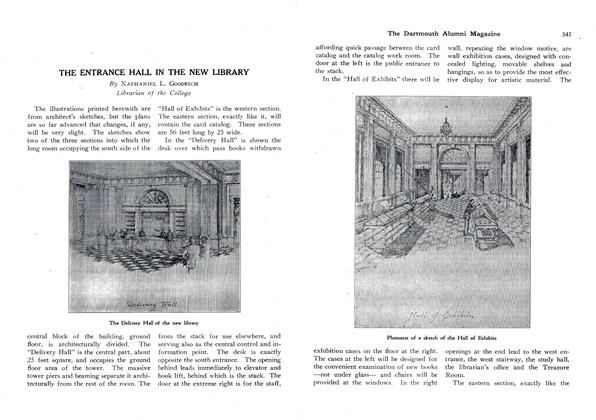
THE ENTRANCE HALL IN THE NEW LIBRARY
FEBRUARY, 1927 -
 Books
BooksSKIING FUNDAMENTALS, EQUIPMENT, AND ADVANCED TECHNIQUE
February 1937 -
 Books
BooksOUT OF THIS WORLD,
January 1951