THE DARTMOUTH CAVALRY, 1862
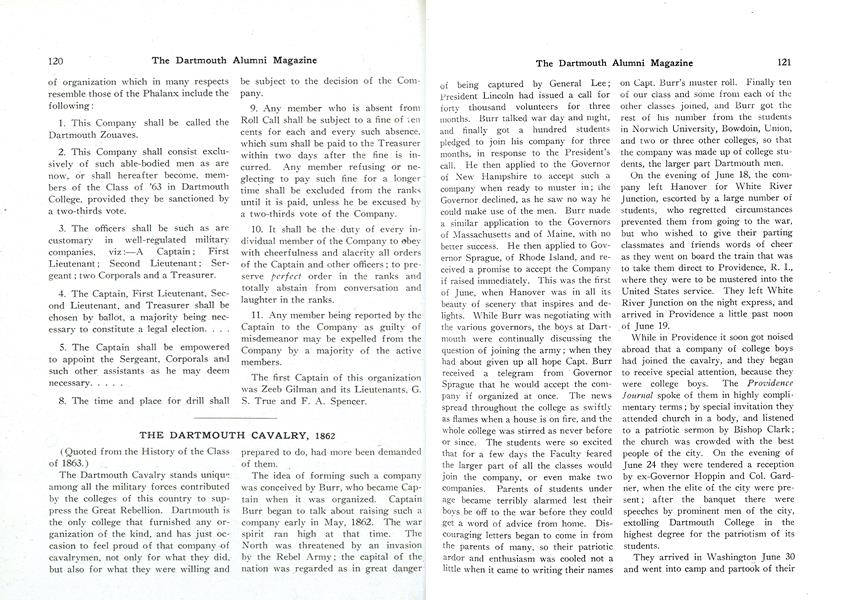
(Quoted from the History of the Class of 1863.)
The Dartmouth Cavalry stands unique among all the military forces contributed by the colleges of this country to suppress the Great Rebellion. Dartmouth is the only college that furnished any organization of the kind, and has just occasion to feel proud of that company of cavalrymen, not only for what they did, but also for what they were willing and prepared to do, had more been demanded of them.
The idea of forming such a company-was conceived by Burr, who became Cap- tain when it was organized. Captain Burr began to talk about raising such a company early in May, 1862. The war spirit ran high at that time. The North was threatened by an invasion by the Rebel Army; the capital of the nation was regarded as in great danger of being captured by General Lee; President Lincoln had issued a call for forty thousand volunteers for three months. Burr talked war day and night, and finally got a hundred students pledged to join his company for three months, in response to the President's call. He then applied to the Governor of New Hampshire to accept such a company when ready to muster in; the Governor declined, as he saw no way he could make use of the men. Burr made a similar application to the Governors of Massachusetts and of Maine, with no better success. He then applied to Governor Sprague, of Rhode Island, and received a promise to accept the Company if raised immediately. This was the first of June, when Hanover , was in all its beauty of scenery that inspires and delights. While Burr was negotiating with the various governors, the boys at Dartmouth were continually discussing the question of joining the army; when they had about given up all hope Capt. Burr received a telegram from Governor Sprague that he would accept the company if organized at once. The news spread throughout the college as swiftly as flames when a house is on fire, and the whole college was stirred as never before or since. The students were so excited that for a few days the Faculty feared the larger part of all the classes would join the company, or even make two companies. Parents of students under age became terribly alarmed lest their boys be off to the war before they could get a word of advice from home. Discouraging letters began to come in from the parents of many, so their patriotic ardor and enthusiasm was cooled not a little when it came to writing their names on Capt. Burr's muster roll. Finally ten of our class and some from each of the other classes joined, and Burr got the rest of his number from the students in Norwich University, Bowdoin, Union, and two or three other colleges, so that the company was made up of college students, the larger part Dartmouth men.
On the evening of June 18, the company left Hanover for White River Junction, escorted by a large number of students, who regretted circumstances prevented them from going to the war, but who wished to give their parting classmates and friends words of cheer as they went on board the train that was to take them direct to Providence, R. I., where they were to be mustered into the United States service. They left White River Junction on the night express, and arrived in Providence a little past noon of June 19.
While in Providence it soon got noised abroad that a company of college boys had joined the cavalry, and they began to receive special attention, because they were college boys. The ProvidenceJournal spoke of them in highly complimentary terms; by special invitation they attended church in a body, and listened to a patriotic sermon by Bishop Clark; the church was crowded with the best people of the city. On the evening of June 24 they were tendered a reception by ex-Governor Hoppin and Col. Gardner, when the elite of the city were present after the banquet there were speeches by prominent men of the city, extolling Dartmouth College in the highest degree for the patriotism of its students.
They arrived in Washington June 30 and went into camp and partook of their first regular army dinner, consisting of hard-tack and very tough, hard, boiled corned beef.
They remained in Washington and had daily drills till July 18, when they crossed the Potomac into the enemy's country. They had become expert horsemen and began to enjoy army life. They remained encamped at Fairfax Seminary till the 27th, then they broke camp and went over into the Shenandoah valley, by way of Harper's Ferry to Winchester, where they joined Gen. Julius White's brigade which was stationed there to watch the passes of the Blue Ridge and the highways of the valley.
During the whole month the Rhode Island squadron was kept on the move and on the watch every day, and not a few nights; in one of their raids to Front Royal they captured Belle Boyd, the famous rebel spy, and delivered her a prisoner at headquarters; they had narrow escapes, but nobody was killed or wounded, though one of the company, not a Dartmouth man, died of fever at Winchester.
Sept. 2, the squadron, under Major Corliss, left camp at 3 p.m. on a reconnoisance and marched over thirty miles, through Middletown and New-town; they captured four prisoners; returning to camp, they found it deserted, and all the tents, stores, etc., belonging to the squadron, burned up; they had orders then to form a rear guard of the brigade retreating to Harper's Ferry; marching all night, they reached Harper's Ferry at 9 a.m., Sept. 3, having been in the saddle for thirty hours, and marched continuously sixty-five miles. They encamped on Bolivar Heights, minus tents and almost everything else, except what they had carried on horseback. But oh, how they slept! While they slept their horses were shod and cared for.
The next day they were ordered to cross the Potomac river and take position on Maryland Heights, opposite the Ferry, having been assigned to that position as part of the Third Brigade of Col. Miles' forces, under command of Col. Ford. There they performed daily picket duty, fully conscious that they were cut off from Washington by Gen. Lee's army. From the observatory on the Heights they could see the Rebel army crossing over the Potomac from Virginia to Maryland. Two of the College boys set out on a scouting expedition of their own and from the mountains on the east side of Pleasant Valley they saw Lee's army encamped at Frederick, Md., getting ready to invade the North.
These things being reported to Col. Miles, all saw they must get out of Harper's Ferry or speedily be captured prisoners of war. A conference of cavalry officers was held to consider the question of escaping with their commands during the night. A plan was devised, and Col. Miles reluctantly consented to let them try to escape. About four o'clock p.m., September 14, the proposed plan of escape was made known to the Dartmouth company by their Commander, Major Corliss, who closed his address to the squadron with the startling information that "by the next morning they would either be in Pennsylvania, or in hell, or on their way to Richmond!" escorted by rebels. They started ; they marched all night, narrowly escaping falling into the clutches of Gen. Longstreet's Army Corps. A little later they captured one of Gen. Longstreet's ammunition and commissary trains, consisting of eighty-five army wagons, each drawn by six mules, and loaded with ammunition and provisions, and followed by forty fat young steers. They arrived in Greencastle, Pa., on the morning of September 15, in a greatly exhausted condition, but without the loss of a man or a beast on the retreat.
The battle of Antietan over, they started for home; they were mustered out at Providence October 2, and arrived in Hanover soon after. Such a reception as they received! Conquering heroes, the world over, never had a more royal greeting on their return from war!
The faculty were disposed, at first, to require the boys to pass an examination on the studies they had lost during the closing weeks of the summer and the beginning of the fall term; a regular college rebellion was threatened and would have occurred had they insisted on their demand. Brown University offered to admit the whole lot to its Senior class without conditions. The Dartmouth men were in Company B, seventh Squadron, Rhode Island Volunteer Cavalry. There were three officers and eighty-two enlisted men; of the total of 85, Dartmouth had 35 men; Norwich University 23;' Bowdoin College 4; Union College 4; Williams College 1; Amherst College 1; unknown 17.
Seven of the Dartmouth boys and three from other colleges were captured on one of their scouting trips to Front Royal, but fortunately they were exchanged in season to get home with the rest.