OCCUPATIONAL ADVICE
In June, 1919 the Trustees created the office of the Associate Dean whose work was "to be developed with the idea of enabling the men of the College to make the right contacts at the close of their college courses and helping them to begin advantageously and promptly what is to be their life work." It is obvious that in the minds of the Trustees the functions outlined by their vote fall into two parts, namely, occupational advice and placement. The methods of handling the work involved were left entirely to the officer chosen for this task.
Occupational advice, or vocational guidance as it is often called, has definite relation to preparation for a life career in matters of training and information and in personal qualities required or desirable for success. The degree and kind of training which one should have in order that he may be considered reasonably well prepared for his occupation offer endless opportunities for investigation and advice. Those who engage in a particular occupation or profession find themselves face to face with certain situations in their daily practice which require a previous knowledge of definite facts and principles. Clearly these facts and principles should be the subject matter of training during a college course. However, a college course does not serve its widest purpose if it is limited to pre-vocational or vocational training. There is a fund of knowledge which every man should possess who expects to be associated with people of education and taste. While this knowledge is not immediately concerned with the occupation in hand, it tends to make life richer and undoubtedly increases one's power to become greater in a chosen occupation as a result of the broader outlook upon life which he thereby acquires. Life is more than occupation and the training one receives in college should' include that which will be beneficial in the portion of his time outside the hours spent in the office or the factory.
No person can select for another the occupation that the other is fitted by nature to enter. Useful advice, however, can be given in several different ways. In the first place, information can be given regarding the several occupations which might be of interest to an individual student or which would seem to include that range of occupations in which he could have some hope of success. In the second place an adviser, may indicate the characteristics or qualities required for success in one career or another and may assist the student in determining whether or not he possesses those qualities. He may make suggestions as to the methods by which one may overcome such defects as his record shows him to have. Beyond that point a choice of occupation rests largely with the individual himself, for no sure method has yet been devised whereby occupation and individual can be measured side by side and linked together if the measurements agree. Apart from such hints as may be given to a student in this way, the decision as to an occupation must depend upon the nature of the study successfully pursued by the student and the result of analyzing himself by means of trial positions.
No advice is of especial value unless the adviser has a considerable amount of definite information about the student advised and can use that information to advantage. The various offices of the College have systematized their records so thoroughly that there is an astonishingly large body of knowledge on file about each individual undergraduate. An occupational adviser needs all of these and transcripts of them form a regular part of the equipment of the office of the Associate Dean. The registration cards of an entering class contain many valuable facts concerning the earlier life of the freshman; the office of the Physical Director has an excellent record of each man's physical condition; the Dean's Office has a record of his scholarship, his prizes, honors and delinquencies; the Department of Psychology has a record of his intelligence rating based on the tests given each autumn to the freshman class; the members of the Faculty have undertaken to make personal estimates annually of all men under their instruction. The use to which each of these records may be put will be clear to everybody.
Since the making of Personal Ratings is so new it may be well to give a brief account of what is done in this regard. The members of the Faculty estimate the student on four personal traits and are guided in their ratings by the following definitions:
Intelligence—Ability to grasp a situation; alertness of mind. Not to be identified with scholarship.
Aggressiveness—Personal force; initiative ; assurance; decisiveness.
Reliability—Evidences of solid character ; dependability; sense of responsibility ; pei-severance; attentiveness; punctuality.
Personality—Bearing; neatness; courtesy; personal acceptability.
The demonstrated value of the officers' rating cards as basis for promotion in the Army suggests many important uses of this newest product of Applied Psychology. A permanent and detailed record of the personal impressions made by a student on many different judges is perhaps the best single basis from which to make personal recommendations, whether for business positions, for admission to graduate or professional schools, or for the furtherance of any other legitimate personal interests . Even more immediately important is the use by the student of his own personal data as an influence in guiding his personal development and his vocational choice.
The knowledge that members of the Faculty are making personal estimates of all undergraduates under their instruction upon four distinct qualities has created a profound impression upon the student body. A student is anxious to ascertain how those in authority are impressed by him and is taking the ratings very seriously. He realizes that there are two sides to success, he must have certain qualities and he must convince others that he possesses those qualities.
It is the plan of the Associate Dean to hold at least one private interview with each undergraduate every year. The freshman class cannot advantageously be interviewed until the second semester. By that time the greater part of the records mentioned above are available and the scholarship record of one semester is completed. An interview with a freshman takes the form of an analysis of his scholarship, his physical condition, his intelligence test, his interests and activities, his choice of a life career and his plans of preparation for it. So far it has been discovered that about two-thirds of a freshman class have a fairly definite idea concerning their life work. The problem then is to endeavor to assist the student in a final determination as to whether the chosen career is the one for which he is best fitted, and in the case of the other third to induce them to begin thinking seriously upon this subject. All known facts about the individual are used in ascertaining the fitness of the individual for any suggested occupation. His experience up to date is considered and analyzed and finally each student is urged strongly to take some position involving regular work during the summer vacation for the purpose of trying himself out, of avoiding idleness and of increasing his sense of responsibility and regularity.
In connection with this last point careful inquiry shows that more than two-thirds of the class of 1923 had been engaged in some useful occupation during the last summer vacation, a few of them had worked either to earn their living or for the sake of experience during various summers before the completion of their preparatory course. Each student of that class was asked particularly what work he would do during the vacation at the end of his freshman year and in the autumn following, he is expected to make a report as to the manner in which he spent his summer and what he learned thereby.
If the system of advice can be carried forward successfully all students should have their careers in life chosen long before graduation. They should also have had direction upon the attainment in scholarship and personal qualities which will help them to succeed in their life work and should have received such guidance as to enable them to live broader and more useful lives. The advice they should receive would therefore extend far beyond the courses contributory to their profession. They should be encouraged to gain at least a fundamental knowledge of the many subjects of common interest to mankind in the hope that they would acquire a genuine interest in the life and activities of many who are engaged in occupations other than their own and would have an intelligent sympathy for movements looking toward civic improvements and higher standards of life.
Certain facts concerning the choice of a life career may be of interest as showing in what direction the thoughts of the present undergraduate are tending. Two hundred and-fifty-three members of the present senior class have indicated their occupations as follows: Business 199; Medicine 12; Law 10; Teaching 9; Engineering 8; Chemistry 6; Journalism 4; Ministry 2; Social Work 2; Art 1. The first point of significance is that 80 percent, of those whose choice is made have signified their intention of entering business, leaving only 20 percent, for all other pursuits. The question immediately arises as to whether Dartmouth College is training its full share of men for the various professions and occupations apart from business. It may be considered that if twelve enter medicine and ten enter law from one class the College is providing a preliminary training to a sufficient number to maintain its. proper quota. It is possible also to maintain that the supply of engineers, chemists and journalists will be kept up if the College continues the proportion reported in the present graduating class. It is certain, however, that the number entering teaching, the ministry and work in social service is far below that required to keep the supply up to the standard. It is particularly to be regretted that the College is by no means supplying its own demand in connection with the increase in its faculty. It is very noticeable moreover that a considerable number of occupations are not reported at all in the list. Those who are deeply concerned for the best development of the College are faced squarely with the question of whether the Dartmouth undergraduates truly represent the breadth of interest of the youth of the country or whether the atmosphere of the College strongly influences toward business those men who come to Dartmouth with other intentions. In the former case it would seem thai means should be adopted whereby students of other types might be attracted to the College. In the latter case a responsibility rests upon the officers of the College to present the claims and opportunities of other walks of life with sufficient attractiveness to offset the prevailing tendency. If one can judge by the choice of occupations of the present sophomore class it becomes evident that both tendencies mentioned above are true to some degree. About 60 percent, of the class, so far as they have already determined upon their occupations, have chosen business as their life work, the remaining 40 percent, are very well scattered through a broad range of professions and other careers. It is clear, therefore, that although the majority of our students come to College with a tendency toward business, there is a positive trend in that direction after they once enter upon their undergraduate course.
The effect of the work of occupational advice can not well be measured within the period of a college generation. Its influence may in some respects be immediate, whereas in others time is required to create a very marked impression. It is worth noting that the student body is considering with unusual attention the desirability of an early choice of their life work. So far as we have figures from which deductions may be drawn the indications are fairly clear that those who know the direction in which their study is taking them attain a higher rank than those who have not settled upon their permanent tasks in life. To this extent the influence of the new office may quickly be felt. Its ultimate place in college guidance can be determined only after a series of years..
The chapel-bound crowd is as care free as usual
PROFESSOR RICHARD WELLINGTON HUSBAND, Associate Dean
More From This Issue
-
 Article
The brevity of time precludes
January 1921 -
 Article
THE SPAULDING SWIMMING POOL
January 1921 -
 Article
EARLY DRAMA IN HANOVER
January 1921 -
 Article
ABSTRACT OF RECORD OF TRUSTEES' MEETING NOVEMBER 13,1920
January 1921 -
 Sports
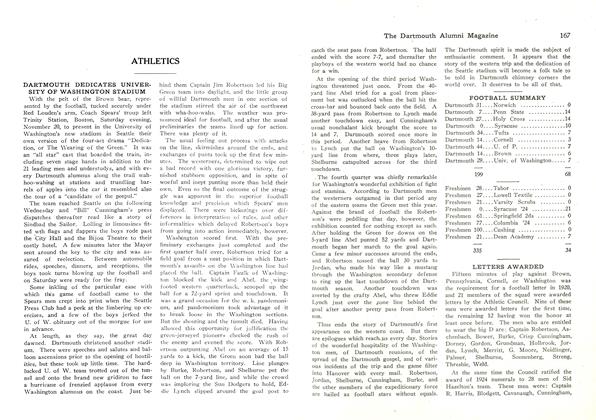
DARTMOUTH DEDICATES UNIVERSITY OF WASHINGTON STADIUM
January 1921 -
 Books
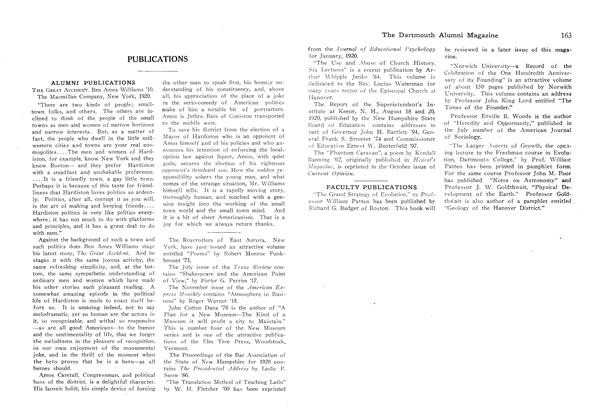
BooksALUMNI PUBLICATIONS
January 1921