The brevity of time precludes
an adequate appreciation in this number of the ALUMNI MAGAZINE of the life and career of the late Hon. Sanford H. Steele, whose death removes from, the alumni body and from the board of trustees a man who was, in every way, a magnificent representative of the best that Dartmouth produces. It was vouchsafed to Mr. Steele to serve the College in ways which are open to few, and to the trusteeship he brought a ripe experience, a sound and conservative judgment coupled with a progressiveness of spirit which the College can ill spare. He was privileged to attend the 50th reunion of his class (1870) and no one then noting his apparently vigorous appearance could have suspected that within six months he would be no more. For to his manifold gifts of mind, Mr. Steele added unusual charms of presence and stature —a fine, hale figure of a man, gifted not only to think sage thoughts but to express them. The college is the poorer for his going, the richer for his lifelong example.
The system of a "general examination" of which one hears much in many quarters, but chiefly from Harvard, seems worthy of a word. It has for its underlying idea the hope of making a general examination of the college student reveal "what he has become,. rather than what he has been through," by giving him a broad test which shall cover virtually all the ground he has traversed during his course.
According to the information before us from Harvard University, it is proposed that hereafter, before any student can be given his degree, he must pass satisfactorily an examination on virtually his entire course—with the exception of his courses in "mathematics and natural science." This exception is' notable and very possibly it impairs the validity of the whole argument for the "general examination", since it appears to recognize the improbability that the average student will cover himself with glory in matters of detail in subjects, now grown dim, which demand much exactitude and accuracy. One gathers that a tolerable vagueness is about all that can be looked for in so comprehensive a test, relating to subjects which were perhaps studied two or three years before, and that it is admittedly unwise to ask a senior very minute questions to show "what he has become" in the way of a mathematician or physicist.
It is easier to defend the "general examination" in theory than in practice, as is true of so many ideas in the pedagogical realm. /In theory it is desirable to discover, before you make a man an A. 8., whether he is a proper Bachelor of Arts in spirit and in truth. A Bachelor of Arts is supposed to carry away with him, as the excuse for his degree, a passable knowledge of liberal arts on which he has spent his time. The fact is, however, that what the ordinary A. B. carries away from college is not a vast accumulation of predigested lore— for much of this he has frankly forgotten. If he carries away a reasonable sufficiency thereof for human nature's daily food (and this is not nearly so much as professional teachers usually imagine) coupled with a mind well trained to function for itself in the company of other and similarly educated men, the college has done all it is ever likely to do with indiscriminate raw material. One fears that such a "general examination" would in most cases reveal, not how much the senior retained of his long and varied studies, but how little; and worse still that this demonstration would not be important.
Examinations are commonly an unsatisfactory sort of apparatus for revealing the actual worth of an individual student, but such as they are they probably serve as well as anything can. Their usual purpose is to discover how much a man knows of a course which he has just been pursuing, with the idea of determining whether it is desirable for him to remain longer in college and go on with other studies. This "general examination" goes to the other end of the line and seeks to establish, after the -fact, whether the four years spent in college have been turned to account, or have been (in the eye of the faculty) wasted years. Of that one may well doubt the utility. And one waits with some expectancy the probable proceedings in equity to compel the university to bestow its degree upon a man who has faithfully paid his term bills, attended all his lectures, passed all his incidental tests, and arrived at Commencement-only to be told that he doesn't remember quite enough of his sophomore subjects to suit a committee of professors.
One of the hopeful things indicated by the Harvard management as in view when they devised this post-prandial inquisition is "bringing the student and the faculty closer together." That it will do this one doubts. Indeed a skeptic may doubt that any means will suffice. Most unfortunately it happens that the faculty is looked upon by the ordinary undergraduate as his natural enemy, or at best as an uncomfortably candid and censorious friend. This is unworthy and deplorable—but so are hosts of other facts in this world of sin. It doesn't operate to prevent their being facts. Making the faculty judges of whether or not a man shall get his degree—all on the basis of his recollection of remote courses taken many months ago—seems to us admirably calculated to increase the distance between instructor and instructed, rather than to span the bloody chasm. This, however, is a mere incidental. The graver question is whether the "general examination" will work well enough, or do substantial justice enough, to warrant its retention.
One may hardly be pardoned for saying of so new a proposal that one is instinctively against it—especially if one be of the currently fashionable cult of conservatives. That is the conservative's easily besetting sin, according to radical innovators. He is always "instinctively against" novel propositions which shock by their novelty. One is told that the proper spirit in which to face a new idea of this kind is one of hopeful receptivity rather than of rude antagonism. This may be questioned. A new idea may be true, or may be false, let us admit; but it is the radical's contention that one should accept it as probably true, and the conservative's notion that it should be treated as more probably a lie. Neither is quite satisfied to be merely open-minded, inclining neither to belief nor to unbelief. The scientific attitude in the case before us would therefore be one of benevolent neutrality—letting Harvard try it out, and prove the doctrine orthodox in the sight of time. Practically, as usual, the educational world will follow its common bent and will be part all in favor of the plan and part all against it.
If we incline to a distrust of the value of this plan it is not so much prejudice against a new idea but incredulity based on what look like antecedent probabilities. From our own experience we all know how little we retain of the multitude of facts we learn, either in college or in daily life. We are well aware that this retained knowledge is discreditably meagre—and yet, can we help it? Are we even sure we should be better, more useful, even more cultivated men if we retained more? The man who can in his senior spring pass a creditable examination on his whole college course honestly seems to us likely to be an abnormality; and if the normal man would give a poor account of himself, why bother to demonstrate that "things are even worse than we dared to hope?" Besides—and this is mentioned with appropriate hesitancy—it is remotely conceivable that part of the failure of a senior to remember his sophomore courses may be due to inefficient instruction. How guard against this ? And will potent, grave and reverend professors of mathematics, say, readily consent to undergo a "general examination" themselves, similar in scope? We recall certain erudite pundits in the line of economics whose showing in an examination on English poets would be disquieting. Yet they pass for learned men.
After all, the objects of education remain dual. It is hoped, by introducing the neophyte to the inherited wisdom of the past, to train his mind for the work of the future. Somewhat too little is made by educators of the latter aim, which seems the more important; and in an especial manner it strikes us that the "general examination" lays an overemphasis on the former which is the less important. The man who retains comparatively little of the material exhibited to him during his student days may have a perfectly supple and use ful mind, and may even be a better educated citizen than one whose purely retentive faculties are his distinguishing characteristic. The real object of education—which is to fit men for active service—should not be lost to sight.
Meantime, the battle rages in pedagogical circles, between classical and scientific, between "cultural" and "practical." Too seldom is it admitted that cultural studies have a highly practical utility, and practical subjects a cultural quality as well, the main object of both being mental discipline. Whatever else a college may do for a man, it at least should send him forth better fitted to play his part in the world that now is; and his conscious recollections of the world that has gone before may be meagre indeed without inviting too deep reprobation. Many a man is the better today for his forgotten Latin, or his forgotten Greek. The fact of his for-getting is not particularly important. What he has retained is a mental aptitude, engendered by study, which is of much more value to him than would be a recollection of the fourth conjugation, or of the proper Greek particles to employ with the appropriate verbs in expressing a future condition less vivid.
A word needs to be said now and again for 'the cultural studies— and more especially the dead languages—on the score of their practical merit. The surest users of English are those who have studied— and at the time measurably understood— Latin. The most accomplished stylists are such as had the advantage of at least a nodding acquaintance with Greek classics. The pen, in order to excel the sword, must be competently wielded; and there never was a day when the world was more certainly governed by the written word forcefully conveying the idea.
Pumping boys full of English classics and. then pumping them out again by the requirement .of analytical themes probably does less for the improvement of American literature than is done by poring over Caesar's Commentaries and the orations of Cicero. Taking apart and putting together the jig-saw puzzle of another man's language usually throws an unexpected light on the construction of one's own.
Between twenty and thirty American colleges are now, or until recently have been, without presidents. It may be unfortunate but it is certainly true that there exists no formal source of supply for this exigent and increasingly important profession. College presidents are born, not made; and the selection of them often rests too largely on chance. Where it does not depend upon chance, it too commonly falls back upon the financial power to hire away from a smaller institution a man whose capacity is proved, leaving' the. smaller college to select anew—on the old lottery basis.
Promotion in this guise has lately increased in frequency. One recalls the case of President Marion L. Burton, 'formerly of Smith College, who was sought by the University of Minnesota and who has more recently still been called to the University of Michigan, which feels itself able to offer him $20,000 a year. Men who have drifted into this field at first by accident and who have seemed to the world to make conspicuously good therein are likely to be called higher. The few places at the top can be filled by careful selection. The many places at the bottom have to choose with less certainty among untried men whose suitability must be taken on trust.
Thus far no graduate. school holds, itself out as teaching young men how to preside over colleges. No correspondence school—though daring greatly in other lines—has yet advertised to do this. Indeed the profession of the college president has grown imperceptibly to its professional estate out of the embryotic status of a faculty chieftain. Erudite clergymen, who could preside over the college with one hand and teach Hebrew, Sanskrit, Greek and Paleontology with the other, would no longer serve efficiently. Educational plants and endowments have augmented until they form what the .vernacular calls an "interest"; and the necessities of the time call for managerial, rather than educational, preeminence. Courses in business administration may actually have more bearing upon the future usefulness of a college president than any other. But even so, the choice of raw recruits to this highly important calling will be dictated by conjecture; and the few who turn out to be especially apt in their new duties will be sought to assume other presidencies after they have been duly trained by actual practice of their profession.
And yet the presidency of a college cannot be filled with all the gay insouciance of a sugar, or steel, "trust" seeking a leader who shall have the proper business acumen. The college head has to hold an even balance between the wisdom of the serpent and the gentleness of the dove—between cold business common sense and warm academic idealism. Which is no doubt, why successful college presidents are born, not made.
Hanover now settles to the winter, which as we are all aware comes early and stays late. Although not so held out by the catalogues, Hanover winter is one of the most important things in the college curriculum as bearing on that intangible essence which we call the Dartmouth spirit, or the distinctive virile character of the College. Boreal cold, deep and persistent snow, a nipping and an eager air, can teach manythings. To be sure the arduous nature of the winter season has sensibly mitigated since "city" water and central heating made their presence felt on the Campus. The old days, when men with the bark on hauled their own meagre stocks of highly expensive coal up three flights to feed their own stoves, and when the first of a morning's ablutions consisted of breaking the ice in a yellow pail, have departed. But the rigor—frosty, yet kindly—of a rural winter, the beauty of the unsullied snows, the necessity of struggle against the essential northern cold, all conspire to make men. Beyond a doubt, Hanover winter figures in the "meminissejuvabit" class—it is pleasanter in the retrospect than in the immediate present. But for. that matter, all one's college life is so. The happiest days of one's life are apt to be those which were not fully recognized as such at the time.
There may well be an epoch-making quality in the opening of the Spaulding swimming pool at the gymnasium. If it means anything it must mean that hereafter every Dartmouth man will, unless he knows already, be taught to swim and take care of himself efficiently under any circumstances in the water. Those of us to whom natural advantages for early acquisition of this art were denied know only too well the difficulty of mastering it in later years. To be done effectively it must be done as one learns to play good golf, or speak fluent French—in youth. One easily imagines the day in which instruction in swimming will be a matter of course in the realm of education—not alone in colleges, but also in schools. It is a vital need. Yet it has been slow in coming and such experiments have been handicapped by the fact that swimming pools are excessively costly possessions for colleges not advantageously set with reference to safe natural waters.
It is perhaps not an overstatement to say that the construction and opening of the Spaulding pool point .to the most important advance in the College's educational developement in many a year. It isn't a frill. It is the bread-and-buttery sort of education. To the man upset in a lake or river, an A. B. degree that has involved the necessity of learning to swim will be a degree well worth the having. All of which presupposes that swimming will become a required course, as it should, for every undergraduate save such as are physically incapacitated for it. It will come hard to the man whom Kipling would describe as a "water-funk"; but to such, of all men, it will prove the most abundant blessing.
More From This Issue
-
 Article
OCCUPATIONAL ADVICE
January 1921 -
 Article
THE SPAULDING SWIMMING POOL
January 1921 -
 Article
EARLY DRAMA IN HANOVER
January 1921 -
 Article
ABSTRACT OF RECORD OF TRUSTEES' MEETING NOVEMBER 13,1920
January 1921 -
 Sports
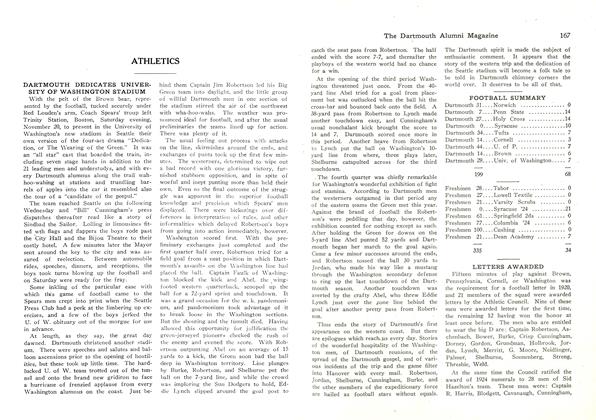
DARTMOUTH DEDICATES UNIVERSITY OF WASHINGTON STADIUM
January 1921 -
 Books
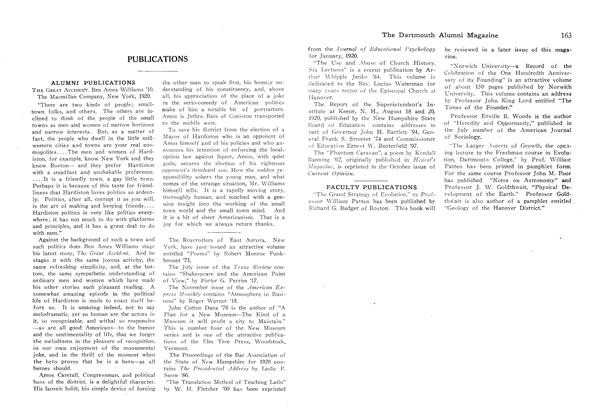
BooksALUMNI PUBLICATIONS
January 1921