A Manual of Debate and Oral Discussion
James Milton O'Neill '07. New York: Century Co.
This is Professor O'Neill's second venture as a bookmaker in the domain of Argumentation. His earlier work is a revision and expansion of the treatise by Laycock and Scales—a text long used in Dartmouth College.
The writer of this review was at the first minded to ask himself what need there was for a new textbook on this subject. Composition" in all its divisions and aspects has been treated in school and college texts far beyond the point of satiety. What can an author now hope to contribute that is new, or worth the while?
Professor O'Neill does not claim to haveinv invented a new method in argumentative composition, but he does claim to have presented in the book now under consideration a treatise especially well adapted to the needs of a particular class of students and readers: namely, "students in schools" (not colleges) "and members of clubs or societies, who wish to improve themselves in the art of debate, and have no opportunity to get regular class instruction."
This book is therefore much less exhaustive, less technical, more simple and much more concise than the writer's earlier work. The order of treatment is much the same. The familiar topics of Proposition, Issues, Evidence, Arguments ("Reasoning"), Refutation, The Brief, Presentation (compositions and delivery), follow one another in the usual way. These topics are presented clearly and concisely, and in definitions less open to criticism than most of the texts which the present writer has examined from time to time in a somewhat extended experience in teaching the subject of Argumentation.' The two topics of Evidence and Kinds of Argument especially are presented with a discrimination and a consistency which leave nothing to be desired; though here, as elsewhere, the lack of illustration, considered below, is to be regretted.
The treatise is very brief, covering only 170 pages. Following the treatise proper 125 pages are taken up with appendixes. In one acquainted with books of this class the brevity of the work would excite some surprise, considering the fact that the author purposes to cover the whole ground. Brevity is obtained not only by conciseness of treatment in general, but also by omitting entirely certain large topics which are found in practically all books on this subject. For example, Fallacies, Definitions, and Persuasion do not appear as distinct topics, and if they appear at all it is only incidentally. Brevity is further secured by omitting illustrative examples — whether examples invented by the author, or citations from acknowledged masterpieces of Argumentation.
It seems unfortunate that consideration of space should have led the author almost wholly to dispense with this most helpful auxiliary. Mr. O'Neill would presumably claim that his aim at conciseness and simplicity justified the omission here criticised; but he is writing for younger students and for those "who have no opportunity for regular class instructions," and surely these especially need all reasonable help to clearness.
A considerable part of the book (125 pages) consists of "appendixes." These contain material for illustration and practice — model briefs; material for "briefing"; suggestions on formal debating, decisions of judges, etc. One appendix, peculiar to this as compared with other texts on Argumentation, is a two-page table of parliamentary motions, giving their relations to each other, and their other special characteristics — whether or not debatable, amendable, etc.
Dartmouth men of the more recent classes will be interested in the dedication of Professor O'Neill's book to the memory of George Ray Wicker, "who in school and college, on the street and platform, taught men to think and to express their thoughts."
Lemuel S. Hastings
More From This Issue
-
 Article
What does a man lose by going to college ?
February 1921 -
 Article
PEN AND CAMERA SKETCHES OF HANOVER AND THE COLLEGE BEFORE THE CENTENNIAL
February 1921 -
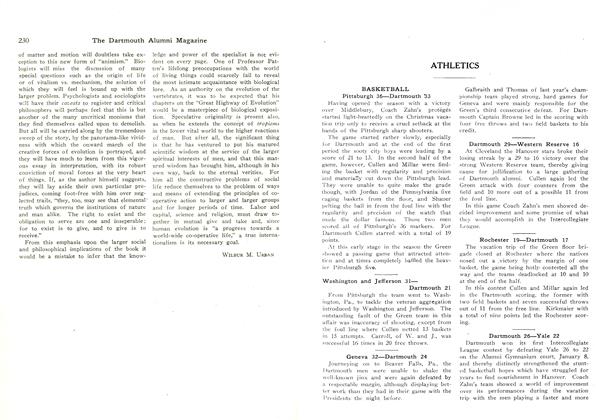 Sports
BASKETBALL
February 1921 -
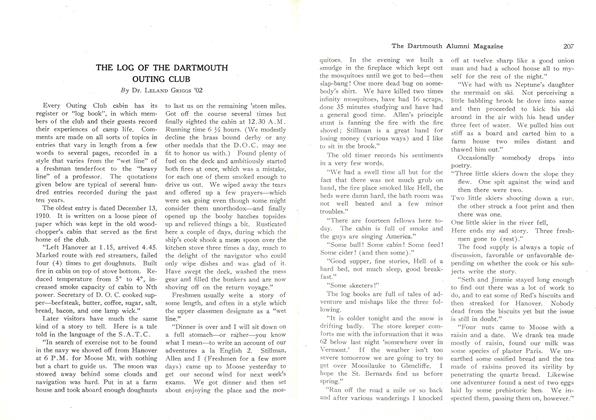 Article
THE LOG OF THE DARTMOUTH OUTING CLUB
February 1921 -
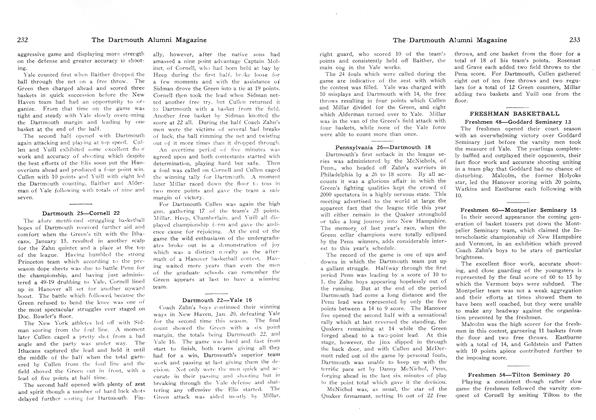 Sports
HOCKEY
February 1921 -
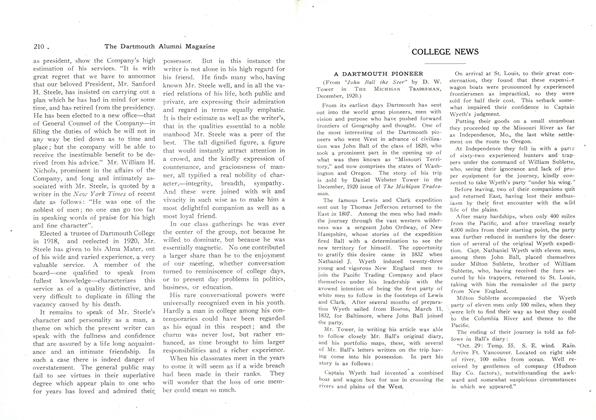 Article
A DARTMOUTH PIONEER
February 1921