Deaths
(This is a listing of deaths of which word hasbeen received since the last issue. Full notices,which are usually written by the class secretaries,may appear in this issue or a later one.)
ALUMNI NOTES
DARTMOUTH CLUB OF CLEVELAND
The Dartmouth Club of Cleveland again has the honored distinction of being the only alumni organization in Cleveland that meets regularly every week throughout the summer months. The average attendance at these luncheons (held in a private dining room at the Hotel Statler) has been twenty men. I wonder sometimes if the- fun had at these sessions is due to the blatant oratory of some of the noisy members, or to the several tables of bridge after everything has been eaten that was paid for.
The summer activities of the club started off with the annual picnic one fine day in June. The scene of this murderous assault was at the Sleepy Hollow Club and within a radius of five miles from that spot. There was golf in the morning for those that don't work very hard. The real picnic started with the ball game in the afternoon between two picked teams, the Lebanites and the White Riverians, in which the former (or was it the latter) team won by a 47 to 39 score. No less than eleven pitchers were knocked out of the box and no more than twenty-one players were knocked out of the field. During the latter part of the game and after it the boys drank a lot of ginger ale and sang songs and the like of that until dinner climaxed the festivities.
The golf tournaments of the club have been held again at regular intervals, the same as last summer. So far this summer we have played the Sleepy Hollow, Acacia, Canterbury, Westwood, and Kirtland Club courses. The turn-out for these parties averages about eighteen men, which is a good showing considering that -we are unable to secure playing privileges on any of these courses on Saturdays, Sundays, and holidays.
W. N. JEAVONS, Secretary
SOUTHERN CALIFORNIA ASSOCIATION
Again this year C. H. Brock '88 established his right to be known as the "Halibut King" of the Southern California Alumni Association. It has been Mr. Brock's annual custom over a period of years to treat the members of this Association to the results of his piscatorial prowess. And always "C. H." has aimed to provide choice young specimens of that particularly eatable fish, the Pacific Coast halibut. Whether or no the weary denizen of the deep would succumb to capture by other fishermen, Brock had a method of his own, in which he was assisted by Mrs. Brock, and he hasn't failed for years in his annual treat for the Southern California Association.
This year, the halibut have not been running at Manhattan Beach as in former years. At least Brock so reported when he went on his vacation early in September. But on Tuesday, September 21, he showed up at the luncheon and announced that he had brought in about twenty-five pounds of halibut, had arranged with the proper parties to cook the dainty in the most approved style, and all comers at the regular weekly luncheon of the Southern California Association could indulge to their fill if they wished. All did, and there proved to be plenty to go around, although there are some lusty trenchermen among the twenty-six members of the Association who were on hand on the 21st.
A rising vote of thanks was extended to Mr. and Mrs. Brock, and C. H. promised a similar treat next year.
REUNIONS
CLASS OF 1876
Sixteen graduates of the class, present in Hanover, out of a total of thirty-two survivors, gave a percentage attendance greater than had been recorded at any previous gathering, the next best being that of 1886 when the percentage was forty-eight. For no one of the intervening gatherings was the record over forty-three, and the average was thirty-five.
Those present at the "50th" were Abbott, Barton, Gale, Goodhue, Hay, Hardison, Hibbard, Hill, Hunt, Peabody, Piper, Roberts, Stimson, Thayer, Tripp, and Woods; yes, Silvae, the only one of the sixteen who had not been in Hanover for fifty years, and classmates were glad to welcome him back. With these sixteen were two other brothers genuinely in the fellowship, both present at the "45th," Dr. Pratt of Dumont, N. J., who did not take a diploma, and Dr. Stimson of Fitchburg, Mass., a brother of Stimmy, an adopted brother of the class.
The attendance of the women of '76 surpassed that of the men. Of widows there were Mrs. (Kenerson) Anderson, Mrs. Gardiner and Mrs. McElroy; of wives, Mrs. Gale, Mrs. Goodhue, Mrs. Hibbard, Mrs. Hunt, Mrs. Roberts, Mrs. Thayer and Mrs. Tripp; of daughters, Miss Gardiner, Mrs. Helen (Hardison) Whittemore, Miss Patterson, Miss Peabody, Miss Pratt, Miss Stimson (daughter of Dr. Stimson), and Miss Thayer; a sister of Stimson, Mrs. Loewe; and two friends, Miss Peck, who came with the Hardisons, and Miss Consuelo, companion of Miss Pratt.
It has occasionally happened at former reunions that not every one of the class present in Hanover during the Commencement season would arrive early enough or remain long enough for the important event, the dinner; but at the reunion dinner Monday evening, June 21, every one of the thirty-nine just enumerated was present. The dinner was, indeed, as heretofore, the leading single interest of the four days' pilgrimage. The place selected for it was in a room on the first floor of College Hall, this hall, with Dartmouth Inn, being the rendezvous of the class. The men and women, being about equal in numbers, were seated, naturally, in alternation; whether discriminatingly or not the Secretary did not observe, perhaps for the reason that he was well pleased with his own assignment on both hands; Tripp and Hill had charge of the place cards.
Never at a reunion dinner had the tables been more beautiful with flowers than upon this occasion. Miss Gertrude Bridgman, in memory of her brother, sent several dozen dark crimson rosebuds; these were placed midway on the center table. On either side of the bank of rosebuds were pansies arranged on the white tablecloth in the form of '76. Mrs. McClary, as has been her custom for the past two reunions, provided white carnations to be worn by each one present; and the College provided vases of peonies, lilies, and other flowers. And the menu, shall one leave it without comment? Not altogether. It was remarked afterward that there had never been so good a dinner provided; a judgment no one disputed.
Tripp presided at the after-dinner exercises. In announcing that each classmate would be asked to respond to a toast, he gave plenty of leeway for other themes if preferred. Every classmate met the test. Some of the briefer responses were among the most amusing; Hay's, for example. No one spoke unduly beyond the brief time allowed; all were interesting. Mrs. Hibbard and Mrs. Roberts spoke for the ladies.
In the midst of the speaking President Hopkins entered and was given a seat at the head table. After listening through two responses, he gave, by invitation, a ten minutes' talk, rich in the qualities of insight and vision, strong in the grasp of realities, and not untouched with idealism; stirring the deeper enthusiasms of those who could but listen, and lingering in the memory.
It was remarked that the quality of the speaking had never before been so high, and doubtless the judgment was correct. This would be only what might be expected; never had classmates spoken out of a richer experience, never had the occasion been more significant. Certainly the after-dinner exercises were never more thoroughly enjoyed. The dinner began at seven-thirty o'clock and adjournment was well before eleven. Roberts had invoked the divine blessing; Thayer gave the benediction.
Sunday evening there was a choice and distinctly class event in the presentation in the local theatre, through the accommodation of the management, or one of Peabody's reels, giving the falls of the Yellowstone River and the geysers of the Park. More than thirty attended, making the first good getting-together of the reunion group. If the estimate is a true one that there is nothing in screen pictures more satisfactory than the representation of natural objects in motion—water, swiftly flowing or falling or in ocean waves, blown branches of trees, waving grain, storm clouds, smoke, the free motions of quadrupeds and birds—then this reel of Peabody's was near perfection, for the technique was equal to the best now attainable.
The important public event of the reunion came on Monday at half-past two o'clock in the tent on the campus when, the "50th" of '76 was recognized by the College. Guy C. Richards, Esq., president of the General Alumni Association, made the opening remarks, explaining the new relation of the College to the fifty years class, and ended by introducing Tripp, who, as class president, had been agreed upon as class representative for the occasion. After an address of unusual interest Tripp introduced in alphabetical order, with words, appropriate and occasionally humorous or witty, the fifteen men who sat in a circle before him, each man rising and standing a moment as his name was spoken. There had been some misgiving as to the success of this particular portion of the ceremony, but it turned out happily for all concerned. One of Tripp's best hits was the introduction of Barton as the "Johnny Lord of the West." Following the introductions were greetings and congratulations from many in the audience. It seemed to be allowed that this new feature of the Commencement program was a success and would be repeated another year.
There was an especially happy circumstance connected with this occasion in the presence of Professor Lord, the only survivor from the group of instructors the class had been under in College. Professor Lord's death a few days after Commencement at his summer home in Wonalancet, N. H., gives a lasting significance to this final meeting, a new value to his words of greeting and congratulation as he took the hands, one after another, of the men he had known for fifty-four years. He seemed in good health at the time and a number of the group must have felt he would not unlikely be present after another five years.
The Commencement exercises Tuesday had an added interest for '76 in the granting of the degree of D.C.S. to Hardison, a bestowal felt universally to be most fitting apart from any possible honor to the class.
Immediately contributing to the success of the "50th" was the work of the executive committee, largely done by Tripp, and the ready contributions of different classmates toward the financial needs of the reunion. Helpful also was the enthusiasm of classmates and their determination that the ."50th" should be a success. And in the successful realization at Hanover the part which naturally fell to Tripp as president of the class and chairman of the executive committee must not be overlooked. Surely he must feel that classmates were not backward with expressions of appreciation and congratulation. The readiness of the College to co-operate and the aidful and silent working of the college machinery will not be forgotten.
Lastly, as an important element in the success of the reunion were Merrill's three literary contributions. The event might have had a realization without these, but it would have suffered seriously in present and lasting value. The page in the Boston Evening Transcript for June 18, the account of '76 in the June number of the DARTMOUTH ALUMNI MAGAZINE and the volume of Biographical Sketches, all labors of love, were such accompaniments of the fifty years' celebration as, we must believe, are rare in college experience; the Sketches especially involving an expenditure of time and painstaking research almost unbelievable by those who have not had a knowledge of such undertakings. Merrill was peculiarly fitted for the task by his work as editor and his preparation of genealogical records. He spared nothing to make the volume, within the limits set, what it should be.
HENRY,H. PIPER, Secretary.
CLASS OF 1891
The Thirty-fifth Reunion of the class of Ninety-One passed off successfully last June with the following in attendance: John Abbott, Bailey, Barrows, Barton, Bugbee, Cobb, Colby, Conant, Doring, Dußois, French, Gray, Heald, Little, Lord, O'Brien, Pond, Prichard, Proctor, Richardson, Rowe, C. A. Smith, C. M. Smith, W. O. Smith, Tewksbury, John Walker, Watson, Willey, and Prof. Thomas W. D. Worthen.
The general program arranged by the committee was carried through with but little change, except that O'Brien felt it necessary to return Sunday afternoon, so took charge of reminiscences at the class picnic, and Sq. Little continued them, with some help from Prof. George D. Lord and Prof. T. W. D. Worthen, in the evening at the headquarters in North Massachusetts Hall. This hall again proved its great availability for smaller reunions because of the excellent reception hall as well as on account of the portico.
A telegram expressing the love of the class and its sincere hope for a restoration of his health was sent to Hazen, who was in a hospital at the time of the reunion.
A cablegram from Sid Walker from Honolulu held the record on distant communication, and Doring traveled the greatest distance to attend the reunion.
One of the pleasant features was the attendance of members of the families of NinetyOne, including Mrs. Barrows and Dana Barrows, Mrs. Bugbee and son and daughter, Mrs. Conant, Mrs. French, Mrs. Gray and Miss Zilla Gray, Mrs. Little, Mrs. Pond and Miss Elsie Pond, Mrs. Prichard, Mrs. Rowe, Frank E. Rowe, Jr. (the class cup baby) and wife, Mrs. Tewksbury, Mrs. John Walker, Olcott Walker and wife, and Mrs. Plummer with two sons and two daughters and Miss Lawrence.
FRANK E. ROWE, Secretary.
NECROLOGY
CLASS OF 1861
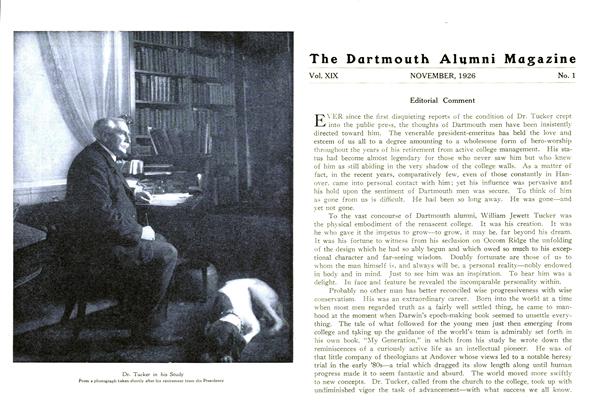
President-Emeritus William Jewett Tucker died at his home in Hanover September 29, 1926, after an illness of long duration. Other departments of the MAGAZINE will pay fitting tribute to his great service to the College and to his generation, and we will not try to give here more than the outline facts of his life.
He was born in Griswold, Conn., July 13, 1839, the son of Henry and Sarah White (Lester) Tucker. His college preparation was obtained at Kimball Union Academy, Meriden, N. H. He was in college a member of Psi Upsilon, and was elected to Phi Beta Kappa at graduation.
For six months after graduation he was principal of Gilford Academy at Laconia, N. H., and then for a year and a half of the high school at Columbus, Ohio. In the fall of 1863 he entered Andover Theological Seminary, where he graduated in 1866, having in the interim served for a time in the Christian Commission with the Army of the Cumberland. From 1867 to 1875 he was pastor of the Franklin St. Congregational church of Manchester, N. H., and then until 1879 of the Madison Square Presbyterian church of New York city.
In 1879 he became professor of sacred rhetoric in Andover Seminary, being also one of the editors of the Andover Review and founder of Andover House, a social settlement in Boston later known as the South End House. From Andover he was called in 1893 to become president of Dartmouth College. From the presidency he retired in 1909, owing to the serious impairment of his health, and he has since resided in Hanover. The last of many books issuing from his pen was "My Generation," of autobiographical nature, published in 1920. Much other literary work, including several courses of lectures, has been a part of his career. He was made a Doctor of Divinity by Dartmouth in 1875, and later by the University of Vermont. The degree of Doctor of Laws was first conferred upon him by Williams in 1893, and afterwards by Yale, Wesleyan, Columbia, and Dartmouth.
Dr. Tucker was married June 22, 1870, to Charlotte H., daughter of John Rogers of Plymouth, N. H., who died September 15, 1882. A second marriage, June 23, 1887, was to Charlotte B. Cheever, who survives him. There are three daughters, Mrs. Frank H. Dixon of Princeton, N. J., Mrs. Nelson P. Brown of Everett, Mass., and Mrs. Frank M. Cushwa of Exeter, N. H.
CLASS OF 1863
Martin Vanßuren Perley died at his home in Danvers, Mass., September 3, 1926.
He was born in Ipswich, Mass., November 26, 1835, son of Silas and Elizabeth (Perley) Perley. His father was a prosperous farmer, and a highly esteemed citizen of that town. His early life was spent on the farm, attending the district school in winter and having the alternating experience of shoemaker and butcher up to his twentieth year. Then he began to think of taking the college course at Dartmouth, and commenced the preparatory course at Topsfield Academy; he kept at it, and completed enough study to gain admission to Dartmouth in the fall of 1859. During these winters he taught in town schools, and accumulated funds enough to see his way clear at Hanover. During his four years he spent the winters teaching schools, as most of the other students did; the curriculum was so arranged then for students to earn money to pay college expenses.
Mr. Perley was quiet, courteous, and temperate in his ways of living; he enjoyed witnessing the sports of his time, but was not an enthusiastic participant in the ball games. He attended strictly to his studies, and usually had good recitations, but did not attain the Phi Beta Kappa rank. He was a Delta Kappa Epsilon, a Social Friend, a "Theolog," a theological trustee, and was elected class poet, but, retaining the honor, he declined the service. In 1883 he received the degree of Master of Arts.
Mr. Perley was very versatile in his abilities, well balanced in his discernment of what to do and how to do it, and indomitable in energy of body and mind. In the fall following graduation he became headmaster of the grammar school at Brownington, Vt., and served one year. He then became principal of Danville, Que., Academy, and served two years with marked success. He found this work too wearing on his bodily powers, while very enjoyable mentally, so decided to engage in the mercantile business, and located at Gloucester, Mass., opening a dry and fancy goods store, and continuing in the business eight years. He was prosperous and sagacious, and then decided to try his hand in newspaper work, and was editor and publisher of the Gloucester Telegram. He made it a good, suitable, and highly entertaining paper; he developed a talent he did not suspect he had, and it served him well later in life. He enjoyed the work, but decided to engage in something more lucrative.
In 1876 he became manager of the advertising department of the Fiske Manufacturing Company of Springfield, Mass., and was engaged, successfully for himself and the company, six years. In the proper months of each year he conducted this business in all the New England states. His outfit consisted of a handsome four-in-hand team of dapple grays and three men as assistants. It was a sight to be remembered when the team drove into a city and halted, and the men proceeded to business. Of course all the merchants gave them a cordial and profitable reception.
Mr. Perley had now reached the prime of life, and yet there were thirty years of tremendous activity of mind waiting for him. In 1883 he was principal of the Academic Institute, Topsfield, Mass.; next principal four years of Ipswich High School; editor of IpswichChronicle; correspondent of the Boston Globe; publisher of directories; publisher of Farmer's Almanac several years; editor and publisher of the Essex Register till the fall of 1898, when he assumed the management of "The Haven," Portsmouth, N. H., where he served the public till the fall of 1902, when his health began to fail and the serious breakdown compelled him to sell out. It was while there he nearly completed the manuscript for his book, "History and Genealogy of the Perley Family." When he had recovered his health sufficiently, with the assistance of his daughter, Miss Edith F. Perley, he resumed the work of putting the copy in order for the printer. The book was published in 1906. It was during the preceding thirty years that he collected the material in the midst of other work. It is a large, valuable, and well edited work. He left an uncompleted work, "History of Linebrook Parish, Ipswich, Mass." Mr. Perley possessed a large and finely selected library, in which room he had done an immense amount of literary work. As the years rolled on toward ninety, his legs failed him, but his mind remained clear and active to the very day he crossed the Great Divide and began the life beyond.
Mr. Perley was twice married: March 6, 1860, to Lydia Maria, daughter of Isaac and Sally (Martin) Pearson of Albany, Vt., who was born October 19, 1838, and died June 12, 1880; May 3, 1881, to Laura Elizabeth, daughter of John and Eleanor Pearson of Albany, Vt., who was born December 20, 1841, and died August 17, 1926.
His children were seven in number, all by the first wife: Eugene Horace, for the last forty years on the staff of the Boston Globe; Warren Healey, in the employ of the American Rapid Telegraph Company in New York until his death in 1884; Carrie Elizabeth, born 1864, died 1868; Edwin Goethe, born 1866, died 1872; Van Herbert, a linotype compositor with the Boston Globe until his death in 1896; Edith Florence, a teacher in the Salem High School; Lotta Ella, who married John A. Perkins and is the mother of John Perley Perkins, a sophomore in Dartmouth College. JOHN SCALES, Secretary.
CLASS OF 1865
Isaac Long Heath died August 9, 1926, at his home in Manchester, N. H. He had been in failing health for a year, but the final illness was of but a week's duration.
He was born in Bow, N. H., August 22, 1840, the son of Carlton and Sarah K. (Long) Heath, and prepared for college at Pembroke Academy. He took a high rank in scholarship in college, and was elected to Phi Beta Kappa.
After graduation he taught for seven years in the public schools of Manchester, first in the intermediate school on Manchester St., and from 1866 to 1872 as principal of the South (now Franklin) Grammar School. Meanwhile he had been studying law, and continued his studies in the office of Briggs and Huse, being admitted to the bar in 1873. He began practice in Manchester, and remained there in diligent and successful practice until near the close of his long life.
In 1876 he served as a member of the school committee of the city. In 1877-78 he was county treasurer. In 1880 he was appointed associate justice of the police court of the city, and continued until May, 1895, when he became justice. This position he held until 1910, when he was retired under the age limit. He was an influential member of the lower house of the state legislature in 1881, 1889, and 1891. When the police commission of Manchester was organized, December 1, 1893, he was appointed one.of its three members and became its chairman, serving until his appointment as municipal judge in 1895. He was one of the leaders of the Republican party in the city, and for five years chairman of the city committee.
Judge Heath was a member and past officer of all the local Masonic bodies, and the funeral service was in charge of the Knights Templar. He was never married, and leaves no relative nearer than cousin.
The following tribute is taken from the address of the officiating clergyman at the funeral service: "Although Judge Heath never so far as I know was a member of any of our churches, he was none the less in spirit a true son of the Puritans. He had the essential Puritan spirit, a certain austerity, a devotion to work, a conception of work as duty, as service, as something owed to the community and to God, a certain detachment from the world, and a pleasure in burden-bearing."
Edwin Blaisdell Hale died August 30, 1926, at his home in Cambridge, Mass., after an illness of three months.
The son of Aaron and Mary (Kent) Hale, he was born in Orford, N. H., June 16, 1839, and prepared for college at Kimball Union Academy. He was a member of Kappa Kappa Kappa and Phi Beta Kappa.
After graduation he became principal of the Lawrence School in Boston, and was then principal of the high school of Newton, Mass. From 1868 to 1873 he was superintendent of schools at Cambridge, and was the first to occupy that position. For the next two years he studied at Harvard Law School, where he graduated in 1875. He began practice at once in Boston, being first in the office of James B. Richardson '57. Later he formed the firm of Hale and Dickerman, of which he was senior member until the time of his death.
In 1878 and 1879 he was a member of the state House of Representatives. He was a member of the Boston Bar Association and the Middlesex Bar Association, of the Cambridge Club, the Colonial Club, the Oakley Country Club, the Tarleton Club of Pike, N. H., and the Masonic order. He was never married, and leaves as his nearest relatives nine nieces and a nephew.
The following is an editorial tribute from a Boston paper: "Edwin B. Hale brought the courteous customs of a former generation into the bustle of the present day. The law, to which he devoted half a century of his life, was for him a means for obtaining justice for his clients rather than a contest in which shrewdness took the place of intelligence. He was public-spirited to a high degree, serving in the legislature and performing other civic duties conscientiously. He was a gentleman of the old school, and those who were privileged to share his friendship will mourn his loss."
Among the bequests in Mr. Hale's will is one of $7500 to Dartmouth College to establish a scholarship, and one of $1000 to the Dartmouth Educational Association.
CLASS OF 1866
It becomes our sad duty to announce the death of our classmate, Dr. George H. Pillsbury, at Lowell, Mass., September 15, 1926. The cause of his death was a shock resulting from an automobile accident.
Pillsbury was one of the most distinguished men of the class. Heredity helped him to make his life's work a very marked success. His grandfather and his father were graduates of Dartmouth, and when he did enter upon his life work it was in the footsteps of his father.
But he did not attempt to live upon the name and deeds of his forbears, but carved for himself in a notable manner a name which will live for years in his native city of Lowell.
Your Secretary happened by a mere chance to be "listening in" to the celebrating of Lowell's birthday. The presiding officer was lauding in an unwonted manner some distinguished citizen, extolling his virtues and the noble things he had done for his native city. You may judge of our surprise and the pleasure we experienced when he said, "This man is Dr. George Pillsbury. If he is present, will he please rise."
This incident indicates the place our classmate filled as a citizen. He was thoroughly grounded for his life work as a physician. The spirit was born with him. Then he began his professional preparation while in college, and he continued later at Harvard and abroad.
In a communication to be placed in the class records at our fiftieth reunion the Doctor said:—"June 5, 1872, I married Mary Augusta Boyden of Lowell, the magnum opus of my life." This union was blessed by four children: Boyden, who graduated from Dartmouth in 1895; George, from West Point at the head of his class in 1900; Henry, from Dartmouth in 1902; and Mary, from Vassar in 1910.
Pillsbury was with us when six of the class met with Judge Hunt in Manchester the last of June to celebrate the sixtieth anniversary of our graduation. Mrs. Pillsbury was with him. The Doctor was just as bright, witty, and cheerful as he ever was. We were glad he was there. It was good to see him.
In the communication spoken of above the Doctor further said:—"Blessed I certainly have been in my wife, my children, and my reputation in the community in which I have passed all my life. I await the final graduation with equanimity.'"
HENRY WHITTEMORE, Secretary.
CLASS OF 1867
William Hood died in a hospital in San Francisco, Cal., August 26, 1926. He had been in the hospital nine days and was apparently recovering from an operation, when he was suddenly taken with a pulmonary embolism, and died in a few minutes.
He was born in Concord, N. H., February 4, 1846, the son of Joseph Edward (Dartmouth 1841) and Maria (Savage) Hood. His home when in college was at Springfield, Mass, where his father was an editorial writer and part owner of the Republican. Before entering college he had served as a private in the 46th Massachusetts Volunteers. He took the course of the Chandler Scientific Department, and was a member of the Vitruvian fraternity (now Beta Theta Pi.) He left college during his senior year, but was given his diploma in 1883 and enrolled with the graduate members of the class.
Upon leaving college he went to California to enter upon engineering work, and obtained work as rodman on the Summit-Downer section of the Central Pacific Railroad, then under construction. He was made assistant engineer in 1868, and for two years was engaged in the construction of the Central Pacific to its connection with the Union Pacific at Promontory, Utah, thus helping to complete the first transcontinental railroad. He also helped to build the branches of the Central Pacific, northerly to Redding and southerly to Goshen, Cal. While he was assistant engineer with the Southern Pacific (1872-75) he designated and built the Tehachapi loop, a construction enabling the railroad to descend quickly from a rough mountain side to smoother ground by spirally curving in the descent and tunneling under the portion of the road already passed over. From 1875 to 1883 he was chief assistant engineer of the Southern Pacific, and participated in the construction of that road through the Mojave and Colorado deserts, and through Arizona and New Mexico to San Antonio, Texas. In June, 1883, he became chief assistant engineer of the Central Pacific and in August of that year chief engineer, and two years later chief engineer of the Southern Pacific Company, Pacific system, which leased and operated all Central and Southern Pacific lines west of El Paso, Texas, holding this position until June, 1900. During this period much important new construction was done, including a line from Redding, Cal., to Ashland, Oregon, completing the rail route from San Francisco to Portland, some features of which were the Sacramento River canyon and Mt. Shasta divide work, and the steep grades, tunnels, and curved switch-backs over the Siskiyou Mountains. In June, 1900, he was made chief engineer of the Southern Pacific Company, and held this office until his retirement in 1921. During this period the coast route, with some difficult tunnel work through Carriso gorge, was completed, and extensive reconstruction of the Central Pacific was accomplished, including the spectacular cut-off across Great Salt Lake. In 1881 Mr. Hood designed a form of easement curves, comprising a series of circular arcs of uniformly decreasing radius, capable of being laid out in the same way as ordinary railway curves, for use in mitigating the shock of fast trains in entering and leaving curves.
This summary of Mr. Hood's professional career perhaps renders it unnecessary to say that he was one of the most distinguished among the list of engineers in railroad construction in this country. In 1923 the College conferred upon him the honorary degree of Doctor of Science.
He was a member of the Jonathan, Bohemian, Pacific Union, Army Engineers, and Army and Navy Clubs, and of Lincoln Post, G.A.R. He was also a life member of the San Francisco Press Club.
Mr. Hood was three times married: August 13, 1873, to Annie A. Bolinger, who died in 1874; February 2, 1878, to Josephine Heator, who died in 1913; and September 13, 1913, to Mrs. Lucia Ottilia Getzler, who survives him. He left no living children.
CLASS OF 1873
Willis Austin Robbins, whose recent death is here chronicled, was born in Newark, Ohio, February 27, 1852. He was the son of Willis and Helen (Warner) Robbins, his father being a banker. He fitted for college at Newark High School, entered the class of 1873 in the classical course, and continued until his graduation. He took a high rank as a scholar, and was a member of Phi Beta Kappa, graduating fourth in the class, and on the Commencement program speaking on "Science as Ministering to Human Comfort." While not especially devoted to outdoor sport, he played an excellent part in baseball, and in the class nine was right fielder. He was a member of the Delta Kappa Epsilon fraternity.
After graduation he returned to Newark, Ohio, and began business life in the office of his father, the senior member of the banking house of Robbins, Wing, and Warner. There he filled the position of cashier. October 16, 1876, the Franklin Bank and his banking house were consolidated under the name of Robbins, Winegarner, Wing, and Company, W. A. Robbins becoming junior member of the firm. In 1895 the Franklin Bank became the Franklin National Bank, of which W. A. Robbins was elected president and H. D. Woodbridge, also of the class of 1873, was elected a member with him of the board of directors. In January, 1922, he resigned his position as president of the bank, but was made chairman of the board of directors. A year later he resigned that position and retired from business affairs altogether. For the first time since his graduation he returned to Hanover in the summer of 1923 to attend the 50th year reunion of his class, and was deeply interested in the remarkable growth and development of his Alma Mater. His sister, Miss Mary Robbins, accompanied him at that time.
He was always interested in financial matters, of which he had become a thoughtful student. In February, 1924, he wrote a letter to Secretary of the Treasury Mellon, suggesting that as there seemed to be little, if any, opposition in Congress to the proposed reduction of the tax on incomes for 1923, it could be passed without delay if it were made a separate bill. Acting on the suggestion from the Treasury Department, a separate tax bill was passed, reducing the tax on incomes for 1923 twenty-five per cent. In his own quiet manner, Mr. Robbins thus continued to be, even in his nominal retirement, an influence on economic and other business matters.
His death was entirely unexpected. A letter written to his class secretary, October 25, 1925, speaks of a recent attack of intestinal indigestion, but adds that he was much better, although not up to his usual weight. Still later, July 17, 1926, he wrote, enclosing a photograph of the home, "where," he says, "I have lived all my days and ' where I expect to end my life. I am in excellent health, and expect to remain so for some time to come." Indeed, he had been in his usual health until a few days before his death. About 6 o'clock on the afternoon of August 25, he was taken very suddenly ill, and was removed to the Newark Sanitarium, where it was found that he was suffering from intestinal obstruction. His condition became quickly so serious that an operation was deemed inadvisable, and he died a few hours later in the same day.
The burial was in Cedar Hill Cemetery. Surviving him are several nieces and nephews, and one sister, Miss Mary S. Robbins, who had been his close companion and home-keeper for many years. He was never married. He was a member of the Protestant Episcopal church, having become a communicant in recent years. Mr. Robbins was quiet, scholarly, somewhat reserved in manner, but when once acquainted, a most charming comrade. He was very fond of his dog, and once wrote the secretary that he expected that they would be together in the great after-life.
S. W. ADRIANCE, Secretary.
CLASS OF 1878
Huntington Smith, known in college days as William Huntington Smith, died in Belmont, Mass., July 22, 1926, after an illness of several years, in the latter part of which he was afflicted with painful mental depression.
Mr. Smith-was born in Hudson, N. Y., December 4, 1857, son of Rev. William Boone and Mary (Edgecombe) Smith. His home when in college was at Fisherville, now Penacook, N. H., and he prepared for college at Penacook Academy, and entered and graduated from what was then known as the Chandler Scientific Department of the College. During senior year he was on the editorial staff of The Dartmouth, and perhaps influenced by this early experience he became the only member of the class to devote his life primarily to journalism and literature.
Soon after graduation he became first a reporter, then assistant editor, and finally literary editor of the Boston Traveler, maintaining at the same time connection with the LiteraryWorld in charge of its French department. His facility in French led to his rendering of French works into English.
His first translation was Ribot's "Diseases of Memory" (1882), followed by several of Tolstoy's works, "My Religion" (1885, the first translation into English), "Napoleon and the Russian Campaign," "Power and Liberty," and Victor Hugo's "History of a Crime," and some others.
He also issued a volume under title "A Century of American Literature."
After leaving the Traveler he spent some time in independent literary work, and then became associate editor and subsequently editor and publisher of The Boston Beacon, a weekly paper of the intellectual type. Disposing of this paper in 1903, he devoted a few years to special writing and travel. He had married in 1884 Miss Anna Harris of Dorchester, who survives him. They have no children.
Mrs. Smith collaborated with him in much of his newspaper work. In 1899 she established in Boston the Animal Rescue League, a humane institution which proved to meet a rapidly increasing demand. By 1909 this establishment had grown to such proportions that Mr. Smith devoted his time mainly to its management and development, and continued to do so until his health, which had always been less than robust, broke completely down.
The following excerpts from an editorial in the Boston Transcript indicate the esteem in which he was held in the newspaper world: "The death of Huntington Smith of Boston removes one of the most cultivated of the oldtime Boston editors, a writer of elegance and force and a translator of high merit. "Mr. Smith was one of the best known of the literary figures of Boston, a man who combined in himself the influence of the mentor, the grace of the writer, and the charm of the competent critic. It is, however, in connection with his services to the Animal Rescue League that the name of Mr. Smith, with that of his devoted wife, will be remembered indefinitely, and attain permanence in the affections of animal lovers, wherever found, that journalistic distinction rarely brings.
"In the invention of the electric cage for the painless disposal of animals, including horses. Mr. Smith made a permanent contribution to the cause of animal relief which has now become standard, and has been adopted by humane societies all over the country, as the Animal Rescue League, as conducted by Mr. and Mrs. Smith, stands as a model for all institutions of the kind."
Mr. Smith was not a member of fraternal organizations, and indeed was not an organization man in any sense. He preferred the role of free lance in politics as in literature. But he was loyal to friends and to class and college. His religious views were possibly summed up in the following response to an inquiry: "My present outlook on life is pessimistic as to immediate conditions, but I never have quite given up an inherited belief in an overruling Deity. I am rather taken with the suggestion that the Supreme Intelligence is working out the universe with the method of 'trial and error' that we little weak humans make use of in our own attempts at progress. From this point of view man himself is only an experiment—a pretty poor one thus far—but I do not suppose that the experiment has gone far enough yet to convince the Experimenter that it is really not worth while. Perhaps it is worth while. At any rate it may lead to something better; and if our lives help in the smallest degree to that, we cannot say that we live in vain."
WILLIAM D. PARKINSON, Secretary.
CLASS OF 1880
William Pierce Johnson died at the American Hospital, Paris, France, August 24, 1926. He was born in Lynn, Mass., July 28, 1859.
For the first year after graduation he studied at the Massachusetts Institute of Technology. Shortly after, considerations of health took him to Californ:a, and he entered into paper manufacturing, with which he was ever after connected, at the plants of the California Paper Company in Stockton and San Francisco, owned by his uncles, Henry and William Pierce. For a time he was a member of the firm of W. T. Bowers and Company, manufacturers of rubber goods, in San Francisco. Later he joined his cousin, Orestes Pierce, in forming the Willamette Pulp and Paper Company, for the manufacture of news print from wood pulp, their mill being located at Oregon City, Ore., and was also general manager of the California Paper Company. In 1914 the Willamette Company was absorbed with others by the Crown-Willamette Paper Company, of which Mr. Johnson became president. Three years ago he resigned the presidency and became chairman of the board of directors. He was also a director of the Bank of California and owner of controlling stock in the Pioneer Rubber Company.
Mr. Johnson was an ardent golfer, and a member of the San Francisco Golf and Country Club, the Lakeside Golf Club, the Sequoia Country Club, and the Claremont Country Qub. He was also a member of the Bohemian Club and the Pacific Union Club and of Psi Upsilon.
He was married in 1885 to Florence Lindsay, who survives him, with a daughter, Mrs. Maximilian Milton of Oakland, and seven grandchildren. An older daughter, Mrs. George Towne, died a year ago.
CLASS OF 1886
Josiah Ide died at Tucson, Arizona, September 1, 1926, of cerebral hemorrhage, after a brief illness.
He was born in Croydon, N. H., September 25, 1862. He was a member in college of the Kappa Kappa Kappa fraternity.
After graduation he went to Malone, N. Y., and there read law. He was admitted to the bar of that state November 23, 1888, began practice at Malone, and continued there until 1901, being in partnership with his classmate William P. Badger. At the last date he removed to Arizona, and had been in active practice in Tucson ever since.
February 22, 1887, he was married to Lucy E. Badger of Malone, sister of the classmate mentioned above, who died before his removal to Arizona. About ten years ago he married Caroline Riviera of Tucson, who survives him. There were no children by either marriage.
CLASS OF 1894
Alfred Bartlett died in a hospital in Boston, August 2, 1926, after a short illness.
He was born in Eliot, Me., June 15, 1870, his parents being James W. and Caroline (Goodwin) Bartlett, and fitted for college at Berwick Academy.
For a short time after graduation he taught in his native town, but soon became connected ivith the book trade in Boston. Shortly before Christmas in 1899, while clerking in Clarke's book-shop, he was asked by a customer for a copy of William Henry Channing's "My Symphony." Being of a publishing mind, he had struck off in attractive form a few hundred copies of the "Symphony," and this became the forerunner of the better type of greeting cards, which became his specialty. In May, 1900, he opened an office on Cornhill, and began the publication of a monthly magazine of reprints which he called "The Cornhill Booklet." This was edited by his classmate Edwin Osgood Grover, and consisted of reprints of forgotten masterpieces. In each issue there appeared an inspirational motto, beautifully hand-lettered or set in type by a master printer. These mottoes were so well liked that Mr. Bartlett began to publish them separately under the name of the "The Cornhill Dodgers." During the next ten years a million of these were sold, and they were highly prized not only for their literary value but for the beauty of their typographical setting. Mr. Bartlett was probably the first to take the greeting card out of the cheap and tawdry condition into which it had fallen, and to give it a worthy place in the publishing field.
In 1900 and 1901 he published an American edition of "The Page" for the artist Gordon Craig, and about the same time issued several calendars which attracted wide attention. He was at one time a member of the Society of Printers and the Society of Arts and Crafts. In the last named organization he was rated as a master craftsman. His place of business was first on Cornhill and later on Boylston St., but had been recently removed to Franklin St.
The death of Alfred Bartlett makes the sixth of the class known to be deceased. Of the eighty-six who received diplomas, eighty are believed to survive, a low necrology which Philip Marden aptly calls a "miracle of mercies." Alfred was less intimately known to his classmates than many. He was by nature reticent almost to the extent of being secretive. To this was added a retiring disposition, with a love for scholarship along his favorite lines. With these tendencies to reserve and self-effacement and his innate shyness increased by the handicap, which in itself was a great obstacle, Alfred's nature thrived best in a small group of well chosen friends. There was not enough of the desire or prompting to mingle generally and promiscuously to make him popular in the strict sense of that word. He might say a prayer for all sorts and conditions of men, but he did not try to get acquainted with them. Athletics were out of consideration for him. His scholastic choices were largely outside of the course of study, except as to English. So he did not become a classroom star or a campus hero. He was kindly, courteously frank, but not aggressively outspoken. Incapable of duplicity, his great capacity for friendship grew upon those who knew him, especially in the post-graduate years. A loyal classmate and a true friend, his life was a heroic example of patience, courage, and achievement under limitation. None saw with clearer vision the things he knew were beyond his reach; for in his heart of hearts he heard the fateful words in Deuteronomy, "I have caused thee to see it with thine eyes, but thou shalt not go over thither."
CLASS OF 1897
Lewis Harvey Blanchard died at his home in Omaha, Neb., September 3, 1926, of apoplexy, being ill only one day.
The son of John Cameron and Abby Staples (McClary) Blanchard, he was born in Peacham, Vt., October 27, 1873, and obtained his college preparation at Peacham Academy. Philip S. Blanchard '04 is a brother. He was a member of Phi Delta Theta.
He first studied law, and graduated from Chicago Law School, but for a long time had been Western representative of the Universal Battery Company of Chicago, living in Omaha for the past eleven years.
He was married April 10, 1907, to Alice, daughter of George D. Holton (Dartmouth 1873) of Chicago, who survives him, with two children, Dorothy, aged fifteen years, and Lewis Harvey, Jr., aged seven.
Says the Secretary of his class: "The class will learn with profound sorrow of the death of 'Peacham' Blanchard. By his death the class loses an embodiment of friendliness and loyalty. No loss of a classmate can be more vitally personal to the members of the class than that of Lewis H. Blanchard. Pat Conway, McCornack, and Burpee Taylor represented the class at the funeral."
Dr. Earl Percy Cushman, a member of the class during the first two years of the course, died at his home in Claremont, N. H., February 23, 1926, from gastric ulcers resulting from injuries received in the World War.
The son of Charles B. and Kate (Lee) Cushman, he was born in Tunbridge, Vt., July 17, 1873.
He began the study of medicine at Dartmouth and completed it at the University of Vermont, where he graduated as M.D. in 1900. He established himself at once at Claremont, and enjoyed a wide practice in medicine and sprgery until the latter part of 1917, when he enlisted for military service. Early in 1918 he went across with the rank of captain in the Medical Corps, and saw active service in a hospital train at the front line trenches, and in July of that year he was struck in the abdomen by a piece of shell. After treatment at a Paris hospital and at government hospitals here he was discharged in 1919, and returned to Claremont, but was unable to continue in active practice on account of his physical condition. He was appointed examiner in the United States Veteran Bureau, but after three years his illness forced him to retire, and since that time he had been a constant sufferer.
October 5, 1915, Dr. Cushman was married to Annie Hodge, who survives him. They had no children. The burial was in his native town.
CLASS OF 1905
In the death of Eliott Park Frost at the Cottage Hospital in Nantucket, Mass., on September 3, 1926, the class of 1905 has lost one of its younger and most intellectual members. His early passing was most unexpected, and was due to a combination of pneumonia and heart trouble following a very minor operation.
He was the son of George B. and Amelia Adelaide Frost, both of whom were ordained Congregational ministers. Born in Oxford, Mass., near Worcester, on January 9, 1884, he prepared for college at Worcester Academy and entered Dartmouth in 1901 before he was 18. In college he early demonstrated a keen intellect, sturdy character, and restless search for knowledge, devoting much of his time to the study of psychology, which attracted his special interest under the teaching of Prof. Herman H. Home. College dramatics were his chief interest outside of his studies.
After graduation Frost devoted four years to post-graduate study. The first year was at Dartmouth, where he earned his Master's degree. Then followed two years at Harvard, upon completion of which he received the degree of Ph.D. During 1908-09 he studied at the University of Berlin as a Harvard fellow.
Except for two or three years after the war, Frost devoted his winters to college teaching in psychology, philosophy, and education. In this field he attained high distinction. His career included a year at Princeton, three years at Yale, five years at the University of Tennessee, and four years at the University of Rochester, New York, where he was professor of psychology and education and director of the extension division and summer school.
His summer months were never wasted, for he took employment of varied kinds—housebuilding, interior decorating, fox-farming, and magazine writing, some of his writings having appeared in the Atlantic Monthly.
While at Knoxville, Tenn., he exhibited an alert interest in affairs outside the classroom, and in the course of his efforts to give athletics better standards and closer regulation in the state universities of the South, he became chairman of the Athletic Council of the University of Tennessee, chairman of the Athletic Conference of the Southern State Universities, and vice-president of the Southern Athletic Council. This work in athletics and his reputation as a psychologist led him into army morale work for about a year at the close of the war. As captain in the R.O.T.C. he was eventually attached to the general staff at Washington as active organizer under General Munson of the Morale Branch, which was concerned with all the camps in the country.
Dr. Frost's liking for this administrative work led him to accept a position with the Rochester, N. Y., Chamber of Commerce as director of its newly formed Industrial Management Council. After two years in this work he returned to teaching, taking a chair in the University of Rochester. Here, too, his interests extended beyond the class room. He was chairman of the Non-Athletic Committee of the University and member of the Board of Control of Student Activities and impartial arbiter of the Hellenic Council. He was also president of the Social Welfare League of Rochester at the time of his death and a member of the Board of governors of Genesee Hospital. He was active, too, in the Tuberculosis Association of his adopted city. Professionally, he was a member of the American Psychological Association, and he belonged to the Rochester Country Club, the Genesee Valley Club, the Corner Club, and the Sigma Nu fraternity. During these last years he did much public speaking. His service in the life of the great city of Rochester was such that there was widespread grief at his sudden and unexpected death.
Eleven years after graduation Frost was married in Rochester to Miss Elizabeth Granger Hollister, daughter of Mr. and Mrs. George C. Hollister of that city, and niece of two of Rochester's most prominent citizens. Mrs. Frost and a nine-year-old son, Granger Hollister, survive him.
Probably no finer tribute to Dr. Frost's personal qualities could be presented tjhan the charming picture given in Mrs. Frost's brief letter for the class report of 1924, which reads as follows: "I met Eliott Frost in 1914 in the pages of the Atlantic Monthly. He taught me then something about the cultivation of nonchalance, and, since 1916, when I met him face to face, he has been giving me daily lessons in the joy of life, the delight of the unexpected, the psychology of the change, the challenge of the future, and the breathlessness of quick decisions. He expected my first decision less than a week from (he day we met, and I have been panting to keep up with him ever since. Apparently I am not the only one who enjoys his challenge. As young as any, he ,has directed youth in Yale, Princeton, the University of Tennessee, and the University of Rochester to delve in mysteries and to face facts. The lay world, also, seems to have some taste for his philosophy, at least if the number of speaking requests I try to protect him from are any criteria. Not the least of his devotees are his friends. When nights grow cold the blue chintzes are drawn across the frosty lattice, the great logs are set alight, and we gather about the wide stone hearth and enjoy the gentle art of conversation till far into the morning. When life is weary we come to him for strength, and when it is petty for largess, when it is somber for wit, and at all times for wisdom."
ROYAL PARKINSON
Harris Willard Fleming died suddenly of heart disease on the morning of September 15, 1926 at Hyannisport, Mass., where he had been spending the summer.
The son of James M. and Kittie R. Fleming, he was born in Ayer, Mass., on July 25, 1883. Moving at an early age to Natick, Mass., his preparatory school education was had in the public schools of Natick. Entering Dartmouth College in the fall of 1901, he graduated in 1905. He was a member of Phi Kappa Psi fraternity and Dragon senior society. He served as a member of the freshman cane committee, the Aegis board, and The Dartmouth board, and during senior year he was business manager of the Dartmouth Magazine.
Very shortly after graduation he entered the employ of Churchill and Alden, shoe manufacturers, in Brockton, Mass., and continued in this work and with this company until the January preceding his death. Commencing his work in the advertising department, he rose steadily, first to the position of advertising manager, then advertising and sales manager, until at the time of his resignation last January he was secretary of the company and one of its board of directors.
He married October 30, 1916, Priscilla Alden Folsom of Bridgewater, who together with two children, Faith and Craig, aged eight and two respectively, survive him. He also leaves his mother and a brother, Paul Fleming of Savannah, Ga.
From the time of his graduation Fleming was most keenly interested in business and mercantile affairs, and a deeply interested student of affairs in the industrial world. He was generally regarded as one of the leading younger business men of his city, and one whose judgment and counsel were most highly regarded and eagerly sought. He gave of his time and strength liberally,., probably as it now appears to the point of injury to his health, in the aid of the welfare organizations of Brockton. His help was given in both time and money in cases of individual need to an extent unsuspected by even his closest friends.
His character—his life—may perhaps be summed up in the three outstanding characteristics —keenness, helpfulness, and his unquestionably predominating characteristic, friendliness. Comparatively few are blessed with the friendly nature—the capacity of making and retaining friends—possessed by Fleming. Forgetful of himself almost to a fault, throughout his entire life he gave of his time, energy, and substance in the assistance of those less fortunate than himself.
In the words of President Farnum of the Churchill and Alden Company, "Always alert, energetic, and ambitious, he never forgot the other fellow should also have his opportunity, and he has left an indelible mark of helpfulness on all those with whom he came in contact."
The passing of Fleming is a grave loss to his city, his college, and his class. To his memory his classmates of 1905 now pay this grateful tribute.
HERFORD N. ELLIOTT.
CLASS OF 1907
Philip Tilton Knight, a member of this class during a part of the course, died at the Polyclinic Hospital, New York city, of pneumonia, July 21, 1926, after a short illness.
He was born in Lebanon, N. H., June 23, 1883, the son of Dr. Edwin Augustus and Mary C. (Whittier) Knight. His father was a nongraduate member of the class of 1863, and his grandfather, Dr. Luther M. Knight, graduated from the Medical School in 1835. His home when in college was in Newton, Mass., and he fitted at Newton High School.
After leaving college he studied art in Boston, at the Eric Pope Art School. Later he studied in Berlin and Paris, after which he lived in South America for four years. In 1918 he was commissioned an ensign in the navy, and was stationed in Boston. For three years from 1921 he was connected with the art department of the New York .Times, and then for two years until his death on the staff of the Sun. His mother survives him and a sister, Mrs. William T. Cobb, both living at 237 West 107th St., New York. He had never married. The burial was at Franklin, N. H., the old home of the Knight family.
Henry John Hatfield died at Bellevue Hospital in New York, September 6, 1926, after a lingering illness. He had been in poor health for the past year.
Hatfield was born in Boston June 24, 1880. He entered college with the class of 1907 but had previously attended Boston University. He remained in college only a year. He had engaged in newspaper work before entering Dartmouth, on the staff of the old Boston Traveler and then on the Boston American.
After leaving college, he entered the employ of the New York City News Association, afterward working on the New York Times, the Daily News and the New York American.
For several years he was in the United States Secret Service under Chief William J. Flynn, and did effective work in many big cases involving crimes against the federal government.
Hatfield was unmarried. His funeral services were held at Campbell's funeral church, New York city, and were conducted by the Knickerbocker Lodge of Masons, of which Hatfield was a member.
CLASS OF 1912
Roy Collier Laing, a member of this class through freshman year, died of pernicious anemia May 9, 1926, at the Methodist Hospital, Los Angeles, Cal. He had not been well for some time, and gave up work March 15. He was taken to the hospital five weeks before his death.
He was born in Albany, N. Y., February 8. 1891, his parents being John Collier and Effie (Cochran) Laing, and graduated in 1908 from Albany High School. He was a member of Delta Tau Delta.
After leaving college he went to work for the Western Electric Company, and continued with them for nine and a half years. He then took a position in Hillsdale, Mich., as purchasing agent for the Alamo Farm Light Company. He remained in Michigan for a year, and then removed to Los Angeles and again went to work for the Western Electric Company at their Los Angeles branch, remaining with them until his death.
He was a Mason, being a charter member and officer in the Mesa Lodge of Los Angeles. For three years prior to his death he was superintendent of the Sunday school of Pilgrim Congregational church and chairman of its board of trustees.
October 28, 1911, he was married in Minneapolis, Minn., to Edna Joan, daughter of Orral George and Elizabeth (Barnard) Blair, who survives him, with their daughter, Joan Elizabeth, born July 22, 1913. They are living at 6030 Sixth Ave., Los Angeles, where they will remain for the present. Besides his immediate family two sisters survive, Mrs. Helen Keator of Utica, N. Y., and Mrs. Lester Carter of San Francisco, and a brother, John A. Laing '05 of Portland, Oregon.
CLASS OF 1921
Carl Bache-Wiig, Jr., born at Eidsvold, Norway, November 18, 1897, came to the United States with his parents in 1903. He prepared for Dartmouth one year at the Portland, Me., High School, one year at Phillips Exeter Academy, and two years at Asheville, N. C., Preparatory School. At the last school he was a member of the football, soccer, and track teams, captaining the track team his senior year.
Carl entered Dartmouth in the fall of 1917, and immediately became a well known figure on the ski jump, in which he excelled during his entire college career. In 1920 he won the honor of being intercollegiate ski jumping champion. He became a member of the Phi Sigma Kappa fraternity, and was active in fraternity affairs while in college, as well as being on both the football and soccer squads his freshman year. He did not continue with football, as the coach advised him that he was too light, but he played on the first soccer team all the while he was in college.
In February, 1918, Carl left Dartmouth to join the navy during the World War. He served :with the Atlantic Fleet and the Armed Guard until February, 1919, when he returned to college. The following February he left college again, and after a nine months' cruise in the Mediterranean he went to work with his father and .brother, who are chemical engineers, as an assistant chemist for the Celotex Company of New Orleans.
In November, 1922, Carl entered the employ of the Wausau Sulphite Fibre Company of Mosinee, Wis., makers of Mosinee Kraft. With this firm he worked through all the different departments of the pulp and paper mills, until he was made purchasing agent, at which work he was occupied when a recurrence of an earlier attack of tuberculosis, probably stimulated by a streptococcus infection, forced him to go to a sanitarium at Stevens Point, Wis., in May, 1925. Carl was making a heroic fight, when appendicitis developed, and an operation had to be performed. His inability to recover caused other complications. Phlebitis developed in both legs, and he became weaker and weaker. As a last resort he was moved to Albuquerque, N. M., in an attempt to save his life. It was too late, however, and he died May 30, 1926. He was buried in Evergreen Cemetery, Portland, Me., on June 4.
Carl is survived by his mother, two sisters, Mrs. Theodore Pease of Springfield, Mass., and Miss Sarah Bache-Wiig, and a brother, John Bache-Wiig 'IS, of Edmonton, Alberta, and Portland, Me.
To those who knew "Blondy" intimately his death was the greatest shock of all, for they knew most clearly the great loss the class, the college, and his friends and family had sustained. Carl was a man with a very deep personality, with strong likes and dislikes, but with an abundance of loyalty. He was absolutely unselfish, but very reticent.
CLASS OF 1922
John Jacob Ackerman, a member of this class during the first part of the course, was killed in a motorcycle accident at Spartanburg, S. C., May 30, 1926.
The son of Jacob E. and Clara (Maire) Ackerman, he was born in Brookline, Mass., October 13, 1900, and obtained his preparatory training in the Brookline schools and at Worcester Academy.
-Since leaving college in 1920 he had been continuously connected with the Royal Manufacturing Company in the cotton waste business, with , headquarters at Spartanburg, and was their general manager in the South.
He was unmarried, and is survived by his mother, his sister, and his three brothers, to whom an expression of the sympathy of the class of 1922 was sent.
MEDICAL SCHOOL
CLASS OF 1879
Dr. George Seeley Thompson died of pneumonia July 16, 1926, at New Compston Park, Windham, N. Y., where he was spending his vacation.
Dr. Thompson was born in New York city in 1849, and spent his entire professional life in that city, attaining high rank as a specialist in gynecology. He retired from active practice 20 years ago, and had made his home in Brooklyn. In 1890-93 he was an instructor in his specialty in the Post-Graduate Medical School, and had also been connected with the Northwestern Dispensary.
He is survived by his wife, Mrs. Maria T. (Beecher) Thompson, a son, Dr. Percy B. Thompson, and two daughters.
HONORARY
William Power Wilson, who received the degree of Master of Arts in 1880, died at his home in Boston, August 29, 1926. He was born in Baltimore, Md., November IS, 1852, the son of James H. and Margaret McKim (Marriott) Wilson. He graduated from Harvard Law School in 1877, and had practiced his profession in Boston for many years.
President Charles William Eliot of Harvard had no very close connection with the Dartmouth fellowship, but his death, which occurred August 22, 1926, at Northeast Harbor, Me., should be noted here, because he was the recipient of the degree of Doctor of Laws in 1909.