Class of 1916
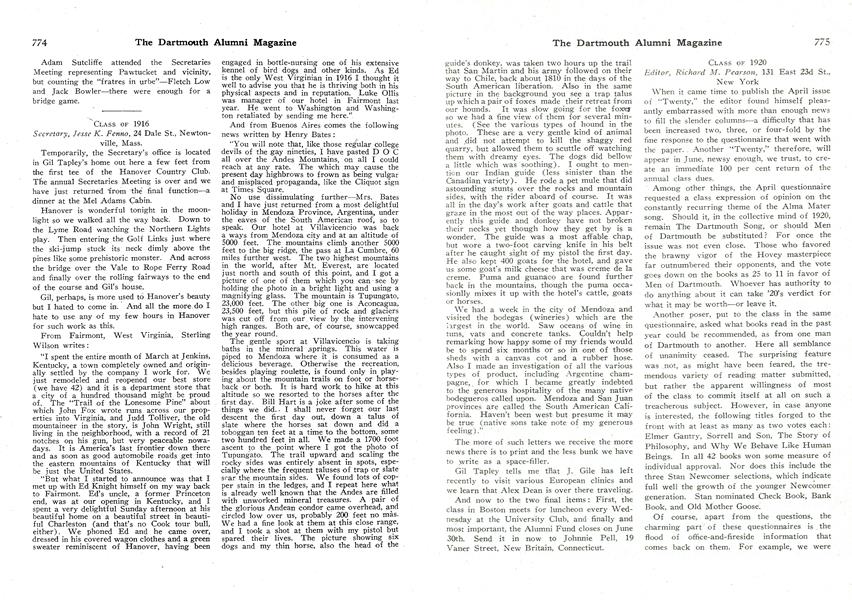
Temporarily, the Secretary's office is located in Gil Tapley's home out here a few feet from the first tee of the Hanover Country Club. The annual Secretaries Meeting is over and we have just returned "from the final function a dinner at the Mel Adams Cabin.
Hanover is wonderful tonight in the moonlight so we walked all the way back. Down to the Lyme Road watching the Northern Lights play. Then entering the Golf Links just where the ski-jump stuck its neck dimly above the pines like some prehistoric monster. And across the bridge over the Vale to Rope Ferry Road and finally over the rolling fairways to the end of the course and Gil's house.
Gil, perhaps, is more used to Hanover's beauty but I hated to come in. And all the more, do I hate to use any of my few hours in Hanover for such work as this.
From Fairmont, West Virginia, Sterling Wilson writes:
"I spent the entire month of March at Jenkins, Kentucky, a town completely owned and originally settled by the company I work for. We just remodeled and reopened our best store (we have 42) and it is a department store that a city of a hundred thousand mighty be proud of. The "Trail of the Lonesome Pine" about which John Fox wrote runs across our properties into Virginia, and Judd Tolliver, the old mountaineer in the story, is John Wright, still living in the neighborhood, with a record of 21 notches on his gun, but very peaceable nowa- days. It is America's last frontier down there and as soon as good automobile roads get into the eastern mountains of Kentucky that will be just the United States.
"But what I started to announce was that I met up with Ed Knight himself on my way back to Fairmont. Ed's uncle, a former Princeton end, was at our opening in Kentucky, and I spent a very delightful Sunday afternoon at his beautiful home on a beautiful street in beautiful Charleston (and that's no Cook tour bull, either). We phoned Ed and he came over, dressed in his covered wagon clothes and a green sweater reminiscent of Hanover, having been engaged in bottle-nursing one of his extensive kennel of bird dogs and other kinds. As Ed is the only West Virginian in 1916 I thought it well to advise you that he is thriving both in his physical aspects and in reputation. Luke Ollis was manager of our hotel in Fairmont last year. He went to Washington and Washington retaliated by sending me here."
And from Buenos Aires comes the followingnews written by Henry Bates :
"You will note that, like those regular college devils of the gay nineties, I have pasted DOC all over the Andes Mountains, on all I could reach at any rate. The which may cause the present day highbrows to frown as being vulgar and misplaced propaganda, like the Cliquot sign at Times Square.
No use dissimulating further—Mrs. Bates and I have just returned from a most delightful holiday in Mendoza Province, Argentina, under the eaves of the South American roof, so to speak. Our hotel at Villavicencio was back a ways from Mendoza city and at an altitude of 5000 feet. The mountains climb another 5000 feet to the big ridge, the pass at La Cumbre, 60 miles further west. The two highest mountains in the world, after Mt. Everest, are located Just north and south of this point, and I got a picture of one of them which you can see by holding the photo in a bright light and using a magnifying glass. The mountain is Tupungato, 23,000 feet. The other big one is Aconcagua, 23,500 feet, but this pile of rock and glaciers was cut off from our view by the intervening high ranges. Both are, of course, snowcapped the year round.
The gentle sport at Villavicencio is taking baths in the mineral .springs. This water is piped to Mendoza where it is consumed as a delicious beverage. Otherwise the recreation, besides playing roulette, is found only in playing about the mountain trails on foot or horseback or both. It is hard work to hike at this altitude so we resorted to the horses after the first day. Bill Hart is a joke after some of the things we did. - I shall never forget our last descent the first day out, down a talus of slate where the horses sat down and did a toboggan ten feet at a time to the bottom, some two hundred feet in all. We made a 1700 foot ascent to the point where I got the photo of Tupungato. The trail upward and scaling the rocky sides was entirely absent in spots, especially where the frequent taluses of trap or slate sear the mountain sides. We found lots of copper stain in the ledges, and I repeat here what is already well known that the Andes are filled with unworked mineral treasures. A pair of the glorious Andean condor came overhead, and circled low over us, probably 200 feet no mas. We had a fine look at them at this close range, and I took a shot at them with my pistol but spared their lives. The picture showing six dogs and my thin horse, also the head of the guide's donkey, was taken two hours up the trail that San Martin and his army followed on their way to Chile, back about 1810 in the days of the South American liberation. Also in the same picture in the background you see a trap talus up which a pair of foxes made their retreat from our hounds. It was slow going for the foxes so we had a fine view of them for several minutes. (See the various types of hound in the photo. These are a very gentle kind of animal and did not attempt to kill the shaggy red quarry, but allowed them to scuttle off watching them with dreamy eyes. The dogs did bellow a little which was soothing). I ought to mention our Indian guide (less sinister than the Canadian variety). He rode a pet mule that did astounding stunts over the rocks and mountain sides, with the rider aboard of course. It was all in the day's work after goats and cattle that graze in the most out of the way places. Apparently this guide and donkey have not broken their necks yet though how they get by is a wonder. The guide was a most affable chap, but wore a two-foot carving knife in his belt after he caught sight of my pistol the first day. He also kept 400 goats for the hotel, and gave us some goat's milk cheese that was creme de la creme. Puma and guanaco are found further back in the mountains, though the puma occasionlly mixes it up with the hotel's cattle, goats or horses.
We had a week in the city of Mendoza and visited the bodegas (wineries) which are the fargest in the world. Saw oceans of wine in tuns, vats and concrete tanks. Couldn't help remarking how happy some of my friends would be to spend six months or so in one of those sheds with a canvas cot and a rubber hose. Also I made an investigation of all the various types of product, including Argentine champagne, for which I became greatly indebted to the generous hospitality of the many native bodegueros called upon. Mendoza and San Juan provinces are called the South American California. Haven't been west but presume it may be true (native sons take note of my generous feeling)."
The more of such letters we receive the more news there is to print and the less bunk we have to write as a space-filler.
Gil Tapley tells me that J. Gile has left recently to visit various European clinics and we learn that Alex Dean is over there traveling.
And now to the two final items: First, the class in Boston meets for luncheon every Wednesday at the University Club, and finally and most important, the Alumni Fund closes on June 30th. Send it in now to Johnnie Pell, 19 Vaner Street, New Britain, Connecticut.
Secretary, St., Newtonville, Mass.
More From This Issue
-
 Article
THE UNDERGRADUATE CHAIR
June 1927 -
 Article
WHAT THE COLLEGE MAN EXPECTS IN BUSINESS
June 1927 -
 Article
ATHLETIC COUNCIL REPLIES TO PRESIDENT HOPKINS
June 1927 -
 Article
SECRETARIES ASSOCIATION MEETS IN HANOVER
June 1927 -
 Article
DARTMOUTH CAVALRY IN THE CIVIL WAR
June 1927 -
 Article
CAN CHINA SURVIVE
June 1927