DINNER SESSION
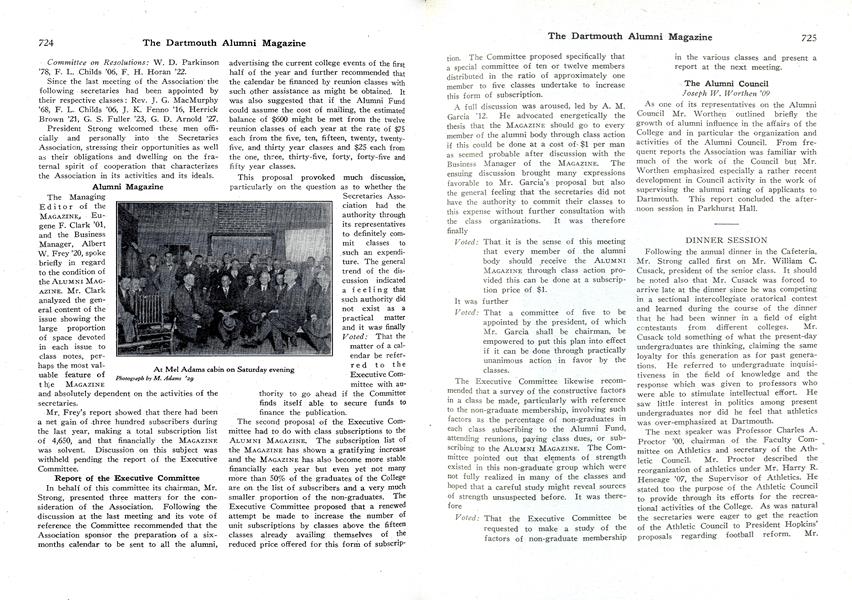
Following the annual dinner in the Cafeteria, Mr. Strong called first on Mr. William C. Cusack, president of the senior class. It should be noted also that Mr. Cusack was forced to arrive late at the dinner since he was competing in a sectional intercollegiate oratorical contest and learned during the course of the dinner that he had been winner in a field of eight contestants from different colleges. Mr. Cusack told something of what the present-day undergraduates are thinking, claiming the same loyalty for this generation as for past generations. He referred to undergraduate inquisitiveness in the field of knowledge and the response which was given to professors who were able to stimulate intellectual effort. He saw little interest in politics among present undergraduates nor did he feel that athletics was over-emphasized at Dartmouth.
The next speaker was Professor Charles A. Proctor '00, chairman of the Faculty Committee on Athletics and secretary of the Athletic Council. Mr. Proctor described the reorganization of athletics under Mr. Harry R. Heneage '07, the Supervisor of Athletics. He stated too the purpose of the Athletic Council to provide through its efforts for the recreational activities of the College. As was natural the secretaries were eager to get the reaction of the Athletic Council to President Hopkins' proposals regarding football reform. Mr. Proctor stated that careful consideration had been and was being given to the proposals and that all on the Council agreed that there was some justification for the charge of overemphasis. So far as Dartmouth was concerned, it was felt that football while undoubtedly causing interference with scholastic work was a smaller factor of disturbance than some other causes, but the Council would like to see some of the proposals made by the President given a trial provided cooperation could be obtained with other colleges. It was felt that advantage might be gained by home and home games but the proposal to use undergraduates as coaches did not find favor. It was felt, however, that all coaching should be dene by resident all-year coaches who were also members of the Depart ment of Physical Education. Mr. Proctor concluded his talk with an effective plea for good feeling among institutions with which we have athletic association's.
The last speaker of the evening was President Hopkins who has always brought new light and inspiration to the secretaries. Referring briefly to his proposals regarding football he claimed no special importance for the particular suggestions made but stated that the reception of the proposals in many quarters had shown how necessary was a thorough reappraisal of values.
The President also referred to the operation of the Selective Process stating that men about whom there is doubt seldom apply now since they know there is no chance for admission. This improves the average quality of applicants, not only making the selection more difficult but also reducing the number that drop out each year through scholastic failures. This again reduces the shrinkage of classes in college and allows a smaller number to be selected than formerly since no change will be made in the limit of two thousand at which the undergraduate body must be kept. Although Dartmouth has been under attack in the press for irreligiousness, probably owing to a recent inadequate questionnaire on the subject, the President stated that in his opinion there was definitely more religious interest than ever before, although less of creed or form. Since history shows that conditions in the world have always been improved by enlightened educated opinion the colleges must furnish an aristocracy of conscience as well as an aristocracy of brains.
The main part of the President's talk had to do with a discussion of the fields of education and scholarship. The function of the liberal arts college is to educate yet it must draw its teachers from the graduate schools whose function is to produce scholars. The President disclaimed any thought of reflection on the aims or ideals of the graduate schools which were necessary to produce education but outlined the difficulties which members of the faculty, fresh from graduate schools, frequently had in grasping the ideals for which such a college as Dartmouth stands in the field of education. The college cannot make real scholars and can only give scholarly appreciation of the real values of life. Then the university must satisfy this desire and appreciation.
The greatest need of the country is a citizenry adequate to meet the great wave of intolerance now evident throughout the world. The college that is trying" to give education must have a feeling of tolerance toward other points of view and must endeavor to train its men in this spirit and in the ability to think straight.
The Secretaries attend Chapel Saturday morning
More From This Issue
-
 Article
THE UNDERGRADUATE CHAIR
June 1927 -
 Article
WHAT THE COLLEGE MAN EXPECTS IN BUSINESS
June 1927 -
 Article
ATHLETIC COUNCIL REPLIES TO PRESIDENT HOPKINS
June 1927 -
 Article
SECRETARIES ASSOCIATION MEETS IN HANOVER
June 1927 -
 Article
DARTMOUTH CAVALRY IN THE CIVIL WAR
June 1927 -
 Article
CAN CHINA SURVIVE
June 1927