CLASS OF 1905
Parkinson sends a clipping about Jim Donnelly, and also a welcome letter from which we extract the following:
"Your notice of the death of Alex Pelletier recalls a visit I had with him in Montreal ten years ago. I believe he was in Parliament then, or was planning to run. He was very proud of his wife, whom he referred to as a lady of culture and ability, active in literary and club or musical circles and a public speaker of note in both English and French. I didn't meet his wife, but was impressed by his own regard for her. He seemed delighted to receive that little visit, and recalled Dartmouth incidents with a great deal of affection.
"There were only half a dozen of the class out for the Boston alumni dinner, but it was good to see them.
"I spent a couple of days in New York recently interviewing applicants for one of our executive positions, and intended to call up some of the class. But time limits and duty prevented. So I really have no news for you. Sibley is still here keeping a close watch on me."
On March 26 Joe Gilman was elected president of the Boston Madison Square Garden, succeeding Major P. F. O'Keefe, resigned. We clip the following from the several press notices sent in by loyal and proud Boston '05ers:
"In announcing the election of Gilman to succeed Major O'Keefe, the board of directors of the Garden said that 'since January 1 more than 400,000 people have attended events in the Garden, including boxing, hockey, wrestling, dog show, amateur boxing—a remarkable result in view of current business conditions. We are confident that Mr. Gilman will bring to his new office the ability to develop interest in Garden events comparable with the results that he attained at Dartmouth College and in his relations with several of Boston's best known business institutions.'
"A native New Englander, 'Joe' Gilman went from the public schools of Exeter, N. H., to Phillips Exeter Academy, where he made a name for himself on the academy baseball and football teams. At Dartmouth he played as guard on the elevens of 1902-03-04, graduating with the class of 1905. He was a member of the Dartmouth eleven which in 1903 christened the Harvard Stadium with the famous 11 to 0 victory over the Crimson. Subsequently he played in semi-professional baseball and in the minor leagues, coaching football at Dartmouth in 1905 and 1907.
"As chairman of the athletic committee at Dartmouth, Gilman directed a rearrangement of Dartmouth schedules and coaching policies which was the basis of the system under which Dartmouth has attained high rank among the college athletic teams of the country. He established the rivalry in football with Cornell, renewed the gridiron rivalry with Harvard, and placed on a definite basis the rivalry with Yale.
"In business, starting as salesman with E. H. Rollins and Sons, Gilman went to Filene's, where he became store manager; thence to C. F. Hovey's, where he became vice-president; and more recently to Jones, McDuffee and Stratton, as president and treasurer. He lives at 243 Otis St., West Newton."
The Dartmouth Musical Clubs gave a concert and dance at the Hotel Somerset in Boston, Friday evening, March 27. Mrs. Lafayette R. Chamberlin was one of the patronesses, and Elizabeth and Katherine Chamberlin, with several other young ladies, sold flowers.
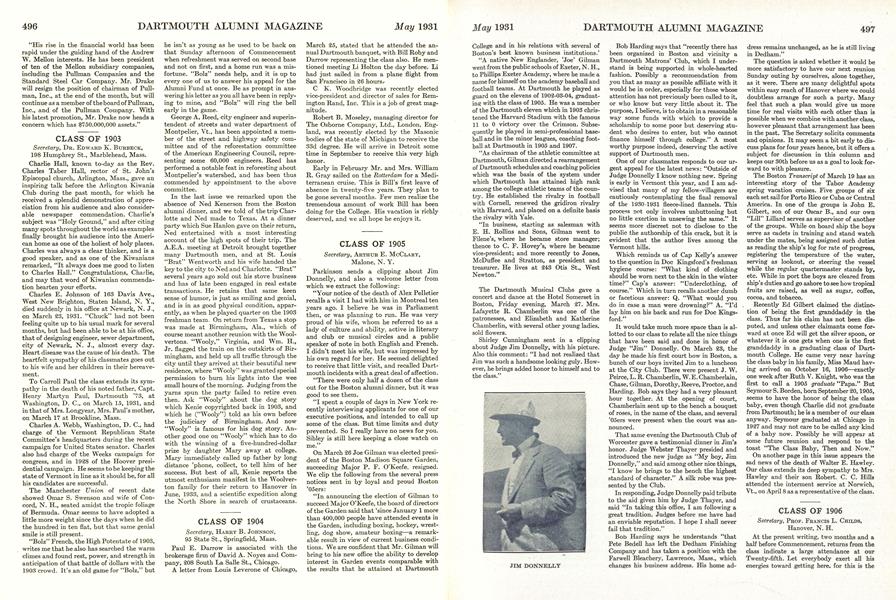
Shirley Cunningham sent in a clipping about Judge Jim Donnelly, with his picture. Also this comment: "I had not realized that Jim was such a handsome looking guly. However, he brings added honor to himself and to the class."
Bob Harding says that "recently there has been organized in Boston and vicinity a Dartmouth Matrons' Club, which I understand is being supported in whole-hearted fashion. Possibly a recommendation from you that as many as possible affiliate with it would be in order, especially for those whose attention has not previously been called to it, or who know but very little about it. The purpose, I believe, is to obtain in a reasonable way some funds with which to provide a scholarship to some poor but deserving student who desires to enter, but who cannot finance himself through college." A most worthy purpose indeed, deserving the active support of Dartmouth men.
One of our classmates responds to our urgent appeal for the latest news: "Outside of Judge Donnelly I know nothing new. Spring is early in Vermont this year, and I am advised that many of my fellow-villagers are cautiously rontemplating the final removal of the 1930-1931 fleece-lined flannels. This process not only involves unbuttoning but no little exertion in unsewing the same." It seems more discreet not to disclose to the public the authorship of this crack, but it is evident that the author lives among the Vermont hills.
Which reminds us of Cap Kelly's answer to the question in Doc Kingsford's freshman hygiene course: "What kind of clothing should be worn next to the skin in the winter time?" Cap's answer: "Underclothing, of course." Which in turn recalls another dumb or facetious answer: Q. "What would you do in case a man were drowning?" A. "I'd lay him on his back and run for Doc Kingsford."
It would take much more space than is allotted to our class to relate all the nice things that have been said and done in honor of Judge "Jim" Donnelly. On March 23, the day he made his first court bow in Boston, a bunch of our boys invited Jim to a luncheon at the City Club. There were present J. W. Peirce, L. R. Chamberlin, W.E. Chamberlain, Chase, Gilman, Dorothy, Reeve, Proctor, and Harding. Bob says they had a very pleasant hour together. At the opening of court, Chamberlain sent up to the bench a bouquet of roses, in the name of the class, and several '05ers were present when the court was announced.
That same evening the Dartmouth Club of Worcester gave a testimonial dinner in Jim's honor. Judge Webster Thayer presided and introduced the new judge as "My boy, Jim Donnelly," and said among other nice things, "I know he brings to the bench the highest standard of character." A silk robe was presented by the Club.
In responding, Judge Donnelly paid tribute to the aid given him by Judge Thayer, and said "In taking this office, I am following a great tradition. Judges before me have had an enviable reputation. I hope I shall never fail that tradition."
Bob Harding says he understands "that Pete Bedell has left the Dedham Finishing Company and has taken a position with the Farwell Bleachery, Lawrence, Mass., which changes his business address. His home address remains unchanged, as he is still living in Dedham."
The question is asked whether it would be more satisfactory to have our next reunion Sunday outing by ourselves, alone together, as it were. There are many delightful spots within easy reach of Hanover where we could doubtless arrange for such a party. Many feel that such a plan would give us more time for real visits with each other than is possible when we combine with another class, however pleasant that arrangement has been in the past. The Secretary solicits comments and opinions. It may seem a bit early to discuss plans for four years hence, but it offers a subject for discussion in this column and keeps our 30th before us as a goal to look forward to with pleasure.
The Boston Transcript of March 19 has an interesting story of the Tabor Academyspring vacation cruises. Five groups of six each set sail for Porto Rico or Cuba or Central America. In one of the groups is John E. Gilbert, son of our Oscar 8., and our own "Lill" Lillard serves as supervisor of another of the groups. While on board ship the boys serve as cadets in training and stand watch under the mates, being assigned such duties as reading the ship's log for rate of progress, registering the temperature of the water, serving as lookout, or steering the vessel while the regular quartermaster stands by, etc. While in port the boys are cleared from ship's duties and go ashore to see how tropical fruits are raised, as well as sugar, coffee, cocoa, and tobacco.
Recently Ed Gilbert claimed the distinction of being the first granddaddy in the class. Thus far his claim has not been disputed, and unless other claimants come forward at once Ed will get the silver spoon, or whatever it is one gets when one is the first granddaddy in a graduating class of Dartmouth College. He came very near having the class baby in his family, Miss Maud having arrived on October 16, 1906—exactly one week after Ruth V. Knight, who was the first to call a 1905 graduate "Papa." But Seymour S. Borden, born September 20,1905, seems to have the honor of being the class baby, even though Charlie did not graduate from Dartmouth; he is a member of our class anyway. Seymour graduated at Chicago in 1927 and may not care to be called any kind of a baby now. Possibly he will appear at some future reunion and respond to the toast "The Class Baby, Then and Now."
On another page in this issue appears the sad news of the death of Walter E. Hawley. Our class extends its deep sympathy to Mrs. Hawley and their son Robert. C. C. Hills attended the interment service at Norwich, Vt., on April 8 as a representative of the class.
JIM DONNELLY
Secretary, Malone, N. Y.