Letters to the Editor
THAT OLD OLD AUTOMOBILE
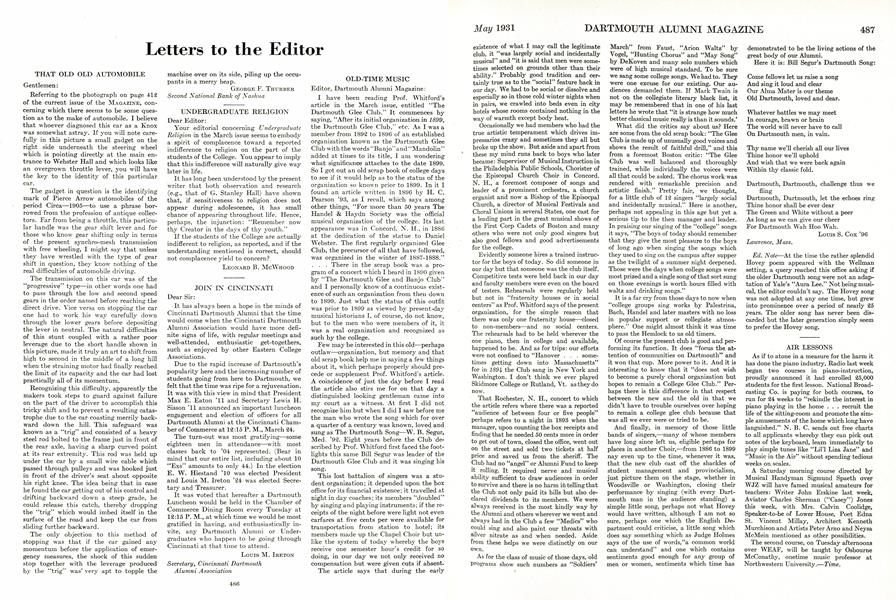
Gentlemen: Referring to the photograph on page 412 of the current issue of the MAGAZINE, concerning which there seems to be some question as to the make of automobile. I believe that whoever diagnosed this car as a Knox was somewhat astray. If you will note carefully in this picture a small gadget on the right side underneath the steering wheel which is pointing directly, at the main entrance to Webster Hall and which looks like an overgrown throttle lever, you will have the key to the identity of this particular car.
The gadget in question is the identifying mark of Pierce Arrow automobiles of the period Circa—1905—to use a phrase borrowed from the profession of antique collectors. Far from being a throttle, this particular handle was the gear shift lever and for those who know gear shifting only in terms of the present synchro-mesh transmission with free wheeling, I might say that unless they have wrestled with the type of gear shift in question, they know nothing of the real difficulties of automobile driving.
The transmission on this car was of the "progressive" type—in other words one had to pass through the low and second speed gears in the order named before reaching the direct drive. Vice versa on stopping the car one had to work his way carefully down through the lower gears before depositing the lever in neutral. The natural difficulties of this stunt coupled with a rather poor leverage due to the short handle shown in this picture, made it truly an art to shift from high to second in the middle of a long hill when the straining motor had finally reached the limit of its capacity and the car had lost practically all of its momentum.
Recognizing this difficulty, apparently the makers took steps to guard against failure on the part of the driver to accomplish this tricky shift and to prevent a resulting catastrophe due to the car coasting merrily backward down the hill. This safeguard was known as a "trig" and consisted of a heavy steel rod bolted to the frame just in front of the rear axle, having a sharp curved point at its rear extremity. This rod was held up under the car by a small wire cable which passed through pulleys and was hooked just in front of the driver's seat about opposite his right knee. The idea being that in case he found the car getting out of his control and drifting backward down a steep grade, he could release this catch, thereby dropping the "trig" which would imbed itself in the surface of the road and keep the car from sliding further backward.
The only objection to this method of stopping was that if the car gained any momentum before the application of emergency measures, the shock of this sudden stop together with the leverage produced by the "trig" was* very apt to topple the machine over on its side, piling up the occupants in a merry heap.
Second National Bank of Nashua
UNDERGRADUATE RELIGION
Dear Editor: Your editorial concerning UndergraduateReligion in the March issue seems to embody a spirit of complacence toward a reported indifference to religion on the part of the students of the College. You appear to imply that this indifference will naturally give way later in life.
It has long been understood by the present writer that both observation and research (e.g., that of G. Stanley Hall) have shown that, if sensitiveness to religion does not appear during adolescence, it has small chance of appearing throughout life. Hence, perhaps, the injunction: "Remember now thy Creator in the days of thy youth."
If the students of the College are actually indifferent to religion, as reported, and if the understanding mentioned is correct, should not complacence yield to concern?
Dear Sir JOIN IN CINCINNATI It has always been a hope in the minds of Cincinnati Dartmouth Alumni that the time would come when the Cincinnati Dartmouth Alumni Association would have more definite signs of life, with regular meetings and well-attended, enthusiastic get-togethers, such as enjoyed by other Eastern College Associations.
Due to the rapid increase of Dartmouth's popularity here and the increasing number of students going from here to Dartmouth, we felt that the time was ripe for a rejuvenation. It was with this view in mind that President Max E. Eaton '11 and Secretary Lewis H. Sisson '11 announced an important luncheon engagement and election of officers for all Dartmouth Alumni at the Cincinnati Chamber of Commerce at 12:15 P. M., March 24.
The turn-out was most gratifying—some eighteen men in attendance—with most classes back to '04 represented. (Bear in mind that our entire list, including about 10 "Exs" amounts to only 44.) In the election E. W. Hiestand '10 was elected President and Louis M. Ireton '24 was elected Secretary and Treasurer.
It was voted that hereafter a Dartmouth Luncheon would be held in the Chamber of Commerce Dining Room every Tuesday at 12:15 P. M., at which time we would be most gratified in having, and enthusiastically invite, any Dartmouth Alumni or Undergraduates who happen to be going through Cincinnati at that time to attend.
Secretary, Cincinnati DartmouthAlumni Association
OLD-TIME MUSIC
Editor, Dartmouth Alumni Magazine: I have been reading Prof. Whitford's article in the March issue, entitled "The Dartmouth Glee Club." It commences by saying, "After its initial organization in 1899, the Dartmouth Glee Club," etc. As I was a member from 1892 to 1896 of an established organization known as the Dartmouth Glee Club with the words "Banjo" and "Mandolin" added at times to its title, I am wondering what significance attaches to the date 1899. So I got out an old scrap book of college days to see if it would help as to the status of the organization so known prior to 1899. In it I found an article written in 1896 by H. C. Pearson '93, as I recall, which says among other things, "For more than 50 years The Handel & Haydn Society was the official musical organization of the college. Its last appearance was in Concord, N. H., in 1886 at the dedication of the statue to Daniel Webster. The first regularly organized Glee Club, the precursor of all that have followed, was organized in the winter of 1887-1888." . . . There in the scrap book was a program of a concert which I heard in 1890 given by "The Dartmouth Glee and Banjo Club" and I personally know of a continuous existence of such an organization from then down to 1899. Just what the status of this outfit was prior to 1899 as viewed by present-day musical historians I, of course, do not know, but to the men who were members of it, it was a real organization and recognized as such by the college.
Few may be interested in this old—perhaps outlaw—organization, but memory and that old scrap book help me in saying a few things about it, which perhaps properly should precede or supplement Prof. Whitford's article. A coincidence of just the day before I read the article also stirs me for on that day a distinguished looking gentleman came into my court as a witness. At first I did not recognize him but when I did I saw before me the man who wrote the song which for over a quarter of a century was known, loved and sung as The Dartmouth Song—W. B. Segur, Med. '92. Eight years before the Club described by Prof. Whitford first faced the footlights this same Bill Segur was leader of the Dartmouth Glee Club and it was singing his song.
This lost battalion of singers was a student organization; it depended upon the box office for its financial existence; it travelled at night in day coaches; its members "doubled" by singing and playing instruments; if the receipts of the night before were light not even carfares at five cents per were available for transportation from station to hotel; its members made up the Chapel Choir but unlike the system of today whereby the boys receive one semester hour's credit for so doing, in our day we not only received no compensation but were given cuts if absent.
The article says that during the early existence of what I may call the legitimate club, it "was largely social and incidentally musical" and "it is said that men were sometimes selected on grounds other than their ability." Probably good tradition and certainly true as to the "social" feature back in our day. We had to be social or dissolve and especially so in those cold winter nights when in pairs, we crawled into beds even in city hotels whose rooms contained nothing in the way of warmth except body heat.
Occasionally we had members who had the true artistic temperament which drives impressarios crazy and sometimes they all but broke up the show. But aside and apart from these my mind runs back to boys who later became: Supervisor of Musical Instruction in the Philadelphia Public Schools, Chorister of the Episcopal Church Choir in Concord, N. H., a foremost composer of songs and leader of a prominent orchestra, a church organist arid now a Bishop of the Episocpal Church, a director of Musical Festivals and Choral Unions in several States, one cast for a leading part in the great musical shows of the First Corp Cadets of Boston and many others who were not only good singers but also good fellows and good advertisements for the college.
Evidently someone hires a trained instructor for the boys of today. So did someone in our day but that someone was the club itself. Competitive tests were held back in our day and faculty members were even on the board of testers. Rehearsals were regularly held but not in "fraternity houses or in social centers" as Prof. Whitford says of the present organization, for the simple reason that there was only one fraternity house—closed to non-members—and no social centers. The rehearsals had to be held wherever the one piano, then in college and available, happened to be. And as for trips: our efforts were not confined to "Hanover . . . sometimes getting down into Massachusetts" for in 1894. the Club sang in New York and Washington. I don't think we ever played Skidmore College or Rutland, Vt. as they do now.
That Rochester, N. H., concert to which the article refers where there was a reported "audience of between four or five people" perhaps refers to a night in 1893 when the manager, upon counting the box receipts and finding that he needed 50 cents more in order to get out of town, closed the office, went out on the street and sold two tickets at half price and saved us from the sheriff. The Club had no "angel" or Alumni Fund to keep it rolling. It required nerve and musical ability sufficient to draw audiences in order to survive and there is no harm in telling that the Club not only paid its bills but also declared dividends to its members. We were always received in the most kindly way by the Alumni and others wherever we went and always had in the Club a few "Medics" who could sing and also paint our throats with silver nitrate as and when needed. Aside from these helps we were distinctly on our own.
As for the class of music of those days, old programs show such numbers as "Soldiers' March" from Faust, "Arion Waltz" by Vogel, "Hunting Chorus" and "May Song" by DeKoven and many solo numbers which were of high musical standard. To be sure we sang some college songs. We had to. They were one excuse for our existing. Our audiences demanded them. If Mark Twain is not on the collegiate literary black list, it may be remembered that in one of his last letters he wrote that "it is strange how much better classical music really is than it sounds.'
What did the critics say about us? Here are some from the old scrap book: "The Glee Club is made up of unusually good voices and shows the result of faithful drill," and this from a foremost Boston critic: "The Glee Club was well balanced and thoroughly trained, while individually the voices were all that could be asked. The chorus work was rendered with remarkable precision and artistic finish." Pretty fair, we thought, for a little club of 12 singers "largely social and incidentally musical." Here is another, perhaps not appealing in this age but yet a serious tip to the then manager and leader. In praising our singing of the "college" songs it says, "The boys of today should remember that they give the most pleasure to the boys of long ago when singing the songs which they used to sing on the campus after supper as the twilight of a summer night deepened. Those were the days when college songs were most prized and a single song of that sort sung on those evenings is worth hours filled with waltz and drinking songs."
It is a far cry from those days to now when "college groups sing works by Palestrina, Bach, Handel and later masters with no loss in popular support or collegiate atmosphere." One might almost think it was time to pass the Hemlock to us old timers.
Of course the present club is good and performing its function. It does "focus the attention of communities on Dartmouth" and it won that cup. More power to it. And it is interesting to know that it "does not wish to become a purely choral organization but hopes to remain a College Glee Club." Perhaps there is this difference in that respect between the new and the old in that we didn't have to trouble ourselves over hoping to remain a college glee club because that was all we ever were or tried to be.
And finally, in memory of those little bands of singers,—many of whose members have long since left us, eligible perhaps for places in another Choir,—from 1886 to 1899 nay even up to the time, whenever it was, that the new club cast off the shackles of student management and provincialism, just picture them on the stage, whether in Woodsville or Washington, closing their performance by singing (with every Dartmouth man in the audience standing) a simple little song, perhaps not what Hovey would have written, although I am not so sure,, perhaps one which the English Department could criticise, a little song which does say something which as Judge Holmes says of the use of words, "a common world can understand" and one which contains sentiments good enough for any group of men or women, sentiments which time has demonstrated to be the living actions of the great body of our Alumni.
Here it is: Bill Segur's Dartmouth Song: Come fellows let us raise a song And sing it loud and clear Our Alma Mater is our theme Old Dartmouth, loved and dear. Whatever battles we may meet In courage, brawn or brain The world will never have to call On Dartmouth men, in vain. Thy name we'll cherish all our lives Thine honor we'll uphold And wish that we were back again Within thy classic fold. Dartmouth, Dartmouth, challenge thus we fling Dartmouth, Dartmouth, let the echoes ring Thine honor shall be ever dear The Green and White without a peer As long as we can give our cheer For Dartmouth Wah Hoo Wah.
Lawrence, Mass.
Ed. Note—At the time the rather splendid Hovey poem appeared with the Wellman setting, a query reached this office asking if the older Dartmouth song were not an adaptation of Yale's "Aura Lee." Not being musical, the editor couldn't say. The Hovey song was not adopted at any one time, but grew into prominence over a period of nearly 25 years. The older song has never been discarded but the later generation simply seem to prefer the Hovey song.
AIR LESSONS
As if to atone in a measure for the harm it has done the piano industry, Radio last week began two courses in piano-instruction, proudly announced it had enrolled 25,000 students for the first lesson. National Broadcasting Co. is paying for both courses, to run for 24 weeks to "rekindle the interest in piano playing in the home . . . recruit the life of the sitting-room and promote the simple amusements of the home which long have languished." N. B. C. sends out free charts to all applicants whereby they can pick out notes of the keyboard, learn immediately to play simple tunes like "Lil'l Liza Jane" and "Music in the Air" without spending tedious weeks on scales.
A Saturday morning course directed by Musical Handyman Sigmund Spaeth over WJZ will have famed musical amateurs for teachers: Writer John Erskine last week, Aviator Charles Sherman ("Casey") Jones this week, with Mrs. Calvin Coolidge, Speaker-to-be of Lower House, Poet Edna St. Vincent Millay, Architect Kenneth Murchison and Artists Peter Arno and Neysa McMein mentioned as other possibilities.
The second course, on Tuesday afternoons over WEAP, will be taught by Osbourne McConathy, onetime music professor at Northwestern University.—Time.
DARTMOUTH DADDIES
To the Editor: It is with pleasure that we announce the addition of a new member to the Dartmouth family. This lusty throated youngster has been named "The Dartmouth Fathers' Association of Bridgeport, Conn." and the cause for his inception is as follows:
The Bridgeport Dartmouth fathers felt that they wanted a more definite, tieup with the college than just—"Oh, yes, my son goes to Dartmouth"; and if they felt that way, they reasoned that the other Dartmouth fathers throughout the world must feel the same way, and it was time that somebody did something about it. And so a committee was appointed, consisting of Dr. Charles H. Sprague (father of Manny Sprague '33) as chairman, Mr. O'Neill (Charlie O'Neill '31), W. B. Lashar (J. M. Lashar '34), H. B. Naramore (H. B. Naramore '33), Dr. R. H. Lieberthal (M. M. Lieberthal '32) with H. R. Horton '27 and L. R. Eaton '27 from the Dartmouth Alumni Association co-operating in an advisory capacity, and plans were made for a meeting at which time the actual organizing would take place.
This meeting was held on April 1, at the Stratfield Hotel, at which time the undergraduates and the Alumni were guests of the fathers at dinner. There were 61 seated at the table which was arranged in a horseshoe shape leaving the center open for the entertainers. The entertainment was a strictly Dartmouth affair. The Alumni presented "The Founding of Dartmouth" a picturization of the song Eleazor Wheelock, some of the historical truths being sacrificed for the sake of humor. C. K. O'Neill and M. M. Lieberthal gave interesting talks on the Dartmouth of to-day and then a few words were forthcoming from the other undergraduates present. Some prospective '35 men present were asked what they expected to find at Dartmouth and replied in a few well chosen words.
The guest of the evening, Mr. Moore, principal of the Bridgeport Central High School gave a short talk during which he commended the fathers for their forward step and expressed his personal interest in watching the organization spread throughout the country.
Mr. O. C. Davis '07, added interest to the evening by putting on display a Gradus AdParnasum printed in 1816. It developed that while there were many loyal Dartmouth men present, few of them had a speaking acquaintance with the aforementioned article and it was very instructive (to those who could read Latin).
During the evening the fathers were initiated into the singing of the Dartmouth songs and the giving of the cheers with the right cadence and proved to be very apt pupils.
The souvenirs of the evening were bronze ash trays in the shape of a D with the lettering Dartmouth Fathers' Association, Bridgeport, 1931. Should any other fathers' association desire to procure these trays, the Bridgeport Association would be glad to refer them to the right party, (adv.).
Other fathers who were called upon during the evening were:—W. B. Lashar, R. H. Lieberthal, H. B. Naramore and W. G. Taylor.
After the entertainment a business meeting was held and the work of organization took place. The nominating committee brought in the follow slate and it was elected by a unanimous vote: President, Dr. Charles H. Sprague; vice-president and treasurer, Dr. R. H. Lieberthal; secretary, H. B. Naramore.
So it can be seen that the new-born infant is to be well taken care of medically.
The very enjoyable evening was brought to a close with the singing of the Dartmouth Song.
So far as it is known, this is the first organization of its kind, not only in Dartmouth history, but in collegiate circles. Even now plans are under way whereby co-operation with the alumni Association, enjoyable and instructive meetings are in store for the alumni and fathers.
It is hoped that other Dartmouth fathers throughout the country will catch the spirit and band together for their own mutual enjoyment and the welfare of the college. If there are any who are interested in so doing, H. B. Naramore, Hilltop Road, Bridgeport, Conn., will be glad to give them any information and help them to get off to a flying start.
Dartmouth Alumni Associationof Bridgeport
Letters to the Editor
-
 Letters to the Editor
SEVERAL IDEAS CONCERNING THE FUTURE DARTMOUTH
March, 1922 -
 Letters to the Editor
Letters
November 1942 -
 Letters to the Editor
Letters to the Editor
MARCH 1969 -
 Letters to the Editor
Letters to the Editor
March 1981 -
 Letters to the Editor
Letters
JUNE/JULY 1984 -
 Letters to the Editor
LETTERS
December 1988


