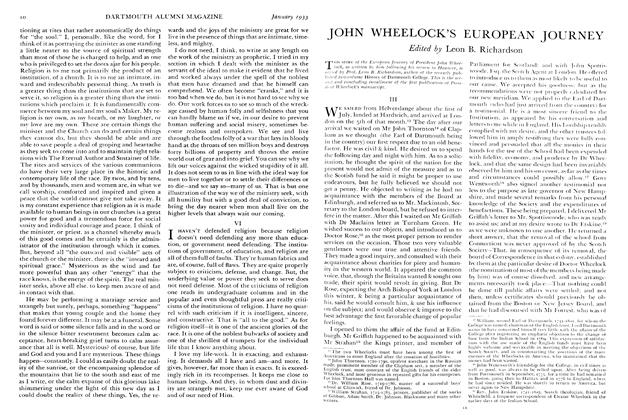
CONTEMPORARY RELIGION
WHAT we want is an honest appraisal of thehard work, the joys and rewards of the ministry as you find them. . . . We shouldalso want you to write freely of your conception ofreligion, of its place in the world today and, perhaps,the world tomorrow."
That is a large order. Books, many of them, have been written on each one of those phrases and to touch, even briefly, on all of them in an article of a few hundred words is quite beyond my power. Let me say straight off, however, that to watch a fifteen- year-old boy in your first church grow into poise and power, to see him become a capable and admired officer in your own beloved college and, then, to receive from him a letter containing the paragraph quoted above—such an experience as that is of the very essence of the rewards that come in the ministry.
I wonder if, after all, that isn't a good place to begin. Just what do men go into the ministry for if it isn't to have a share in the shaping of human lives which will, in turn, be set to the task of making this a better world in which to live? The only way that will be accomplished, I believe, is by giving to successive generations of human beings compelling glimpses of their own capacities and possibilities as servants of the best. And then, if, in addition to these "glimpses," you can give to these same human beings the undergirding and empowering conviction that there is an inexhaustible reservoir of power (or a Power) upon which they can draw, you have, to my mind, pretty nearly stated the practical aim of contemporary religion.
This probably makes it evident that I am writing from the point of view of what might be called liberal Protestantism. Probably much that I shall say will not mirror the opinion of many clergymen. I must speak, however, out of my own experiences and convictions. The views of religion, as of a moutain, are of necessity many. I but speak of that which I do know and hope.
II IT MIGHT NOT be amiss in this college magazine to state that the fundamental ends of religion and of education seem to me to be almost identical. "Ye shall know the truth and the truth shall make you free." Religion and education both seek to set the minds and souls of men free, free as the full-flung
sail is free to catch the invisible wind. Yet, as the sail is bound to the mast and the ship and to certain procedures if it is to catch the winds and use them, so the mind and soul are bound to society's needs and ideals and to the procedures of orderly thought and spiritual intent.
Religion and education, at their best, both seek to set men free, but, they seek to set them free for a purpose. That purpose is the discernment and service of the highest and best life that the mind can comprehend or the heart desire. Religion and education both seek the enlightening, the steadying and the lifting of human beings to the highest levels of usefulness and of happiness of which they are capable.
Dr. Smith Ely Jelliffe, the noted physician and psychiatrist, speaks frequently of "the capture, transformation and release of the cosmic energy." The phrase is an excellent one and, if I may interpret "cosmic energy" as including "spiritual" as well as "physical" or "electrical" energy, it seems to me that we of the modern ministry are seeking to help our fellows to do that very thing. There is "energy." There are mighty, mysterious "forces" that seek to pour their strength through human minds and hearts, just as Moosehead Lake (by the side of which I sit as this is written) pours itself through the sluice ways into the Kennebec. Religion and education are both tremendously concerned with this "capture, transformation and release of energy," and both of them have their eyes fixed not only on the means whereby this may be done, but also on the ends. Religion has, of course, historically and ideally, her remote, other-worldly, philosophic goals. "Thy Kingdom come" is the classic prayer of the Christian faith—but for most of us parsons our chief concern, I suspect, is a rather practical one. We want to discover and to live and to help others to discover and live the highest and the best life possible. Over all the routine tasks and practical endeavors that occupy us, however, and beyond the climbing horizons that lure us, there does lie "a light that never shone on land or sea"; but that is another and a more intimate story.
What these first paragraphs have been seeking to do is to make plain my "conception of religion, of its place in the world today—and tomorrow." May I sum it up by saying that for me religion is life built down upon the conviction that there is "energy,"
"a Power," a "God," upon which, or Whom, men may draw and by which or Whom their lives are indubitably lightened, steadied and lifted?
III Now THE practical work o£ a minister of religion centers, perhaps, around these three things. He seeks to enlighten, to steady and to lift. One of the immemorial words of the Christian religion, of nearly all religions, is this word "light." We all need enlightenment. We need light in our minds that we may understand a little better this marvellous world that surrounds us and of which we are a part. We need to have light flung on those mysterious regions that lie out beyond "the knowledge trails," regions seen rather clearly by the mystic and more dimly glimpsed by the rest of us. We need to have light flung down over and into our complex human life that we may live more wisely and justly with one another. In the novel "If Winter Comes," Hutchinson makes the hero say: "I tell you, Hapgood, that plumb down in the crypt and abyss of every man's soul is a hunger, a craving for other food than this earthy stuff. . . . Light, light; he wants light!" Fifteen years in the ministry have convinced me that the need and the desire for "light, more light" is not alone the cry of the dying Goethe, but, also a fundamental desire lying deep in the heart of every normal man and woman.
Not alone do we need light, we also need steadying, for, being human, we are bound to stumble, particularly when the path becomes suddenly steep, or rough, or is lost. One of the chief tasks, and one of the hardest, too, of the real minister is this steadying of those who stand in need. One of the reasons it is so hard is because the minister is human, too, and may be himself in desperate need of steadying at the very moment when he is called upon to steady some one else. To fcomfort and sustain parents who have lost a little girl at the very hour when your own lies desperately ill is not an easy assignment. The most important and worth while part of my own ministry is coming to be this very thing: this privilege of trying to steady those who are suddenly assailed by some inward or outward storm of life-shaking proportions. You may, perhaps, enlighten people in large companies, but you can really steady them only by one and by one. It is in this region that the minister sees people at their tragic and pitiful worst. Singularly enough, it is right here, too, that he sees them at their unbelievably heroic best. I know, perhaps, better than I wish I did, the depths to which men fall, but the thing that really amazes me most is not the low levels to which man can slip—it is the heights to which they aspire and actually do climb. The older I grow and the better I know the inner lives of men and women, the more I marvel at their capacity for greatness and at their victories won, some of them, against tremendous odds.
Enlightenment. Steadying. Lifting. These last two are, perhaps, almost synonymous, but not quite. By lifting, I am thinking especially of the ministry as it seeks to serve those remote ideals, "'toward which the whole creation moves."
Plato was the great prophet of the ideal, but he placed the sphere of its realization in the impossibly remote empyrean. That probably is good as philosophy, but it is not so good as religion. Jesus of Nazareth was also a great prophet of the ideal but his chief concern with it was to make it impinge upon and change human life. It was a thing to be striven for here and now as well as to be thought and dreamed about. "Thy will be done on earth, as it is in heaven." That was his prayer and to discover the "will" and to do it was his honest endeavor. A modern disciple of both Plato and Jesus has caught the essence of the matter in a glorious phrase: "The ideal is the shadow of God in the mind of man." With Plato the idea was "shadow"; with Jesus that shadow lay, imperial and imperious, "in the mind of man."
Now the minister of religion is a servant of the ideal. It is his place and privilege to make men aware of the noblest hopes that the race has cherished, to tell of the distance that has been covered and of the way that still lies out before their feet. It is part of his task to bring th'ese hopes into sharp and compelling focus in men's minds and to describe the far horizons in such fashion that those who hear him, and know him to be a well-balanced and honest man, will, as an inevitable consequence, begin to "think on these things" and then will undertake to live, nobly and hopefully, in the light of the ideals that he has pointed out.
IV WE ARE ready now to consider briefly some few of the actual duties of the average parish minister. It has seemed to me essential, however, to give you first a glimpse of some of the deeper motives and higher meanings that lie back not only of the minister's choice of his profession, but that also are the constant background of all he does and says.
The minister seeks to enlighten. He is a teacher. He wants to discover, to declare and to defend the truth. Therefore, the good minister is first, last and always a student up to the limit of his mental equipment, his pocketbook and his time. Herein is one of the chief rewards and joys of the ministry. He is, theoretically, the arbiter of his own time. He can make his own schedule and heaven won't help him if he doesn't! All the realms of human knowledge are his to travel through and everything he reads, hears, learns is grist to his mill. It is his business to read wisely and widely and to be an eager, humble learner always. The modern minister has no business to be ignorant of the major movements and concerns and convictions of his time. It is my humble opinion that if the rank and file of the clergy would spend three or four honest hours five days each week in hard study, in wide reading and in careful writing, the cause of religion in our day and time would go forward by leaps and bounds. This thing can and should be done. Men can always find time for the thing they deem to be of paramount importance. The minister has before him, then, the opportunity, the obligation and the joy of a life- time of acquisitive study. If he would really enlighten others he must first, himself, be enlightened—and real enlightenment is no light and easy matter. It is serious business but one packed full of fun and growth.
The minister stands in his pulpit privileged and obligated to be, in so far as in him lies, an inspiring teacher of the truth. He is charged, also, with the task of introducing scores and usually hundreds of children to the truth and worth of religion. It is a delicate and difficult task. He is usually given only volunteer help, poorly trained, if at all. He has a cruelly meager bit of time each week. Parents are apt to be apathetic or sharply but ignorantly critical of all that is done or isn't done. Yet here is a tremendous and glorious opportunity. Hundreds of boys and girls, from birth to twenty, with an instinct for religion, with life before them— and the minister is responsible. It is for him to see that they get an idea of the nature and worth and wonder of religion that will stand up under their later mature judgment and meet their current as well as their later needs. This piece of work, when one takes into consideration the handicaps, is being far better done than most laymen realize. The modern emphasis is falling less in our Church Schools on the teaching of the Bible and more on the formation of character. If parents would take their Church Schools more seriously, if they would give the minister sufficient funds to get trained leadership and to train teachers, if they would make more time available and would enter sympathetically into the effort to fit their children out with a sane, healthful, religious attitude, the joy of the work of the ministry would be many times multiplied and one of its chiefest griefs removed. I do not plead thus out of my own experience, for I have been fortunate in this matter almost beyond belief. I know what happens when parents give intelligent and generous support: I covet this experience for my fellow clergy.
V I SAID THAT the minister was not only a teacher, given the opportunity and obligation of enlightenment, but that he was also a priest. Many Protestant clergymen object mildly to that term. To them it hints at a religious heritage and philosophy that smacks of "magic," of an impersonal func- tioning at rites that rather automatically do things for "the soul." I, personalis*, like the word, for I think of it as portraying the minister as one standing a little nearer to the source of spiritual strength than most of those he is charged to help, and as one who is privileged to set the doors ajar for his people. Religion is to me not primarily the product of an institution, of a church. It is to me an intimate, in- ward and indescribable personal thing. As truth is a greater thing than the institutions that are set to serve it, so religion is a greater thing than the insti- tutions which proclaim it. It is fundamentally com- merce between my soul and my soul's Maker. My re- ligion is my own, as my breath, or my laughter, or mv lose are my own. There are certain things the minister and the Church can do and certain things they cannot do, but they should be able and are able to save people a deal of groping and heartache as they seek to come into and to maintain right rela- tions with The Eternal Author and Sustainer of life. The rites and services of the various communions do have their very large place in the historic and contemporary life of the race. By twos, and by tens, and by thousands, men and women are, in what we call worship, comforted and inspired and given a peace that the world cannot give nor take away. It is my constant experience that religion as it is made available to human beings in our churches is a great power for good and a tremendous force for social sanity and individual courage and peace. I think of the minister, or priest, as a channel whereby much of this good comes and he certainly is the admin- istrator of the institution through which it comes. But, beyond all "the outward and visible" acts of the church or the minister, there is the "inward and spiritual grace." Mysterious as the wind and far more powerful than any other "energy" that the race knows, is the energy of the spirit. The real min- ister seeks, above all else, to keep men aware of and in contact with that.
He may be performing a marriage service and strangely but surely, perhaps, something "happens" that makes that young couple and the home they found forever different. It may be at a funeral. Some word is said or some silence falls and in the word or in the silence bitter resentment becomes calm ac- ceptance, heart-breaking grief turns to calm assur- ance that all is well. Mysterious? of course, but life and God and you and I are mysterious. These things happen—constantly. I could as easily doubt the real- ity of the sunrise, or the encompassing splendor of the mountains that lie to the south and east of me as I write, or the calm expanse of this glorious lake shimmering under the light of this new day as I could doubt the realitv of these things. Yes, the re- wards and the joys of the ministry are great for we live in the presence of things that are intimate, time- less, and mighty.
I do not need, I think, to write at any length on the work of the ministry as prophetic. I tried in my section in which I dealt with the minister as the servant of the ideal to make it evident that he lived and worked always under the spell of the noblest that men have dreamed and that he himself can comprehend. We often become "cranks," and it is too bad when we do, but it is not hard to see why we do. Our work forces us to see so much of the wreck- age caused by human folly and selfishness that you can hardly blame us if we, in our desire to prevent human suffering and social misery, sometimes be- come zealous and outspoken. We see and live through the footless folly of a war that lays its bloody hand at the throats of ten million boys and destroys forty billions of property and throws the entire world out of gear and into grief. You can see why we lift our voices against the wicked stupidity of it all. It does not seem to us in line with the ideal way for men to live together or to settle their differences or to die—and we say so—many of us. That is but one illustration of the way we of the ministry seek, with all humility but with a good deal of conviction, to bring the day nearer when men shall live on the higher levels that always wait our coming.
VI
I HAVEN'T defended religion because religion doesn't need defending any more than educa- tion, or government need defending. The institu- tions of government, of education, and religion are all of them full of faults. They're human fabrics and are, of course, full of flaws. They are quite properly subject to criticism, defense, and change. But, the underlying value or power they seek to serve does not need defense. Most of the criticisms of religion one reads in undergraduate columns and in the popular and even thoughtful press are really criti- cisms of the institutions of religion. I have no quar- rel with such criticism if it is intelligent, sincere, and constructive. That is "all to the good." As for religion itself—it is one of the ancient glories of the race. It is one of the noblest bulwarks of society and one of the shrillest of trumpets for the individual life that I know anything about. I love my life-work. It is exacting, and exhaust- ing. It demands all I have and am—and more. It gives, however, far more than it exacts. It is exceed- ingly rich in its recompenses. It keeps me close to human beings. And they, in whom dust and divin- ity are strangely met, keep me ever aware of God and of our need of Him.
Rev. Boynton Merrill ' 15 The author of "Contemporary Religion" has a career ofsteadily mounting distinction behind him and promise ofgreat things to come. Dick Merrill was president of theflourishing Dartmouth Christian Association in 1915. Hewas one of Harry Hillman's track stars in college days andwas right hand man for John Aulis in the Commons. During the War he held the rank of lieutenant in the Navy,being chaplain of the U. S. S. Pennsylvania, flagship of theAtlantic Fleet. A Pastorate of four years at Putnam, Conn.,succeeded by six years as associate minister of the OldSouth Church, Boston, led to his accepting a call from theSecond Church in Newton, his present position. Dr. Merrillattended Union Theological Seminary and received thehonorary degree of Doctor of Divinity from Dartmouth in1928. He is a trustee of Wellesley College."Contemporary Religion" is the second of a series ofarticles descriptive of professions and careers followed byDartmouth men. It will be followed next month by anarticle on the Law by George M. Morris '11, of Washington,D. C. Senator George H. Moses '9O will write on Public Lifeand the final number of the present series, Medicine, willbe contributed by Dr. William G. Morgan '90, former president of the American Medical Association.