Widely Read, Praised, & Damned
An Interview withBill Cunningham '19
IT WAS IN the lobby of the Taft Hotel at New Haven before the Yale game of two seasons ago that I first saw Bill Cunningham. He was, as always, wearing his big. gray alpaca pile coat and was surrounded, as usual, with querulous alumni and admiring lesser journalistic lights. From that time on I anticipated the moment recently when I pressed the apartment house bell opposite the name of that one-time Nugget piano player who used to room over Dave Storrs' Bookstore for seventeen bucks a year.
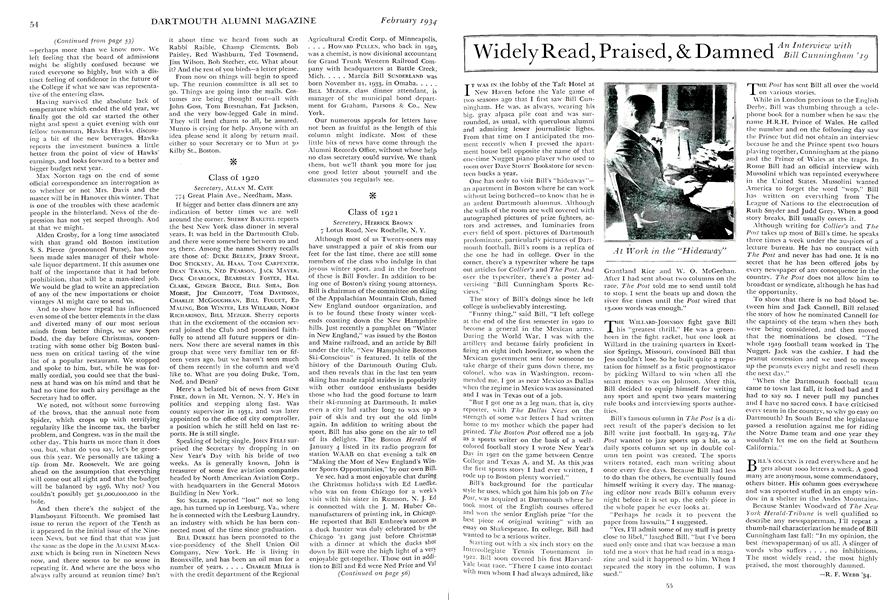
One has only to visit Bill's "hideaway"an apartment in Boston where he can work without being bothered—to know that he is an ardent Dartmouth alumnus. Although the walls of the room are well covered with autographed pictures of prize fighters, actors and actresses, and luminaries from every field of sport, pictures of Dartmouth predominate, particularly pictures of Dartmouth football. Bill's room is a replica of the one he had in college. Over in the corner, there's a typewriter where he taps out articles for Collier's and The Post. And over the typewriter, there's a poster advertising "Bill Cunningham Sports Reviews."
The story of Bill's doings since he left college is unbelievably interesting.
"Funny thing," said Bill, "I left college at the end of the first semester in 1920 to become a general in the Mexican army. During the World War, I was with the artillery and became fairly proficient in firing an eight inch howitzer, so when the Mexican government sent for someone to take charge of their guns down there, my colonel, who was in Washington, recommended me. I got as near Mexico as Dallas when the regime in Mexico was assassinated and I was in Texas out of a job.
"But I got one as a leg man, that is, city reporter, with The Dallas News on the strength of some war letters I had written home to my mother which the paper had printed. The Boston Post offered me a job as a sports writer on the basis of a wellcolored football story I wrote New Year's Day in 1932 on the game between Centre College and Texas A. and M. As this .was the first sports story I had ever written, I rode up to Boston plenty worried."
Bill's background for the particular style he uses, which got him his job on ThePost, was acquired at Dartmouth where he took most of the English courses offered and won the senior English prize "for the best piece of original writing" with an essay on Shakespeare. In college, Bill had wanted to be a serious writer.
Starting out with a six inch story on the Intercollegiate Tennis Tournament in 1922, Bill soon covered his first Harvardale boat race. "There I came into contact with men whom I had always admired, like Grantland Rice and W. O. McGeehan. After I had sent about two columns on the race, The Post told me to send until told to stop. I sent the boats up and down the river five times until the Post wired that 13,000 words was enough."
THE WILLARD-JOHNSON fight gave Bill his "greatest thrill." He was a greenhorn in the fight racket, but one look at Willard in the training quarters in Excelsior Springs, Missouri, convinced Bill that Jess couldn't lose. So he built quite a reputation for himself as a fistic prognosticator by picking Willard to win when all the smart money was on Johnson. After this, Bill decided to equip himself for writing any sport and spent two years mastering rule books and interviewing sports authorities.
Bill's famous column in The Post is a direct result of the paper's decision to let Bill write just football. In 1933-24, ThePost wanted to jazz sports up a bit, so a daily sports column set up in double column ten point was created. The sports writers rotated, each man writing about once every five days. Because Bill had less to do than the others, he eventually found himself writing it every day. The managing editor now reads Bill's column every night before it is set up, the only piece in the whole paper he ever looks at.
"Perhaps he reads it to prevent the paper from lawsuits," I suggested.
"Yes, I'll admit some of my stuff is pretty close to libel," laughed Bill, "but I've been sued only once and that was because a man told me a story that he had read in a magazine and said it happened to him. When 1 repeated the story in the column, I was sued."
THE Post has sent Bill all over the world on various stories.
While in London previous to the English Derby, Bill was thumbing through a telephone book for a number when he saw the name H.R.H. Prince of Wales. He called the number and on the following day saw the Prince but did not obtain an interview because he and the Prince spent two hours playing together, Cunningham at the piano and the Prince of Wales at the traps. In Rome Bill had an official interview with Mussolini which was reprinted everywhere in the United States. Mussolini wanted America to forget the word "wop." Bill has written on everything from The League of Nations to the electrocution of Ruth Snyder and Judd Grey. When a good story breaks, Bill usually covers it.
Although writing for Collier's and ThePost takes up most of Bill's time, he speaks three times a week under the auspices of a lecture bureau. He has no contract with The Post and never has had one. It is no secret that he has been offered jobs by every newspaper of any consequence in the country. The Post does not allow him to broadcast or syndicate, although he has had the opportunity.
To show that there is no bad blood between him and Jack Cannell, Bill related the story of how he nominated Cannell for the captaincy of the team when they both were being considered, and then moved that the nominations be closed. "The whole 1919 football team worked in The Nugget. Jack was the cashier. I had the peanut concession and we used to sweep up the peanuts every night and resell them the next day."
"When the Dartmouth football team came to town last fall, it looked bad and I had to say so. I never pull my punches and I have no sacred cows. I have criticised every team in the country, so why go easy on Dartmouth? In South Bend the legislature passed a resolution against me for riding the Notre Dame team and one year they wouldn't let me on the field at Southern California."
BILL'S COLUMN is read everywhere and he gets about 1000 letters a week. A good many are anonymous, some commendatory, others bitter. His column goes everywhere and was reported stuffed in an empty window in a shelter in the Andes Mountains.
Because Stanley Woodward of The NewYork Herald-Tribune is well qualified to describe any newspaperman, I'll repeat a thumb-nail characterization he made of Bill Cunningham last fall: "In my opinion, the best (newspaperman) of us all. A slinger of words who suffers .... no inhibitions. The most widely read, the most highly praised, the most thoroughly damned.
At Work in the "Hideaway"