HANOVER BROWSING
I SHALL START this issue with some very fine recommendations from E. Gordon Bill, Dean of the Faculty. He writes:
"Three reasonably recent books I can recommend most highly as full of absorbing and sustained human interest are (1) Diamond Jim by Parker Morell, (2) Broncho Charlie by G. S. Erskine, and (3) My OwnStory by Marie Dressier. Then two books published several years ago were among the best books I have read at any stage: (4) For the Defense and (5) Life of Lord Carson both by the late Edward Marjoribanks. A perfectly delightful small book published within the last year or two is (6) Saunterer's Reiuards by E. V. Lucas. Incidentally, this author has a great series of charming short sketches."
Dean Bill also recommends Frank M. Chapman's Autobiography of aBird Lover. "One of the very best books," writes Dean Bill, "is Sciencevs. Crime by H. M. Robinson." He continues: "It has more sustained interest than any thriller, and very cleverly illustrates each advance made by science in its fight against crime by brief details from some noted cases." As for mystery stories Dean Bill writes, "I read so many murder and mystery stories that I really do not feel like recommending any in the usual mine-run, but I will speak of The Murder of My Aunt by Hull (a most unexpected and diverting tale) and Merely Murder by Heyer (full of clever and sustained dialogue and characters). I usually recommend and pick first-class mystery stories by their authors rather than by their titles, and I can strongly recommend anything written by Freeman Will Crofts, R. Austin Freeman, Dorothy Sayre, or P. Taylor. This last author, as you of course know, writes mystery stories with a great deal of Cape Cod local color, and I rate them toward the very top of the heap."
I am familiar with several of these books and express my thanks to Dean Bill for this well-balanced list. The Murder of My Aunt by Hull was certainly one of the best of re cent mystery stories, unusual and diverting.
Professor Fred Lewis Pattee '88, well-known critic of American literature, a teacher to whom I owe a great deal that I am unable to express here, poet and friend, writes from Coronado Beach: "Biographies interest me most now. I cannot endure the mass of current fiction. I have greatly enjoyed Edgar Lee Master's Vachel Lindsay and Mark Twain's Note-Books edited by A. B. Paine. I have endured Honey in theHorn (Atlantic prize novel), but I have no desire to reread it." I can sympathize with Dr. Pattee on much of the current fiction. I should like to recommend here Professor Pattee's own books: A History of American Literature Since 1870, Sidelightson American Literature, and his most recent book on American literature published by Appleton-Century.
Ralph Sanborn '17 recommends: It Can't Happen Here, Lewis; a bombastic, futuristic effusion without much substance but none the less entertaining (I found this, as did Malcolm Keir, rather terrifying; part of the locale of the story is Dartmouth College); The GardenMurder Case, Van Dine, a horsey mystery that is too obvious; Northto the Orient, Anne Lindbergh, an imaginative prose description written with the poetic charm of a master (previously reviewed here); Years Are So Long, Lawrence, read belatedly but with avidity, splendid except for unnecessary exaggeration; Mutiny on the Bounty and PitcairnIsland, Nordhoff and Hall, a case of joining the long parade of admirers; Butterfield 8, O'Hara, a Manhattan interlude primarily of interest to those who "know" the island; L Claudius by Graves, masterly presentation of a musty subject; TheCurtain Falls, Reed, a source of great delight for lovers of the stage. Professor James P. Richardson reports that he has been too busy since he got out of the hospital to do much reading. He considered Van Dine's latest very mediocre, but liked, as I did, The League of Frightened Men by Rex Stout. He writes that he wants very much to read Walter Duranty's I Write What I Please.
My friend and fellow classmate Frank H. Horan, assistant to the Federal Attorney for the Southern District of New York, and soon (I hope) to be a Judge, delighted me with a long letter about books. It is too good not to use complete. (Thanks, pal, for helping to write my column for me!) His letter follows: "Bliss Perry in his recently published autobiography And GladlyTeach says: 'My day's work, for more than half a century, has been with gentlemen. That fierce economic and class struggle which I read about in Marxian books has passed me by ' And that very likely is why this quiet book is so charming and modest a description of a splendid career. One who has read many recent autobiographies of folks who have been in the struggle and have afterwards disembowelled themselves with gusto can turn the pages of this book and find out how an industrious Yankee has lived a rich life in the sphere that he marked out for himself. The dwindling ranks of fanatic fishermen will find that Professor Perry is one of their own. Those who think that the plain life of the New England scholar a half century back was really rich will like his description of life in Williamstown, and will perhaps see a parallel in Hanover life of that period.
"Europa by Robert Briffault is a detailed description of phosphorescent particles in the stream of pre-war European life which the writer mistakenly regards as important. The book is brilliant, but one may believe
that Briffault overestimates the significance of a spent and frustrate aristocracy and that his major premises are wrong. Yet this is a book to be read, for the man knows and he has thought. (Reviewed in November issue.)
"In Protestant (more recently agnostic) America any suggestion that there is a vigorous modern literature motivated by a belief in Roman Catholicism may be received skeptically. The Catholic LiteraryRevival (Bruce, Milwaukee) by Calvert Alexander, S. J., demonstrates that the revival contains more than the overwhelming dialetic pugnacity of Chesterton and Belloc. I bought the book because I felt that perhaps George Moore had not said it all in Hail and Farewell, that beautifully written lament that I have only lately read.
"Stuart Chase may not find it easy to prescribe for our economic maladies, but it seems so. Government in Business is an easily written description of the pervasiveness of modern government. Whether he's right or wrong, Chase has a following; and it is quite important to know what people think, as it is to know what is really so. This writer does put notions into people's heads. "One of the finest short stories with which I am acquainted is Mary in the current The Dublin Magazine. Slowly and cumulatively Padraic Fallon invokes immense pity for the perplexity of a peasant wife with a weak, sottish husband.
"Esther Forbes is of course one of the best contemporary novelists. In Miss Marvel she writes the morbid story of a provincial girl (from near Worcester) who, feeling a cut above her neighborhood, devotes a disintegrating imagination through decades to the memory of a correspondence with a Westerner she never saw, while her sister similarly goes crazy, comforted by the memory of a consumptive fiance who died before the marriage."
Frank mentions in his letter a book I have intended to Comment on myself, namely, Jessie Conrad's Joseph Conrad andHis Circle. He found it enjoyable and writes: "This curious Pole, surely one of the most enigmatic men ever to live, asked much of his wife. Here are all of his splendid group of friends Cunninghame Graham, Galsworthy, Crane, the egregious Hueffer. And the Conrad courtship, brief, abrupt, and vexed!" I would only add to this one or two remarks. When I last saw Mrs. Conrad she told me of a novel she was writing. This she never completed, or if so, never found a publisher; so she turned to write another book about her husband. We really learn little about him of importance, and one would never guess that he was a literary genius of the first rank from reading her book. I think it rather unhappy to air Conrad's familiar linen in public even with the best of intentions, and this book adds little of value to the Conrad story, though true it is Mrs. Conrad bore a cross, but even so the rewards must have been greater than one would be led to believe from this book.
Quack, Quack! by Leonard Wolff. Harcourt, Brace, 1935.
This is a book that I should like to make required reading in almost every course in college. It is a plea for rationality in a world dominated today by emotionalism and anti-intellectualism. The book is divided into two parts. The first, political quackery, an analysis of Hitler and Mussolini; the second, intellectual quackery, a scathing analysis of Spengler, Keyserling, and Bergson. This was a book that badly needed to be written and I am grateful to Mr. Wolff for doing such a convincing job.
Burners of Men, by Marcel Griaule. Lippincott, 1935.
A travel tale of modern Ethiopia written (unfortunately) in the third person. It tends to prove, that the Ethiopians are savages, and the author describes in one horrible chapter the burning alive of a prisoner "Death by Fire in Muslin." The author is a French scientist.
No Hero, by John P. Marquand. Little, Brown & Co., 1935.
An exciting and well-written story of one Casey Lee's adventures in securing a fueloil formula in Japan and China.
Herbert F. West '22
Article
-
 Article
CHARLES H. COGSWELL '80
August, 1915 -
 Article
DEATH OF VICTOR PLACE '03 FORMER DARTMOUTH STAR
August, 1923 -
 Article
PROFESSOR GRANDGENT SPEAKS AT PHI BETA KAPPA INITIATION
April, 1925 -
 Article
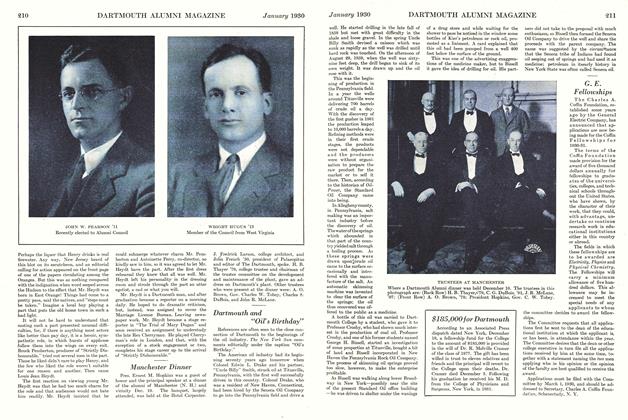
Manchester Dinner
January, 1930 -
 Article
Dartmouth Authors
September 1976 -
 Article
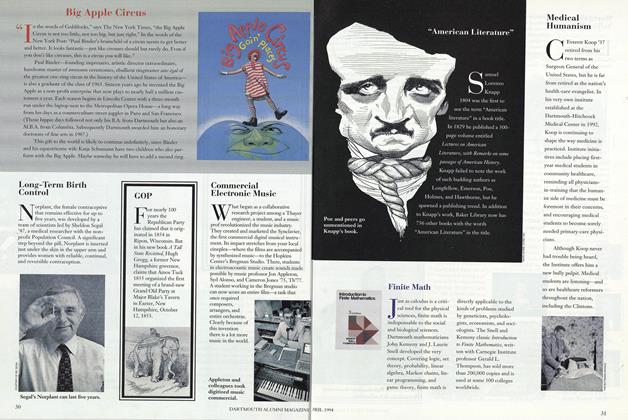
Long-Term Birth Control
APRIL 1994


