The Old Families of Hanover
AS COMPILED FROM DATA GATHERED BY DR. OILMAN D. FROST '86AND WRITTEN DOWN BY ERIC P. KELLY '06
The Freeman Murder
AND NOW ACROSS the pages of the Freeman family history stalks grim A. a hideous murder unparalleled almost in shocking details among the really few murders that have disfigured the happiness and tranquility of dwellers in the Upper Connecticut Valley. It was a murder without motive, a murder which in every circumstance should have been avoided, and brought about by a chain of events that would not have been possible in our civilization of today. The revolting deed, and the morbid aftermath of ten thousand people gathering in Haverhill (N. H.) to make a Roman holiday out of the hanging of the murderer shock us no less today, one hundred and thirty years after, than it must have shocked the more contemplative minds of 1806. The victim in this affair was Russell (6) Freeman,* a brother of Edmund, first settler in the township. He was born in Mansfield, Conn, in 1750, was a grantee of Hanover, a Speaker of the New Hampshire House in 1797, member of the State Council, Town Treasurer and prominent in local affairs. As a Selectman in 1789 he was imprisoned with James Wheelock, also Selectman, for debt due the State from the Town. He married Abia Durkee (1756-1820) in 1776. She was the daughter of Thomas Durkee of Woodbury, Conn., and Hanover, N. H. From this marriage there were ten children, of whom four died young, and several of the others later removed to western New York State with their mother.
It seems curious, now, that considering the prominence of the Freemans, that such a tragedy as this could have been possible. To begin with, Russell Freeman, being a farmer, much occupied with business for the town, had run into debt, met misfortunes, and had been seized by his creditors and placed in jail in Haverhill. Along with him in the Haverhill jail was Captain Joseph Starkweather of Haverhill, and a certain Josiah Burnham, blacksmith, landsurveyor, schoolmaster and speculator in several towns of the county. Starkweather was imprisoned for debt, Burnham likewise, although other charges were hanging over him. Burnham was the grandson of the Rev. William Burnham, a graduate of Harvard, and for many years pastor of a church in Kensington (Farmington), Conn.
Burnham was 62 years old. He had been in jail for six years or more. He had been involved in some curious land transactions for more than thirty years, and some of his statements show that he was distinctly ab normal and over-emotional. A curious strain of what seems to us religious fanaticism was in his make-up. That he was a corespondent in a pending divorce case has been stated and denied. It is however given as an alleged cause for a murderous attack upon his fellow prisoners. For they had been lodged in the same room with him in the jail, and early accounts of the murder state that they discussed this divorce matter with him in no pleasant fashion. At any rate, at a moment when neither was paying much attention to him, he whipped out from the waistband of his trousers a long knife, made by himself from an old scythe, and threw himself upon Freeman.
THE FATAL ATTACK
As Freeman had no weapon, he could not defend himself. The murderer, now a raging madman, slashed him in terrible fashion. Then leaping upon Starkweather who came running from a distant corner of the room he served him in the same fashion. With the two men beyond human help, Burnham turned the knife upon himself, but by this time outsiders had heard the commotion and came in, in time to save Burnham from himself and preserve him for the gallows. At once the question arose what to do with the two bodies, for under the law (until 1818) the body of a debtor belonged to the creditor, and they could not be removed. The lawyer for the creditors suggested that the bodies be barrelled up, salted and preserved. Col. David Webster, the sheriff, however, made a hurried trip by night to Judge Livermore's house in Holderness and got a court order for burial.
Then followed the trial. One Daniel Webster, a young lawyer who appeared with Alden Sprague of Haverhill was appointed counsel for the defence, made his first and only argument against capital punishment, explaining in later memoirs that he was young and had no matters of fact or law upon which to build a defense. Burnham was found guilty and executed publicly in that fashion which appears to us today repugnant and horrible.
He was led forth to execution in August, 1806. The Rev. Mr. Bittinger in his history of Haverhill thus describes it:
"The hanging of Burnham was a great occasion. It is estimated that fully 10,000 people gathered on the west side of Powder House Hill, where the execution took place. They came from near and far, in carts and in wagons, on horseback and on foot. Old men and young men, beaux and lassies, mothers with babes in their arms and even invalids. A military guard escorted the prisoner from the jail to the scaffold, and a long sermon, preceded by singing and prayer was preached by the Rev. David Sutherland of Bath to the immense concourse of people who listened with deep emotion to the preacher Burnham was given an opportunity to address
the multitude which he did in a faltering and broken speech He mentions in his speech that he had been a believer in the doctrine of universal salvation, and but for this he would not have committed the crime for which he was about to suffer, and he admonished his hearers to beware of this doctrine."
Mind you, all this time Burnham stood pinioned, with the noose about his neck, his coffin presumably upon the ground beside him. Mr. Sutherland's sermon must have taken two hours on the subject TheWages of Sin Is Death, in which he divides the subject into three parts, one addressed to the congregation in general, a second to the prisoner to whom he held out some hope in the Hereafter if he would cast himself on the mercy of God. Then turning directly to the crowd about the gallows he exhorted them to change their ways before it was too late, saying "Possibly there are some among you, who, if your crimes were as well known as Josiah Burnham, should, like him, be brought to an untimely end." The signal was given to the executioner at last, and the rope which held the death-trap was cut with the same knife with which Burnham had committed the two murders, and he fell to his death. The knife was presented to the Dartmouth College Museum.
OTHER FREEMANS
From 1760, and for more than a hundred years, the Freeman family is part and parcel of Hanover in New Hampshire, and part as well of the new college, Dartmouth, which is the descendant of Mr. Wheelock's Charity School, moved up through the wilderness from Lebanon Crank Parish, Connecticut. Its history is the history of America, a story of constant and rapid expansion. In England the Freeman family had remained probably in one locality in its entire history, possibly for a thousand years, but no sooner does it come to America than it begins to spread, from the original settlement on Cape Cod to Connecticut, then into New Hampshire, then into New York and states west, and by the end of the 19th century is scattered all over the country, with but few remaining dwellers in Hanover
and nearby towns. After Edmund (6) Freeman, the first Hanover settler, whose story is told in the first article, other members of the family came into the town. Chief among them were: Jonathan (6) Freeman, Otis (6), Russell (6), and Moody (6), all brothers, and Martha (6) a sister. There were however two older members of the family than any of these, Sylvanus (5), and Prince (5), uncles of the foregoing, who were also grantees of Hanover. All of these were vitally concerned with, the affairs and growth of the town, some holding public office and some influential in the College.
Sylvanus (5) Freeman was born in 1716, and died in 1776 in Connecticut. He never made his permanent home in Hanover. He married Mary Dunham, and by her he had eleven children. Of these there were: Elisha of Norwich, Vt.; Elizabeth of Woodstock, Vt. who married Nathan Fletcher; Sarah of Hanover who was married to Nathaniel Hewes of Hanover and Lyme; Keziah of Hanover, who was married to her cousin Moody (6) Freeman; Temperance of Mansfield, the wife of Jesse Bennett; Mary of Mansfield, the wife of Eleazar Slafter. All these in a deed, "quit claimed all rights to lands in Hanover which their Brother John died seized of, and which he bequeathed to our beloved father Sylvanus Freeman, late of Mansfield, Conn, since deceased, intestate, for in consideration of filial duty we owe to our honored mother, Mrs. Mary Freeman, and our certain and sure dependence, we have of her well being well and comfortably supported during her widowhood by her son Sylvanus of Mansfield, Conn." This Sylvanus later lived in Hanover, and probably in Lyme, but died about 1800, and his mother died in Lyme in 1815, aged 95 years and is buried beside her daughter Sarah Hewes, who died in 1851, aged 101.
The other elder Freeman was Prince (5). He was born in 1713, came to Hanover in 1760, had ten children, all born in Mansfield, and died in 1781. There is no record of his burial. Among his children were: Prince of Lyme; Enoch, of Lebanon; Elijah and Roger of Norwich; Elizabeth, who married John Durkee of Hanover, (she lived to count eight children, 24 grandchildren, and 21 greatgrandchildren); Ruth, who married Abijah Durkee of Hanover (she had six children), and died in 1846 at the age of 80.
The brothers of the first settler in Hanover, Edmund (6) Freeman, to whom a chapter has already been devoted, now follow in order. Chief among them was Jonathan (6) Freeman, a man who played a very important role in the life of the town and the College. He was bom in Mansfield in 1745, and died in Hanover in August 20, 1808. He served the town as town clerk, and selectman for many years; he probably laid out in 1770 the lots of the Hanover Plain Village where the College now stands; was surveyor of the town, a Presidential elector in 1793, casting his vote for George Washington; was Congressman from 1793 to 1808. He was College "Financier" from 1788 to 1808, handling wood-lots and rents in the college properties; he was a trustee of Dartmouth from 1793 to 1808, and the degree of A.M., Hon. was conferred in 1795. His wife was Sarah Huntington daughter of Jeremiah Huntington, grand-daughter of Christopher Huntington: she was born in Norwich, Conn. Dec. 15, 1748, and died in Hanover in 1846, aged about 98 years.
When Jonathan (6) went out to Hanover Center to live, he built himself a house about a quarter of a mile east of the Center, on the north side of the old Wolfeboro road. This was the most western of two houses erected close together on that site. It, like many of the old houses, has since been burned, but the cellar is still to be seen at a not great distance from the Foster House.
To Jonathan (6) and his wife Sarah, were born ten children. One of the most prominent was Peyton Randolph (7) Freeman 1775-1868. He was a lawyer, a friend of Daniel Webster, and for a time clerk of the U. S. District Court in Portsmouth. In the later years of his life he retired from practice and lived in Hanover, died here, and was buried in the Center bury- ing lot. At the time of his death he was the oldest alumnus of Dartmouth College, having received his degree in 1796. For the funeral, many of the professors and students went to the Center, and attended the services.
Another son of Jonathan (6) Freeman, was Jonathan (7) Freeman Jr. 1777-1858. He was called the Squire. His first wife was Mary Whitehouse of Pembroke, 1784-1829. They had eight children, of whom three died young. The fourth, William Phillips (8) Freeman, was born in 1816, attended Kimball Union Academy from 1832 to 1836, and was drowned in New Bedford in 1841. The youngest child was Samuel Huntington (8) Freeman, born in 1820, died in 1906. He was graduated from Dartmouth College in 1843 and later from the Albany Medical College.
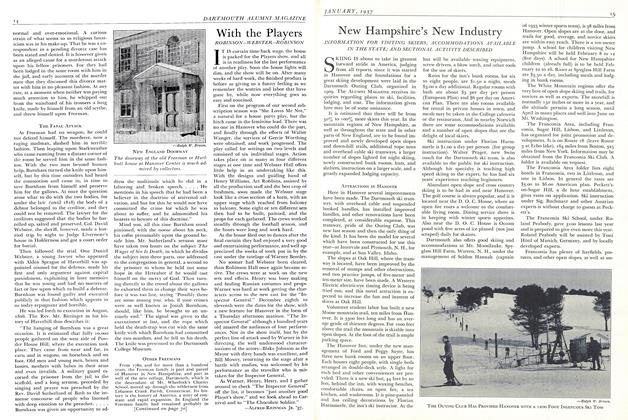
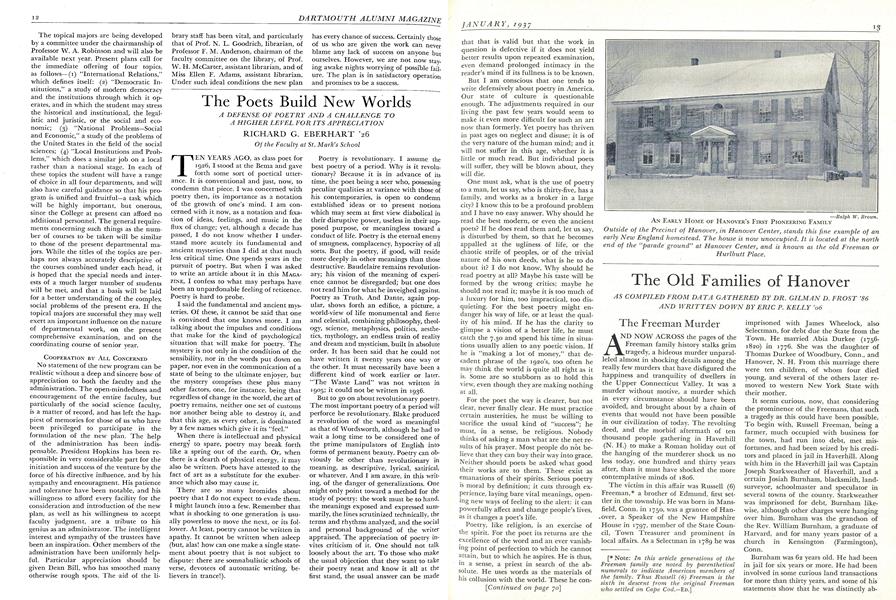
Squire Jonathan (7) Freeman, lived at first in a house at the north end of the Parade Ground at Hanover Center. This is one of the few houses that survived from the era of the early Freeman generations, and is the only Freeman house remaining at the Center. It is rather handsome in appearance, and is known to later generations as the Hurlbutt house, called after Elihu Hurlbutt who lived there some time after the Freeman's departure. On the window panes of the front room, left side, first floor, are scratched the names, C. Freeman and J. W. Freeman. Done with a dia- mond in a ring, presumably, these signify: Caroline Freeman (8), and Jonathan W. (8) Freeman, children of Jonathan (7), the Squire.
The Squire married a second time, after the death of his wife, Mary Whitehouse Freeman, this time a Miss Elizabeth Digby Belcher Oliver, daughter of the Rev. Thomas Fytche Oliver, an Episcopal clergyman of Salem and Baltimore. The marriage was in 1833, and she died in 1852. She is buried in the Dartmouth Cemetery. During the period of his second marriage, Squire Jonathan lived in a house on the site of the present Theta Delta Chi house on the College Plain. Two sisters of the Squire, Sarah and Hannah, and perhaps their mother in her last years, lived in a framed house built in 1843 that stood until recently on the present site of Carpenter Hall, a house moved away to become the residence of Professor Stearns Morse. In this house Sarah died in 1871, and Hannah then moved to New Jersey, and died in 1875. Of other children of Jonathan (6) Freeman whose destinies are interwoven with the history of the town or College, there is first, Asa (7). He was graduated from the College in 1810, became a lawyer in Dover, and there married Frances Atkinson of that town in 1820. Their son, Francis (8) Freeman was graduated from the Dartmouth in 1841. A brother of Asa's was Samuel (7) Freeman, who was graduated from the Medical School in 1813, and became a physician at Balston Spa and Saratoga Springs, N. Y. where he practised for thirty years. He married Helen Van Rensellear Woodruff who died in 1863. He survived her for seven years.
While speaking of locations at Hanover Center, it is interesting to know that a rather undesirable, rocky, practically uninhabitable, section of land on the top of Lord's Hill was drawn, one whole share to the right of the Glebe for the church of England, and one whole share to the right of the Incorporated Society for the Propagation of the Gospel in Foreign Parts. Whoever drew the lots out of the hat in Mansfield, when parcels of land were assigned by such drawing may have, by incredible coincidence or culpable intention, placed these prospective shares in such an undesirable site, but the shares for the first settled minister, and that for the benefit of a school in said town fared better. In a deed, dated in 1826, given by Isaac Fellows to his son Ira, the land east of Jonathan (7) Freeman, is described as the "propagating lot," meaning the lot on top of Lord's Hill, granted to the Society for the Progation of the Gospel. This lot was next to that for the Glebe of the Church of England."
A third brother of Jonathan (6) Freeman was Otis (6) Freeman. He was born in Mansfield, Conn, in 1748 and died at Hanover Center in 1832. His house was situated half a mile north of Hanover Center, on the east side of the Two-mile Road. It was later known as the McPherson house, and eventually burned down. Otis married Ruth Bicknell (1752-1814) as his first wife and after her death married a widow, Mary Bliss Shaw, relict of Col. Daniel Shaw of Bradford. He had seven children, all by his first wife. Of these the first was James Otis (7) Freeman, born in 1773 at Coventry, Conn, and died at Moultonboro in 1815. He was a lawyer, and married, in Moultonboro, Sarah French. The third son was Jonathan (7) Freeman, (1783-1873) called in later life, Deacon Jonathan to distinguish him from his cousin, Squire Jonathan. He married Mary Russell, daughter of Thomas Russell of Conway, and to them were born eight children. He lived in a house south of the Center, where the present road to Etna crosses the old Wolfeboro Road. Deacon Jonathan was for a long , time Town Clerk in Hanover, but removed with his wife to Freehold, N. J. where they later died. Their eldest son, Otis Russell (8) Freeman, (1809-1902) born in Hanover, was graduated from the Medical School in 1843, having previously, in 1837, married Abigail Alden, daughter of Samuel Alden of Hanover, and his wife, Abigail Willard. Of Deacon Jonathan's other children, Ruth, the fourth in the family, married Amos Richardson, a graduate of the College in 1837, who became principal of the Institute at Freehold; Martha, the seventh child, was married to a Mr. Doran, who taught at the Institute at "Penn." Otis' youngest child, George (7) (1795"1868) was a member of the Dartmouth class of 182 a. He died in Parma, N. Y.
Russell (6) Freeman, (1750-1805), brother of Otis, Jonathan, Otis, Moody, and Martha, was the unfortunate Freeman murdered at Haverhill. After his death, his widow, formerly Abia Durkee (1756-1820), was married to Russell's brother, Moody (6) Freeman, as his second wife. Russell had had ten children and Moody had had fourteen, but few of the twenty-four were left at home when Moody married Abia.
Moody (6) Freeman brother of Edmund, Russell, Otis, and Martha was born in Mansfield in 1753. He was not a grantee, but came to Hanover in 1774 or 1775. He removed to Thetford in 1780. His first wife whom he married in Mansfield, was Keziah (6) Freeman, a cousin, daughter of Sylvanus (5), and Mary Dunham. Keziah (6) was born in 1756, died in 1810. His second wife was his brother Russell's widow as mentioned in the foregoing paragraph. He had fourteen children, three of whom were born in Hanover, five in Thetford, and six in Clarkson, N. Y. Practically all were brought up in New York state. He was given land by his father, the 5th hundred-acre lot in the first range laid out to his father (Ed mund, Fifth), excepting "two acres containing a quarry of slate stones on the southerly line of the lot at a place called Slate Brook." He died in 1828 at Clarkson.
The youngest child, Martha (6) was born at Mansfield in 1759. She was married to Roger Hovey in 1783. He was a blacksmith at the Center and made the locks, hinges and doorplates of old Dartmouth Hall. She died in Berlin, Vt. in 1841, aged 82 years. Martha was probably married in Hanover, though the family removed to Thetford in 1814. She had ten children, all born in Hanover. Her fourth child, Martha, married Noah Coleman. From that marriage came the Colemans of Hanover and Norwich. Major X. O. Dewey of Hanover, and Mrs. C. D. Hazen of Christian street, Hartford, Vt. are her flescendants and also Mrs. Cornelius A. Field, whose husband was long postmaster at Hanover. Another child of Martha (6) was Edmund Otis Hovey, a graduate of the College in 1828, and Andover Theological in 1831. He was given a D.D. at Dartmouth in 1869. For forty years he was a professor at Wabash College, Crawfordsville, Indiana, where a brother of the present president of Dartmouth is president. He died in Crawfordsville in 1877.
From Edmund (7), Otis (7), and Nathaniel (7) Freeman, children of Edmund (6) Freeman, were descended most of the numerous Freemans of Lebanon, Plainfield, N. H., Hartland, Hartford, and Sharon, Vt.
NEW ENGLAND DOORWAY The doorway of the old Freeman or Hurl-butt house at Hanover Center is much ad-mired by collectors.
[* Note: In this article generations of theFreeman family are noted by parentheticalnumerals to indicate American members ofthe family. Thus Russell (6) Freeman is thesixth in descent from the original Freemanwho settled on Cape Cod. ED.]