1897
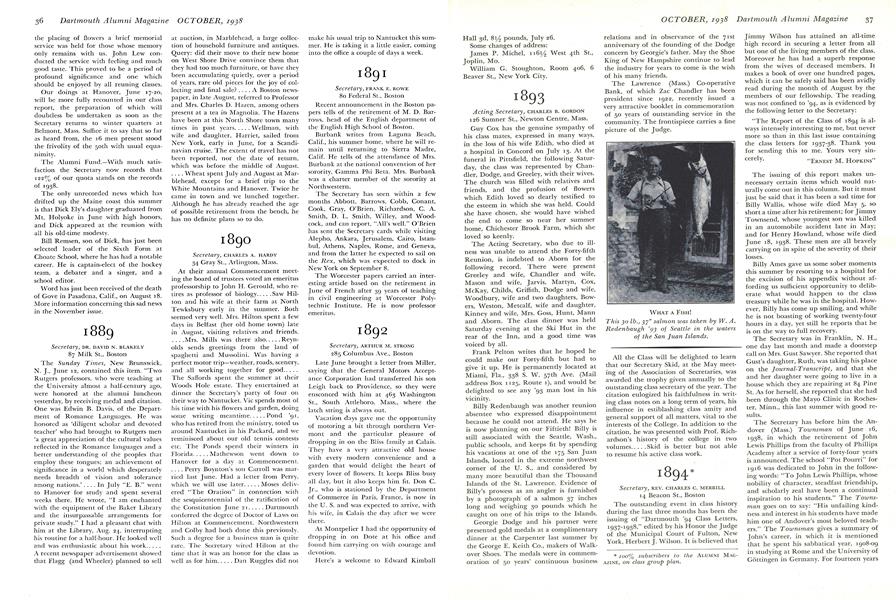
THE DARTMOUTH FACULTY, 1893-97, AS SEEN BY OBSERVANT SENIORS.
Charles F. Richardson. Louis Benezet goes this fall from the school superintendency of a great industrial city to a teacher's desk cooled by the Dartmouth elms. Can a Rotarian become a college professor? All members of the family wish Benezet to look like a professor and realize that a transformation is necessary. They have agreed that Benezet must learn to smoke and practice it. A disreputable pipe in operation is today the recognized symbol of faculty membership.
It was not so in 1893. Fred Emery brought in cigarettes in 1895, but Clothespins Richardson alone made public confession of his belief in the efficacy of a pipe. Of course he did not smoke in college buildings nor on the street but in his study there came together his personal friends; there were his shelves of books, his pipes, the students who loved him, his yard-long Dachshund, Geist, and the easy chair in which his upright body could bend into surprising but comfortable angles.
I remember that Bailey, Gibson, Sibley, and I as sophomores were returning to college for the winter term, and Professor Richardson not only smoked in the smoking car but returned pipe in hand and stopped to talk with us. We were impressed and I think grieved. Tobacco was so harmful to purse and purity that all recipients of scholarship aid had to declare each year that they had used neither tobacco nor rum. Recall this was in 1895.
The name "Clothespins" was an apt one. He was tall, straight, with aristocratic legs and articulated arms. He had known Ralph Waldo Emerson in person. He could read Anglo-Saxon with the raucus insistance of a katydid and the Faery Queen with musical cadencies. Each year he asked, "Where are the snows of yesteryear?" and we regarded their absence as a major social calamity. Since then we have found them. They were in Tuckerman's Ravine all of the time, unknown to us and the professor. We have searched for them elsewhere. A. A. Bacon found them in Syria on Mount Lebanon. Semp Smith found them in the Sierras, and Lewis, Mills, and Ethan Allen Smith in the Rockies.
In the classroom Richardson was a great teacher with no interest in the duties of a prison guard. As a young graduate I sought his classroom in the upper reaches of Culver Hall, a barn-like building, and found the professor picking up from the floor chalk, erasers, apple cores. "There was considerable artillery practice here today," was his only comment.
Some elected his courses for the inspiration, some to make a restful term's schedule; and some of these idlers found that they had entered a new work which has since happily been theirs. Clothespins' heart was too kind and his love of literature too great to permit carnage and slaughter. The Dean sighed, "Professor Richardson has never flunked a student," but I recall that Habbakuk-like he declared the persistence of eternal justice. "One third of the class in yesterday's examination evidently planned to secure a mark of 50%, and, gentlemen, those students hit the mark with unerring accuracy."
I still read Emerson and Chaucer and Spenser and so do Frank B. Noyes, Phi Beta Kappa, and Frank M. Coakley, Theta Nu Epsilon. Clothespins taught well.
Frank D. Sherman. It was a bitterly cold day in the Wentworth Hall mathematics room No. 2. The woodbox was empty, the stove was discouraged, and Professor Sherman came in heavily clad and rubbing briskly his numbed hand against his overcoat. We always rose when Professor Sherman entered, for his empty sleeve was a hero's badge, and we gladly retold the stories of the courage in the "War of Rebellion" of this quiet and determined man. There were no pacifist students in 1894.
"The day is inclement," said Frankie, "will some young gentleman go to the storeroom for wood?" This was a mistake, the professor should have been specific. "Will Mr. Goodenow bring the wood?" would have been administratively and educationally correct. The class rose to the opportunity as a single gentleman. "Yes, Professor Sherman." All went; none returned. The professor was a good sport; he passed in a report of perfect attendance that day and there was no rebuke on the day following, but for self-protection, and it was necessary, we came to the classroom fully prepared for several continuous days.
Sherman did not have the personal popularity of his scintillating mathematical colleague, Professor Worthen, but we knew well that he was a superior teacher, systematic, thorough, and with a mastered knowledge of his subject. One cloud, however, hung over his head. He had come to a college professorship through the Chandler Scientific School, and it was doubted that unspotted scholarship was possible except as it sprouted from the classics.
Professor Sherman lived in his own well-built Victorian house on the Hospital corner. He followed the pleasing custom of a home evening devoted to calls from home-longing students. It was a brave attempt, but I doubt that either the student or Professor and Mrs. Sherman was at ease. Students and faculty had few common interests as the century was closing. "Guidance" was not a professorial obligation when we were students. Thank God!
I have never been much of a mathematician, but whenever I arrange material with logical care and when I stick to a job until it is done I recall Professor Sherman. Balch and Shattuck could make the same statement.
Albert C. Crehore. Professor Emerson, greatest of deans, most lovable of men, it must be confessed explained to moronic students in physics with red flannel precision and his illustrative experiments generally failed, though we were assured, "The principle is just the same."
Then came young Crehore from Yale. He was accurate, clear, and definite, somewhat impatient with boys who had made themselves lazy and whom the Lord had made dull. His experiments never failed; his students frequently did. He loved science; he endured boys. We had the feeling that to him Hanover was agrarian and Dartmouth was traditional, and he was right.
The vital statistics of the town of Hanover will show that 1896 was for the Crehores a happy and eventful year. Hanover was very dull that winter, but Mr. and Mrs. Crehore shared in the college church with Mr. and Mrs. Phelps—he was the college artizan—a well-located pew toward the front of the sanctuary. The gallery pews, prime seats for observation, were occupied on either side by sophomores and juniors. From December to April the attendance surpassed all records. The Reverend Doctor Leeds was greatly encouraged, for he remembered the revivals of religion of the earlier days.
We were greatly pleased that eventually the Crehores named their first-born Dorothy Dartmouth, but one half of the class lost heavily to Jimmie James. His betting book was complete with established handicaps, and odds were offered which recognized time, primal personal characteristics, and even appropriate names. To this day Ed Cass and Billy Ham will neither play bingo nor buy speculative stock.
Goodenow. A letter from Goodenow tells that he is still in Portsmouth, Va., in the express business. He has chosen to work nights rather than to displace a worthy man who needs employment. No classmate has seen Goodenow for many years. His address is 112 Court St.
Poor. Mrs. Poor maintains the Hanover home. Daughter Elizabeth is a teacher of homemaking in the city schools of Norwalk, Conn. Daughter Dorothy with her husband and young John Edward lives in Hampton, N. H.
Brown, A. W. The secretary found Brown at his rooms in the Columbia Hotel in Leominister, Mass., surrounded by his books and his collections of stamps. Brown gave up teaching a few years ago but has many local interests.
Butterfield. After eight years as commissioner of education for the state of Connecticut and a longer period in a similar office in New Hampshire, Butterfield has returned to public school supervision. He is now superintendent of schools for Bloomfield, a residential suburb of Hartford. He continues to maintain his home in West Hartford.
Secretary, State Capitol, Hartford, Conn.