Class of 1897
THE SONS OF WHITTIER
In 1820, President Francis Brown of Dartmouth received a labored letter from Deacon John Ela of East Haverhill, Mass., requesting that a preceptor be sent to instruct the youth for the winter term in the district school. A robust young man was necessary, and a man of unviolated morals and orderly demeanor was desired. The President of the College, after prayerful consideration—for college presidents prayed in 1820—and consultation with the senior professor, sent down Senior George Haskell. He boarded around. The food was better at the Whittiers', but the girls were livelier at the Elas'. I am afraid that young John Greenleaf was a sorry scholar or Haskell a poor teacher, for the contemporary evidence makes no reference to hooks and trammels, to tare and tret, or to the teaching of orthography, but indicates that the teacher spent his evenings to no profit in an attempt to indoctrinate Essex County youth with the culture of academic Dartmouth. It was a failure. Haskell did not get John Greenleaf into Dartmouth, and President Brown reproved him for not bringing back at least one student to help the struggling college. Years after this, this dull boy wrote a poem. It memorialized Haskell and made Dartmouth famous. Whittier should have had an honorary degree, but he was a poor man and he did not like Daniel Webster.
On the lower Merrimac it takes three generations for a belief to take root, and it was in the late eighties that the Whittier towns, Haverhill and Amesbury, began to respond to the Dartmouth tradition. The result was that we had in the class of 1897 from Amesbury, Bolser and Pillsb'ury, and from Haverhill, Ela, Hardy, Hilton, Kelly, McFee, Perkins, and Poor. Without knowing it, they Were the poetic sons of Whittier and the academic grandsons of Haskell, 1821.
Jack Ela headed the delegation. It was proper, since he was nearest of neighbors and with ancestors mentioned disrespectfully by Whittier. Now he has in Portland a prosperous business in memorial stones. He can recite Whittier by the page and with a poetic eye, he sees beauty and also produces it.
With Ela came to Dartmouth "Bish" Hardy, and to be a Hardy in Groveland is like being a Cabot in Cambridge or a Poor in Newbury. Hardy knew music, loved it, and could produce it even in the Dartmouth of 1897. Now living in retirement with his children and grandchildren in Brookline, he has been an orchestra leader and professional musician all his days.
In the delegation was McFee, a handsome man and a courtly one, a glee club leader. Today in Boston and Haverhill, he is a great practitioner of the healing arts, and all of this is because Whittier praised the country doctor in the poem, "Snow Bound."
In Dartmouth, Kelly and Pillsbury were athletes of the varsity type, and afterward both were college directors of the manly sports. They were athletes because they, without definite plan, were imitating the Dartmouth athlete in the poem.
The same urge caused Fred Perkins to participate in college football. Today he is a farmer and church warden of great dignity in Georgetown. Kelly is one of Indianapolis' most able and beloved physicians, and Pillsbury, from his home in Stamford, Conn., goes daily to his work- wholesale beef—in New York City.
Hilton was the son of a migratory clergyman who nested for a short time in Haverhill. In his home in Rochester, N. Y., he is a kind father to a household of able children in a home that typifies the one that Whittier vividly recalled.
From 1897, the only two sons called back to Dartmouth as professors were Poor and Bolser. As modest as Whittier, as scholarly as Haskell, they were the return that President Brown looked for in vain in 1821. The years proved that Poor, as we always knew, was the most talented, the best loved, and the most original member of our class. It is easy to praise a man after his death, but to praise one living em- barrasses both parties. Therefore, the writer hopes that he may outlive Bolser, so that without restraint he can write the obituary of a great teacher, a productive scholar, and a man praised for his consideration and kindliness.
Of William H. Balch of Stoneham, Mass., Pa Rollins has written, "No one else in our class, or probably in any class, is a 'Chevclier de la Orden du Duarte,' but this honor was conferred on Billy Balch by the Dominican government on December 25, 1937. The reason for it was Billy's volunteer efforts, in the midst of confusing propaganda, to get the true situation, as he senses it, in the Dominican-Haitian embroglio into the minds of Boston news- paper editors. Billy lived a long time in Santo Domingo, and a few years ago revisited the island. Duarte is a Dominican national hero. Billy wants his classmates to address him from now on as Chevelier.
"But this honor is not the only distinction Billy has received. Four other times what he has done has called forth official recognition.
"i. By letter dated March 7, 1913, relating to a report made by him to the U. S. A. State Department regarding the Dominican-Haitian frontier, the State Department wrote him—
" 'Thanks of the Department of State for the efficient services rendered by you in this connection, which seem to merit the special appreciation of this government in view of the difficulties and hardships to which you were subjected.'
"2. Special Order 2981—El Paso, Texas. " 'The District Commander desires me to express his appreciation of the excellent work performed by Quartermaster Sergeant Balch, Company M. sth Mass Infantry, in connection with the installation of the sewer at Camp Cotton, E) Paso.'
"3. On April 19, 1919, he received a citation from General Pershing—'for exceptionally meritorious and conspicuous services.'
"4. On September 24, 1919, the Legion d'Honneur decorated him as an 'Officer de l'Ordre de l'Etoile Noire.' This was in connection with his services as liaison officer on General Harbord's staff.
"Has anyone else in our class received as many and diverse honors as Grandpa? We are glad he has them; and long may he enjoy them! Phi Beta Kappa—Major—Officer de l'Ordre de l'Etoile Noire—Chevelier —we salute you!"
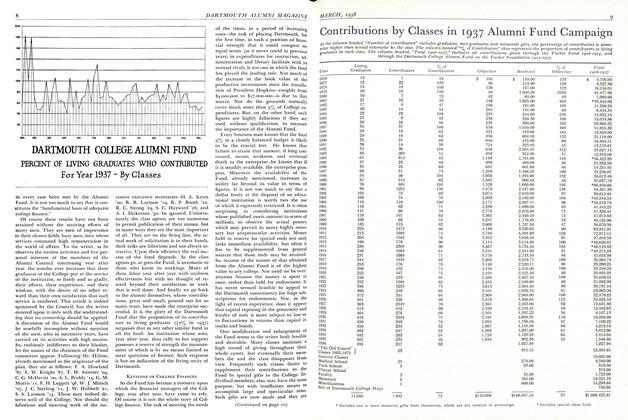
AI.UMNI FUND RECORD FOR 193757 contributors (74% of graduates),total gifts of $1,466.28 (109% of objective ).
MORTON C. TUTTLE, Class Agent
CONTRIBUTORS
1897 Adams, Benjamin F. Appleton, Fred S. Bacon, Arthur A. Bolser, Charles E. Boyd, J. Merrill Brown, Jay D. Brown, Maurice F. Butterfield, Ernest W. Carr, Edward G. Cass, Edgar D. Chase, Henry M. Christophe, Herman Clay, Paul R. Conlon, James H. Drew, Frank E. Folsom, Ralph P. Foss, George E. Gibson, Hamilton Ham, William H. Heald, Franklin E. Holt, Hermon, Jr. Huckins, Theron H. Johnson, Frank C. Keating, John F. Kelly, Walter F. Lewis, George M. Lull, Henry M. McCornack, Walter E. McFee, William D. Marshall, Benjamin T. Meserve, John S. Morrill, Albert H. Mosher, Loren A. Noyes, Frank H. Pillsbury, Charles H. Rowe, Brainard A. Ryan, Joseph F. Sanborn, Byron Shattuck, Harold B. Sibley, J. Otis Smith, Erdix T. Smith, Selden C. Taylor, Burpee C. Temple, Winfield Tent, George E. Thorne, John T. Tracy, Charles A. Tuttle, Morton C. Ward, Roy J. Watson, Albert P. Wood worth, Edward K.
Secretary, State Capitol, Hartford, Conn.
More From This Issue
-
 Feature
The Story of the Alumni Fund
March 1938 -
 Feature
Report of 23rd Alumni Fund Campaign
March 1938 -
 Feature
Rankings of Classes on 1937 Alumni Fund Achievement
March 1938 -
 Feature
Contributions by Classes in 1937 Alumni Fund Campaign
March 1938 -
 Feature
Green Derby Contests for 1937
March 1938 -
Feature
Annual Records of the Fund from 1916 to 1937
March 1938