IV. Wilson Hall
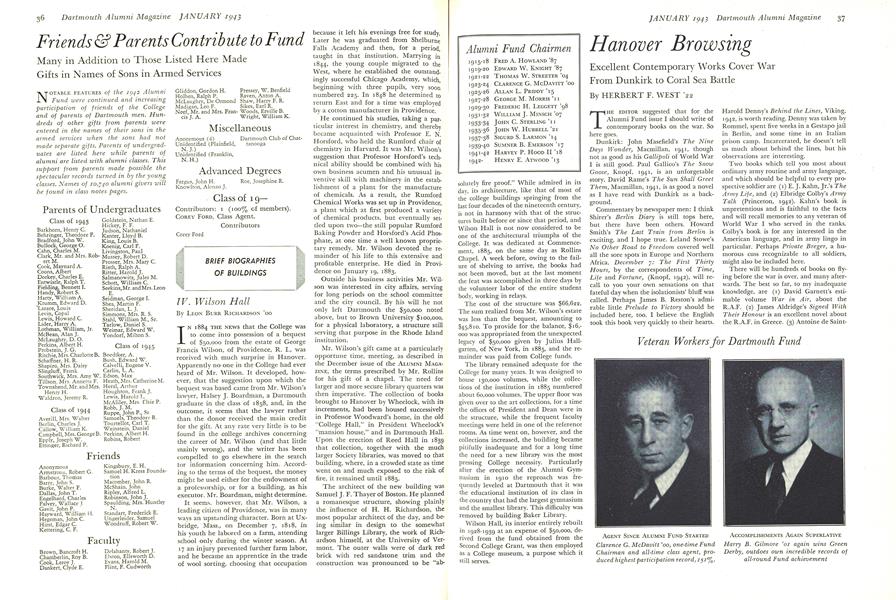
IN 1884 THE NEWS that the College was to come into possession of a bequest of §50,000 from the estate of George Francis Wilson, of Providence, R. 1., was received with much surprise in Hanover. Apparently no one in the College had ever heard of Mr. Wilson. It developed, however, that the suggestion upon which the bequest was based came from Mr. Wilson's lawyer, Halsey J. Boardman, a Dartmouth graduate in the class of 1858, and, in the outcome, it seems that the lawyer rather than the donor received the main credit for the gift. At any rate very little is to be found in the college archives concerning the career of Mr. Wilson (and that little mainly wrong), and the writer has been compelled to go elsewhere in the search tor information concerning him. According to the terms of the bequest, the money might be used either for the endowment of a professorship, or for a building, as his executor. Mr. Boardman, might determine.
It seems, however, that Mr. Wilson, a leading citizen of Providence, was in many ways an upstanding character. Born at Uxbridge, Mass., on December 7, 1818, in his youth he labored on a farm, attending school only during the winter season. At 17 an injury prevented further farm labor, and he became an apprentice in the trade of wool sorting, choosing that occupation because it left his evenings free for study. Later he was graduated from Shelburne Falls Academy and then, for a period, taught in that institution. Marrying in 1844, the young couple migrated to the West, where he established the outstandingly successful Chicago Academy, which, beginning with three pupils, very soon numbered 225. In 1848 he determined to return East and for a time was employed by a cotton manufacturer in Providence.
He continued his studies, taking a particular interest in chemistry, and thereby became acquainted with Professor E. N. Horsford, who held the Rumford chair of chemistry in Harvard. It was Mr. Wilson's suggestion that Professor Horsford's technical ability should be combined with his own business acumen and his unusual inventive skill with machinery in the establishment of a plant for the manufacture of chemicals. As a result, the Rumford Chemical Works was set up in Providence, a plant which at first produced a variety of chemical products, but eventually settled upon two the still popular Rumford Baking Powder and Horsford's Acid Phosphate, at one time a well known proprietary remedy. Mr. Wilson devoted the remainder of his life to this extensive and profitable enterprise. He died in Providence on January 19, 1883.
Outside his business activities Mr. Wilson was interested in city affairs, serving for long periods on the school committee and the city council. By his will he not only left Dartmouth the $50,000 noted above, but to Brown University $100,000, for a physical laboratory, a structure still serving that purpose in the Rhode Island institution.
Mr. Wilson's gift came at a particularly opportune time, meeting, as described in the December issue of the ALUMNI MAGAZINE, the terms prescribed by Mr. Rollins for his gift of a chapel. The need for larger and more secure library quarters was then imperative. The collection of books brought to Hanover by Wheelock, with its increments, had been housed successively in Professor Woodward's home, in the old "College Hall," in President Wheelock's "mansion house," and in Dartmouth Hall. Upon the erection of Reed Hall in 1839 that collection, together with the much larger Society libraries, was moved to that building, where, in a crowded state as time went on and much exposed to the risk of fire, it remained until 1885.
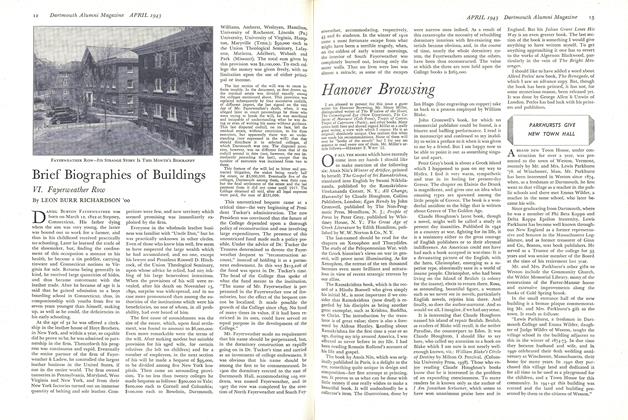
The architect of the new building was Samuel J. F. Thayer of Boston. He planned a romanesque structure, showing plainly the influence of H. H. Richardson, the most popular architect of the day, and being similar in design to the somewhat larger Billings Library, the work of Richardson himself, at the University of Vermont. The outer walls were of dark red brick with red sandstone trim and the construction was pronounced to be "absolutely fire proof." While admired in its day, its architecture, like that of most of the college buildings springing from the last four decades of the nineteenth century, is not in harmony with that of the structures built before or since that period, and Wilson Hall is not now considered to be one of the architectural triumphs of the College. It was dedicated at Commencement, 1885, on the same day as Rollins Chapel. A week before, owing to the failure of shelving to arrive, the books had not been moved, but at the last moment the feat was accomplished in three days by the volunteer labor of the entire student body, working in relays.
The cost of the structure was $66,622. The sum realized from Mr. Wilson's estate was less than the bequest, amounting to $45,810. To provide for the balance, $16,000 was appropriated from the unexpected legacy of $50,000 given by Julius Hallgarten, of New York, in 1885, and the remainder was paid from College funds.
The library remained adequate for the College for many years. It was designed to house 130,000 volumes, while the collections of the institution in 1885 numbered about 60,000 volumes. The upper floor was given over to the art collections, for a time the offices of President and Dean were in the structure, while the frequent faculty meetings were held in one of the reference rooms. As time went on, however, and the collections increased, the building became pitifully inadequate and for a long time the need for a new library was the most pressing College necessity. Particularly after the erection of the Alumni Gymnasium in 1910 the reproach was frequently leveled at Dartmouth that it was the educational institution of its class in the country that had the largest gymnasium and the smallest library. This difficulty was removed by building Baker Library.
Wilson Hall, its interior entirely rebuilt in 1928-1939 at an expense of 150,000, derived from the fund obtained from the Second College Grant, was then employed as a College museum, a purpose which it still serves.