1917
The Hats Off Department this month rises, uncovers, and gives a long cheer for Capt. Sam White USNR. The good news comes, not from Sam, but from Lt. Col. Gil Swett, recently transferred to Sam's section of the late circle closing on Japan. Gil says:
All '17ers will be interested in the news that Sam is now a four-striper. One of the pleasant surprises waiting me out here was to find Sam on the same base, and we've been seeing quite a bit of each other. The promotion was one of those "popular choice for President" affairs, which all the Navy Joes out here seemed to recognize wholeheartedly as a deserved boost. His job is a key one, and one that is seldom entrusted to any but Annapolis graduates,—the Staff Operations officer on a "flag rank" command. At present, in addition, he is acting Chief of Staff,—the Admiral's top brass hat. The extra stripe was washed down well with Navy grog, and I have just recovered sufficiently to be able to write you the news without shaking ink all over the page. It was an occasion, and the very evident appreciation of the Navy of this solid citizen was gratifying. (The place was lousy with rank.) Also had another surprise in finding my brother's ship in the same area, with a chance to see him occasionally. My own assignment up here has turned out to be a happy one for me. It's rugged country, but most of the rough edges have been filed off by my predecessors. Food is good. My quarters look from the outside like a railroad section hand's shack, but inside it has all the comforts, including electricity, shower bath, pin-up decorations, and hot and cold running whiskey. The officers with whom I am associated are as congenial a gang as I have yet struck in the service, and the work is interesting and, I think, reasonably effective.
Not only is a letter from Brig. Gen. Ed Langmead a rare pleasure but we wish to commend him on his accurate forecasting:
The war is, for the Air Forces, practically over. We have about run out of targets. The'' ground forces have a bit of mopping up to do and then we can all get back to our ice cream and hamburgers. Speaking with true Air Force bias I say that the German lost his war when, in 1944, he failed to protect his industrial and transportation structure against the combined attacks of the RAF Bomber Command and the U. S. Army Eighth Air Force. The devastation of the Rhineland cities is complete. What the German Luftwaffe failed to do to England we did to Germany. The result is not pleasant to contemplate. Actually it makes you "sick at your stomach" to drive through the cities which were Cologne, Frankfort, Mannheim, etc. All that is left is the pavement of the streets, with great piles of rubble on either side. I spent last winter in the Department of Vosges. The terrain and climate did remind me of New Hampshire. We had about fif-teen days of zero weather, and snow that piled up to about twenty-one inches on the level. The young folks did a bit of skiing but I had just enough sense to refrain from showing them how to do it. Our operations were snowbound during January. February brought us a freak spell of good weather and we wiped out the Colmar pocket. Don't ever let any of your Navy friends scare you into any sleepless nights with that Pacific war boogie. When we turn toward Japan the combined resources that has defeated Germany, and that includes the Russian forces, the job to be done will look rather small. That 16-year-old boy of yours (and my 15-year-old boy) will be grieving over the swell war they just missed by a couple of years. Incidentally, the cycle of European wars has been thrown'off schedule by the perversity of the German to admit defeat. He isn't going to be ready to start another ruckus for quite a spell. Of Bolshevism and the Russian I have no fear. Russia has the greatest undeveloped resources in the world. To the development of these resources the Russian nation will devote her energies, after she has assisted in the securing of her Siberian empire by participation in the defeat of Japan.
Perhaps Ed's letter is a little biased in favor of the Air Force, and not without reason. Being confirmed civilians, however, well just sit that one out.
A real pleasure recently was that of looking up Mark Penick in Quincy, Ill. A little conspiracy with his daughter Marcia, eighteen, resulted in the picture which embellishes this column. Mark has gained a little girth, like most of us, but his interest in all things '17 has not waned. Returning from two and a half years of service in World War I, a pilot with the 141 st A.S.; Mark studied law at Chicago University and received his degree in 1922. The pleasant evening at his home included not only Mrs. Penick and Marcia, but also the other member of the firm of Penick and Penick, Mark's father. Besides being one. of the city's leading attorneys, specializing in matters of chancery, Mark served a four-year term in the Illinois State Legislature, 1932-1936, and, thereafter, twoN terms as State's Attorney for Adams County, ending in 1944. His hobby is photography, of which the lovely Penick home exhibits several fine examples. In fact, Mark was recently awarded a verdict by a picked group of judges for the finest example of amateur photography, and the winning picture was published in Camera. Mrs. Penick ably manages the domestic phases of Mark's life, searches for food for the family, and maintains an active interest in Girl Scouts, sorority, and other similar social affairs, no doubt partially sponsored by their attractive daughter. Marcia, who graduated from Stevens College, Columbia, Mo., '44, is now a sophomore at Purdue planning her course toward a science major.
Fat Spears has resigned as coach at University of Maryland, and will devote his attention wholly to the practice of medicine in the future. Starting with the Big Green in 1917, he has coached West Virginia, Minnesota, Oregon, Wisconsin, and Toledo in the intervening years. Our best wishes go with Fat wherever he settles.
Dartmouth Night at The Pops in Boston in mid-July attracted a representative group of 'i7ers with their wives and families. Those seen in Symphony Hall were the Houghton Carrs, Duffy Karnan, the Maclntyres, the MacKillops, Irma McGowan and son Tommy home on furlough from the submarine service, the Olds, the Sunny Sanborns, the Saults, the Derring Smith family, the Stockwells, and Hal and Jo Weeks. Our hope is that the Dartmouth sponsorship was successful so that the evening may be repeated next year.
The friends of the late Cliff Thompson will be interested to know that Lill and her four children have survived the war and the occupation in France. You will recall that Cliff met and married Lill in France during World War I, and brought her with him to the States when he returned. After Cliff died in an airplane crash, Lill returned to France with the children, and sometime later remarried. When the Germans took over, her husband was murdered, and the children all sent to a concentration camp. Her daughter, Helen, belng an American citizen, was released after three weeks, but it was only comparatively recently that Lill was rejoined by her three sons. The Germans had taken all my clothes, furniture, and everything, and I am just getting to recover a few things and have a home again." Hers has been a tragic life, but we are greatly relieved at last to know that she and the children are alive and safe.
Tom Cotton could cool you off on the hottest day of the year, telling of the shaded' old swimming pool just back from the Hudson at Bear Mountain where he enjoys week-ends. One Sunday, a record breaker, undaunted by the torrid weather, Tom put in a full day of manual labor, sheathing the country attic with 9x5 plaster boards, right up to the boiling point. "It relaxes me," said Tom, "putting in a full day fixing the pump and doing the thousand and one things around the cottage." Speaking of the Russians, with whom he has had considerable first-hand experience, Tom says, "They're fine folks, but are like a family which never had a penny and suddenly inherits a million bucks. Let 'em settle down "and stop throwing their weight around and- they'll be 0.K."
Alden Vaughn is still teaching at Blake School for Boys in Minneapolis and apparently enjoying the experience. He did not enjoy moving recently, however, in the war-crowded city, and reports now being pretty well bruised up learning to live in a two-room apartment. Hank Bomgardner writes:
Been selling automobiles and service, paying fraternity dues, and occasionally kick in to '17 funds for 25 years. Fine visit with Baldy Trier recently but missed seeing any of gang in Washington or New York. My boy spent his third Christmas in Navy, his wife a Wave. My daughter (Wasp) has hung up her flying togs and is attending Katherine Gibbs School in Boston. Her husband, a B-25 pilot was shot down South Pacific,—three posthumous awards. I keep busy meeting payroll, 40 to 50 employees, serving on two State boards, and too many local boards, but still have time to draw to an inside straight once a week at the Country Club. As far as Dartmouth activities go I'm a lost ball in the tumble weeds, way out here on the Wyoming Nebraska border.
Not so Hank. It's impossible to be a lost ballto 'l7, particularly with a record like that.Sherm Smith says:
Natalie was graduated from Simmons College June 11. Alan, having completed infantry basic at Camp Croft, is studying Japanese at the University of Chicago, previously had two semesters in the University of Connecticut, studying engineering under ASTRP. One of his instructors is Mitsui, whose father was Mitsui '15, and who himself is Dartmouth '43. Natalie and Gladys went to the summer place at Tahanto, Cape Cod, this summer and I found transportation to get there occasionally.
Sherm invited all '17ers to look the Smiths up on the Cape, and we are sorry not to have caught the August issue with the invitation. Our fault in moving around so much. Maybe he will issue rain checks good during the summer of '46.
On our own behalf we can report a fairly successful vacation in being privileged at intervals to share our chowder with Al and Helen Emmons, Don and Helen Brooks and Betty, Spique and Ruby Maclntyre and Phil and Jo Evans. The only way it could have been improved upon is by luring more of the gang our way. It was fun, however, as was, and we are always hopeful. Major Butch Sherman and Lee had the best of intentions. They planned a Sunday trip from Boston but were prevented by w.k. tire troubles. Now we are already looking forword to next summer.
With gas again available, it becomes easier to see the Big Green in action, even on thin tires, if you are careful. With games in Syracuse, New Haven, Princeton, Hanover, and New York remaining, there isn't an alibi that will cover an easterner's not seeing at least one. And, particularly, do not forget Bob and Anita Scott's invitation to cocktails after the Yale game. That is a real reunion.
LAWYER-LEGISLATOR, Mark Penick 'l7, is another Dartmouth alumnus whose avocation as well as his vocation is winning him renown. An amateur photographer, one of his camera studies was re- cently judged finest of its type and published in Camera.
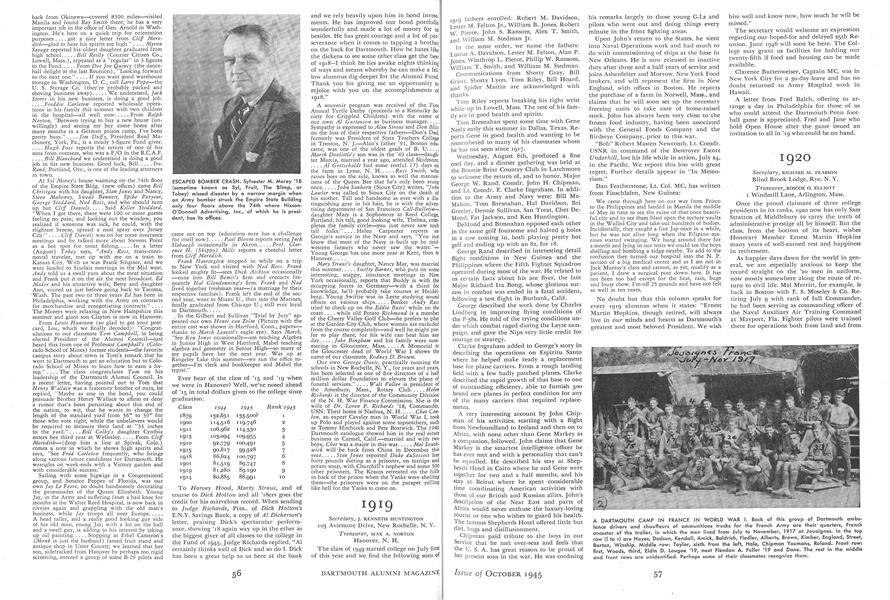
A DARTMOUTH CAMP IN FRANCE IN WORLD WAR I. Back of this group of Dartmouth ambu- lance drivers and chauffeurs of ammunitions trucks for the French Army are their quarters, French ancestor of the trailer, in which the men lived from July to November, 1917 at Jouaignes. In the top row (I to r) are Hayes, Dodson, Kendall, Amick, Baldrich, Fiedler, Alberts, Brown, Kimber, England, Street, Barton, Winship. Middle row: Taylor, sixth from the left. Hale, Chipman Youmans, Roland. Front rows first. Woods, third, Eldin D. Lougee 'l9, next Flendon A. Fuller 'l9 and Dane. The rest in the middle and front rows are unidentified. Perhaps some of their classmates recognize them.
Secretary, 57 Chestnut St., Dedham, Mass.
Treasurer, 9 Park Terrace, Upper Montclair, N. J.