The Homestretch
THEY call it the homestretch. And they're lazy days. You all know the thing that is Spring in Hanover, and you all know the sub-species, Senior Spring in Hanover, but there is something in being here as it happens, in having it your own Senior Spring, which convinces you that there must be something a little different in this one that sets it apart from all the others. Much is undoubtedly the same, but even in the sameness there is a compulsion which cannot be snidely tossed aside.
Seniors have seen three other springs here, but there is a quickening tempo through that last year which just about now drums an excitement into you that's hard to keep inside. The first twinge came with the torches and the blaring band and the songs and cheers that made up Dartmouth Night last fall. It was really the first time you tagged anything "the last." You soon forgot though. Then there was "the last" home game, that always to be remembered win over Cornell, and it took a little longer to forget. Then mid-semesters, "the last" Carnival,
"the last" semester, "the last" hockey game, and the "lasts" began to snowball. Some began to mention it now, but still laughingly. After all, everybody knows there is something weak in nostalgia. So you continue doing the normal things, being as calm as the next one. The nagging thought that your daily routine will not be normal very much longer is a little unpleasant, but it's nice in a way too.
Suddenly, almost, everyone is saying, Six more weeks!" but still the inflections differ. Six more weeks to those little things you can hold in your hand like the clay pipes, and the big things you can't, like the way it must be when that "last" note of your "last" Men Of Dartmouth skids over Balch Hill and dies. You begin to open your eyes to a lot of things which are really very new to you.
They've probably taken down the shutters on Dartmouth Hall every spring, and chipped the old white paint away so that the rusty brick shows through, but this time—now the red specks stand out against the surgical white of the walls, and it looks like a sick thing with measles. And you wish they'd hurry up and finish. You wish they'd put the shutters back.
You know they've pounded the little green posts into the not-yet-green grass every spring for a long time too, but on these mornings you wish the green spot would hurry and creep to the edges of the paths so that they could take those reminders of incomplete spring away.
And the smudgy clumps of corn snow have lain around this long before too, but you wish those vestiges of Spring Not Quite would run off. They aren't the right background for a softball game. You wonder what the craggy little
You wonder what the craggy little men who collect the duckboards are thinking, and what thoughts are running through the heads of the men in the high-laced boots who are up trimming the trees even before eight o'clock classes. And you notice men glancing up at the sky and the hills more often as they slowly course to class and back.
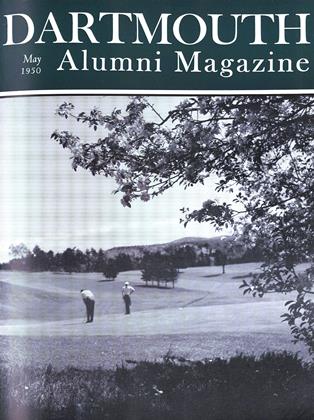
Even the President has caught it. You looked up from that approach shot on the twelfth hole the other day, and there he was slowly walking by the edge of the trees. And it was kind of nice to notice when he shifted position in Great Issues the other morning that he wore one sporty argyle sock and one brown one. A thing a man can do on a nice spring morning.
With these things, your thesis-due date still seems a long way off, the hour exams sneak up more silently than usual, the walk to Baker strangely long, the books more imposing. You can hear those unspoken admonitions from those few who can still admon- ish: "Finish it up with a bang," or, "Don't let down." And you know they're right, but . . .
New thoughts and feelings come along with the consciousness of things. One minute you think you'd like to be picking courses for another year, then the next feeling that the six weeks with all their exams and books will never pass. You look forward to The Day, and yet you don't; at the same time realizing that nothing new lies in that dilemma, really, even though it's new to you. You ask yourself a lot of big blunt questions, knowing that they too have all been asked before. The answers come hard. And even that's a part of it.
There are more cars back from spring vacation, and yet you realize that you'll have to give up a weekend to cover your senior tax. That comes hard too. The nice days seem endless. You want only to do nice and easy things, but there are so many things to do which aren't nice and easy. With the green hills and blue sky also comes the thought that this may be another "last," the "last" New England spring, at least the last one which will be anything more than a memory goad. This realization hones your appreciation and consciousness to an even keener point, and you have to smile at yourself—realizing the magic in twenty-one years; at the same time glad you do.
No explanation offers itself as to why you make a point of saying hello to passing acquaintances; why you stand on the Inn corner for so long after dinner, just talking; why the beer talk in these days turns more and more to warm remembrances of good times had, of fewer ones awaited. You sense an almost frantic remembrance already. Everyone seems to be trying to hold close—even unconsciously—the things enjoyed, so that the ones who made these things will not slip out of reach or out of mind. You know many of them will. Jokes are made about what Dick'll be doing by the time fifth reunion rolls around, and whether by then Louise will even let George come —too many parties. You know some will not even come back. Like pariahs they took what they wished of the four years, feel they owe nothing, see no reason to return. You pity them in their loss.
You realize that so many of the things you remember here are tied to groups, to other men all very much like yourself. There are associations and connections; you have melted into the whole in some ways, become a part of a community. Now, with G-Day so close, you can see that in reality you were alone through it all; made your own choices, took only as much as you gave. It was an individual's experience, and you yourself are the final winner or loser. You have had the chance to learn to contain your own chaos. With this dawning comes a few regrets.
But regrets, afterthoughts, complaints, things you'd like to change, bitter memories, barren places—the unpleasant things-they are not for these days. They are winter thoughts, and winter is gone.
For many the days of surety, of knowing, are soon to be gone. You will have to pay the bills, and when you come or go will not depend on the way the Dean makes up the College calendar. There's a moment of panic. The ivory tower days are dying, and your thoughts on this are not simple. "Realities" have been thrown up at you more than anything else these past four years, and now you'd like to face a few of your own. They may break you. You may bend them. You know that the odds aren't stacked against you any more than against the next guy—if you don't want them to be. But the unknown always provokes hesitation, even if you know little time remains in which to hesitate. There is a little more, though.
You see, almost every day, the elections in which new men, kids no longer, take over your jobs, your collegiate responsibilities, and you suddenly look up to find you can no longer "spot" the freshmen. "Pass and be forgotten with the rest..." the song goes. You hope you won't, but know you probably will. With this thought you see the College as a Real Thing for maybe the first time. To you, and others like you before and after, it gives, offers, and there will always be others standing by ready to step to the line. You're glad—then more thoughts crowd close in tumbling, confused regiments.
Then you look back to the little men spreading the lime and the fertilizer, the guy practicing his chip shots on the lawn, who you'll get for a Green Key date and whether you'll remember her name in two years, the professors you got to know and like and sympathize with, and the ones you laughed at, realizing at the same time they were big men. But the laughter and the parties are easy to remember, these things that are the fiber of the draining days. You're appreciative and critical, glad and sorry about it all. Occasionally the thousands of pieces almost fall together into a whole picture, but then they don't and you're still confused.
The cynics—and there are thosewould write it all off as "the recurring college pattern." But you are sure, here in the spring sunlight, that small improvement could be made on these days that will not come again. And you're right.
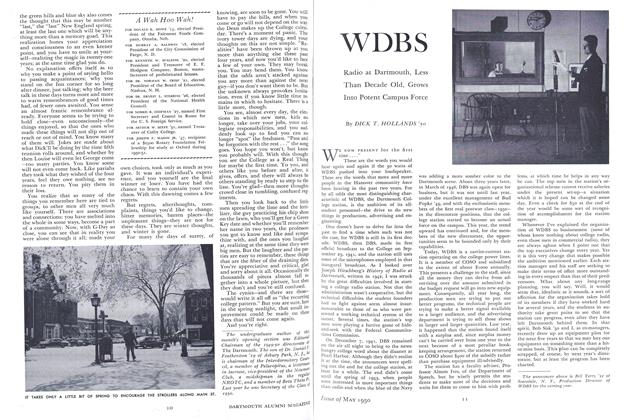
IT TAKES ONLY A LITTLE BIT OF SPRING TO ENCOURAGE THE STROLLERS ALONG MAIN ST.
Undergraduate Issue This month we present our annual Undergraduate Issue, a traditional spring event in the ALUMNIMAGAZINE'S publication year. Undergraduates have contributed a great part of the editorial, photographic and art contents, and other features of this issue are devoted to student activities and achievements during the college year 1949-50.
A Wah Hoo Wah!FOR DONALD K. HOWE '15, elected President of the Fairmont Foods Company, Omaha, Neb. FOR MURRAY A. BALDWIN '18, elected President of the City Commission of Fargo, N. D. FOR KENNETH W. SPALDING '20, elected President and Treasurer of E. F. Hodgson Company, Boston, manufacturers of prefabricated houses. FOR DR. NORMAN w. CRISP '21, elected President of the Board of Education, Nashua, N. H. FOR DR. ERNEST L. STEBBINS '26, elected President of the National Health Council. FOR NORRIS B. CHIPMAN '27, named First Secretary and Consul in Rome for the U. S. Foreign Service. FOR ARTHUR w. SEEPE '31, named Treasurer of Colby College. FOR JOSEPH F. MARSH JR. '47, recipient of a $2500 Rotary Foundation Fellowship for study at Oxford during 195-'51.
The undergraduate author of th'smonth's opening section was EditorialChairman of the 1949-50 directorate 0f The Dartmouth. The son of Dr. Daniel I Featherston '19 of Asbury Park, N. J., heis chairman of the Interdormitory Council a member of Palaeopitus, a lettermanin lacrosse, vice-president of the Newman Club, a midshipman in the regularNROTC, and a member of Beta Theta Pi-Last year he was Secretary of the Class of 1950.