1899
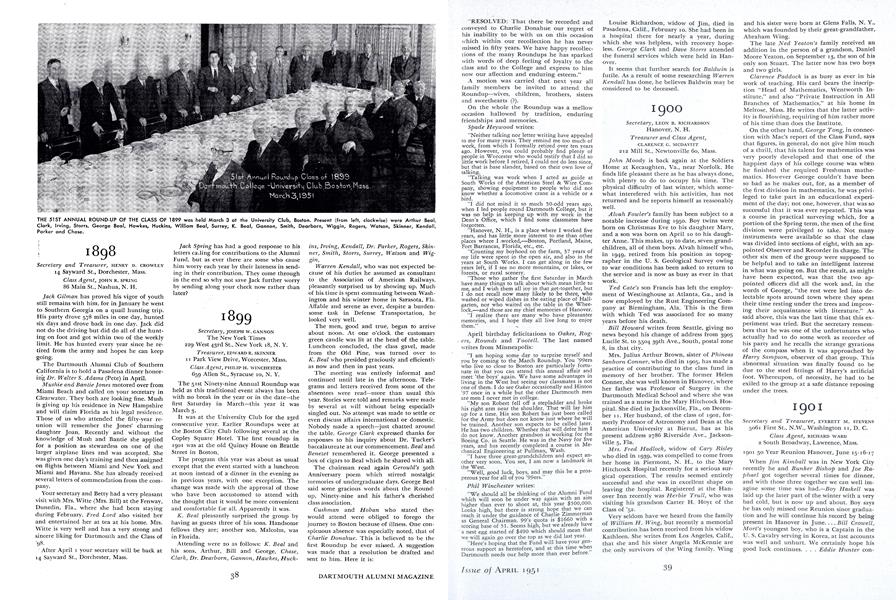
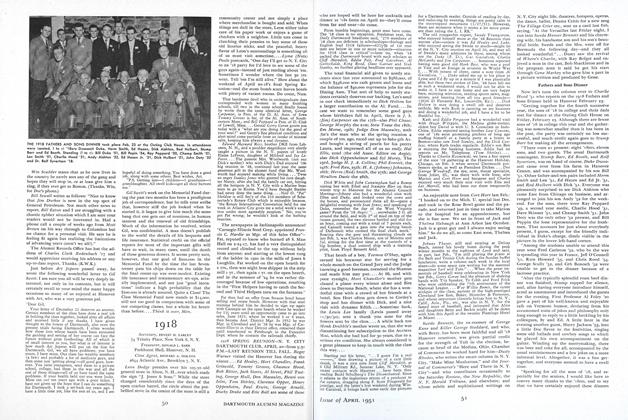
The 51st Ninety-nine Annual Roundup was held as this traditional event always has been with no break in the year or in the date—the first Saturday in March—this year it was March 3.
It was at the University Club for the 23rd consecutive year. Earlier Roundups were at the Boston City Club following several at the Copley Square Hotel. The first roundup in 1901 was at the old Quincy House on Brattle Street in Boston.
The program this year was about as usual except that the event started with a luncheon at noon instead of a dinner in the evening as in previous years, with one exception. The change was made with the approval of those who have been accustomed to attend with the thought that it would be more convenient and comfortable far all. Apparently it was.
K. Beal pleasantly surprised the group by having as guests three of his sons. Handsome fellows they are; another son, Malcolm, was in Florida.
Attending were 20 as follows: K. Beal and his sons, Arthur, Bill and George, Chase,Clark, Dr. Dearborn, Gannon, Hawkes, Huckins,ins, Irving, Kendall, Dr. Parker, Rogers, Skinner, Smith, Storrs, Surrey, Watson and Wiggin
Warren Kendall, who was not expected because of his duties he assumed as consultant to the Association of American Railways, pleasantly surprised us by showing up. Much of his time is spent commuting between Washington and his winter home in Sarasota, Fla. Affable and serene as ever, despite a burdensome task in Defense Transportation, he looked very well.
The men, good and true, began to arrive about noon. At one o'clock the customary green candle was lit at the head of the table. Luncheon concluded, the class gavel, made from the Old Pine, was turned over to K. Beat who presided graciously and efficiently as now and then in past years.
The meeting was entirely informal and continued until late in the afternoon. Telegrams and letters received from some of the absentees were read—more than usual this year. Stories were told and remarks were made by several at will without being especiallysingled out. No attempt was made to settle or even discuss affairs international or domestic. Nobody made a speech—just chatted around the table. George Clark expressed thanks for responses to his inquiry about Dr. Tucker's baccalaureate at our commencement. Beat and Benezet remembered it. George presented a box of cigars to Beal which he shared with all.
The chairman read again Gerould's 50th Anniversary poem which stirred nostalgic memories of undergraduate days. George Beal said some gracious words about the Roundup, Ninety-nine and his father's Cherished class association.
Cushman and Hoban who stated they would attend were obliged to forego the journey to Boston because of illness. One conspicuous absence was especially noted, that of Charlie Donahue. This is believed to be the first Roundup he ever missed. A suggestion was made that a resolution be drafted and sent to him. Here it is:
"RESOLVPID: That there be recorded and conveyed to Charlie Donahue our regret of his inability to be with us on this occasion which within our recollection he has never missed in fifty years. We have happy recollections of the many Roundups he has sparked with words of deep feeling of loyalty to the class and to the College and express to him now our affection and enduring esteem."
A motion was carried that next year all family members be invited to attend the Roundup—wives, children, brothers, sisters and sweethearts (?).
On the whole the Roundup was a mellow occasion hallowed by tradition, enduring friendships and memories. Spade Heywood writes:
"Neither talking nor letter writing have appealed to me for many years. They remind me too much of work, from which I formally retired over ten years ago. However, you could probably find plenty of people in Worcester who would testify that I did so little work before I retired, I could not do less since, but that is base slander, based on their own love of talking.
"Talking was work when I acted as guide at South Works of the American Steel & Wire Company, showing equipment to people who did not know whether a locomotive crane is a vehicle or a bird.
"I did not mind it so much 50-odd years ago, when I led people round Dartmouth College, but it was no help in keeping up with my work in the Dean's Office, which I find some classmates have forgotten.
"Hanover, N. H., is a place where I worked five years, and has little more interest to me than other places where I worked,—Boston, Portland, Maine, Fort Barrancas, Florida, etc., etc.
"Counting my boyhood on the farm, 37 years of my life were spent in the open air, and also in the years at South Works. I can get along in the few years left, if I see no more mountains, or lakes, or forests, or rural scenery.
"Those who gather the first Saturday in March have many things to talk about which mean little to me, and I wish them all joy in that get-together, but I do not recall now many likely to be there, who washed or wiped dishes in the eating place of Hallgarten, nor who waited on the table in the Wheelock,—and those are my chief memories of Hanover.
"I realize there are many who have Pleasanter memories., and I hope they all live long to enjoy them."
April birthday felicitations to Oakes, Rogers, Rounds and Tootell The last namedwrites from Minneapolis:
"I am hoping some day to surprise myself and you by coming to the March Roundup. You '99ers who live so close to Boston are particularly fortunate in that you can attend this annual affair and meet 'the boys' again. We have some advantages in living in the West but seeing our classmates is not one of them. I do see Oakes occasionally and Hinton '97 once in a while but the other Dartmouth men are men I never met in college.
"My son Robert fell off a Stepladder and broke his right arm near the shoulder. That will lay him up for a time. His son Robert has just been called for the Army but does not know just where he will be trained. Another son expects to be called later. He has two children. Whether that will defer him I do not know. Another grandson is working for the Boeing Cos. in Seattle. He was in the Navy for five years, and has recently completed a course in Mechanical Engineering at Pullman, Wash.
"I have three great-grandchildren and expect another very soon. You see, I am now a landmark in the West.
"Well, good luck, boys, and may this be a prosperous year for all of you '99ers."
Phil Winchester writes:
"We should all be thinking of the Alumni Fund which will soon be under way again with an aim higher than ever to shoot at, this year $500,000. Looks high, but there is strong hope that we can reach it under the guidance of Charlie Zimmerman as General Chairman. 99's quota is $1660 with a scoring base of 51. Seems high, but we already have a nest egg started of $490 which should mean that we will again go over the top as we did last year.
"Here's hoping that the Fund will have your generous support as heretofore, and at this time when Dartmouth needs our help more than ever before.
Louise Richardson, widow of Jim, died in Pasadena, Calif., February 10. She had been in a hospital there for nearly a year, during which she was helpless, with recovery hopeless. George Clark and Dave Storrs attended the funeral services which were held in Hanover.
It seems that further search for Baldwin is futile. As a result of some researching WarrenKendall has done, he believes Baldwin may be considered to be deceased.
Secretary, The New York Times 229 West 43rd St., New York 18, N. Y. Treasurer, 11 Park View Drive, Worcester, Mass. Class Agent, 659 Allen St., Syracuse 10, N.Y.