On Learning
EVERYWHERE I turn I read in a scholarly book or hear on the radio or from the pulpit that man is a Yahoo, the world a madhouse, and the universe bristles with hostility to man. I read a much-praised book called The Conservative Mind. I find that the main assumption the book is that man is weak and vicious by nature, the main thing about his temper is that he is given to sin and violence. All the conservative thinkers chosen for study in this book assume that the intellectual position of the conservative man can not be maintained except by the assumption that man is a terrible weakling. They do not believe that their distrust of all radical social change, which is the essence of the conservative mood, can be argued except by first building up a picture of individual human nature as corrupted by original sin.
You can add to this compulsion to insist on a vicious human nature an equally insistent description of a vicious external nature. A recent example of that is good old Robert Frost saying to millions on television one Sunday afternoon last winter: "Don't forget, nature is cruel!" And the normally kind old poet thrust out his lower lip and he seemed almost angry as he said it. He went on to deny that he had ever written any nature poems, almost as if he had been accused of some perversion.
Thus far we have established a vicious human nature and a vicious external nature. Now we only have to note examples in current conviction of a vicious God. That hit me when I read the fairly recent book, Melville's Quarrel With God. Or again when I read some essays by the neo-Calvinist Kierkegaarde, such essays as "Sickness Unto Death."
Now I ask if these are not the three blasphemies of modern thought. How can you breed a race of confident and achieving and hopeful men if the mind is sicklied o'er with this sort of basic despair about man's inner nature, external nature, God's nature? I leave aside such despair as is engendered by the spectacle of a technology inventing monstrous engines of destruction that we have no will or means to control.
When I get weary of hearing thrown at me all these assertions that all is vicious I turn in reverie to some of my powerfully uneducated neighbors in Maine who don't know enough to be unhappy or to realize that to some of our most powerful modern minds man's nature, external nature, and God's nature are cruel. These people escape much moral gloom just because it takes a lot of higher education to attain the higher levels of unhappiness. Yet these people when bright, as some of them are, have powers of intuition, of instinctual wisdom, and of carrying on by animal faith that some intellectuals lack because, though they have it potentially by heritage, they allow it to atrophy. They might do well to try to recapture it.
At this point some of you will think that I am about to present another of those too familiar anti-intellectual blasts. But I am not. If I were to nail a motto to my masthead it would be a sentence from Philosopher Whitehead's Science and the ModernWorld: "Intellect alone is not enough; it must be supplemented by intuition." And I would urge you to note that he says supplemented, not supplanted. In first sampling the vein of sentimental nihilism in modern thought, and then moving along into what I have learned out of school from people rather than from books, about our instinctual resources, I too am interested in stressing how we may supplement our intellectual activity, and not abandon mind, as if it were a sinking ship, for the life-raft intuition.
You may have seen in the New Yorker magazine a cartoon that pictures a stout summer person on the lawn of her Cape Cod summer home. She is saying with a deep sigh, "Oh dear, how happy we could be if it were not for Russia!" We all know that something gnaws us, and we can all too easily find the cause in something unpleasant and nearest at hand. But something gnawed at our hearts long before Russia began to.
In his most recent play, The Confidential Clerk, T.S, Eliot puts his finger on the real ogre. Sir Claude is exclaiming about his passion for ceramic art:
I sometimes have that sense of identification With the maker, that I spoke of - an agonizing ecstasy Which makes life bearable. It's all I have. I suppose it takes the place of religion. ... I dare say truly religious people - I've never seen any - can find some unity. Then there are the men of genius. There are others, it seems to me, who have at best to live In two worlds: each a kind of make believe: - That's you and me.
Note the key phrases in this speech. Truly religious people discover a unity that makes life bearable. Then note that what makes the sentimental nihilists find life unbearable is what Henry Adams called "multiplicity," the antithesis of unity. Or as he says, "Man craves order but nature is chaos." Or Virginia Woolf insisting on a fragmentized world in which no patterns can be seen, and experience at best is formless incandescence, a luminous halo, knowable only in single moments. Eliot then makes Sir Claude say that he can find no religious people. That is typical of modern pessimism: religion would be a great help but religion is beyond us. As Kierkegaarde, the Danish neo-Calvinist puts it, there are no Christians in Christendom because Christ demands absolute surrender and all men will hang on to some of their vices. Or as The ConservativeMind sees it: every social or economic question always gets back to the theological fact of original sin and the universality of what Hawthorne called "that sink of iniquity, the human heart." So that if all men are perverse what chance is there that any of their schemes for social improvement are anything but perverse also? The speech from the play ends as you will note with the suggestion that most people live in two worlds instead of an integrated world and so all men lead lives of quiet desperation. In this speech, then, T. S. Eliot puts his finger on what gnaws us: It is our inability to see unity instead of a fragmentized world; we see a meaningless man in a meaningless universe.
Some writers of course see this mood as originating at the beginning of time. Consciousness itself, which was a punishment meted out to man for the first disobedience, is itself the fall of man, the tragedy of man. For as soon as man began to think at all he at once began to have some thoughts of an unpleasant nature. Nihilism is simply the dark side of the coin called intellect.
Whitehead says in Science and theModern World that the great discovery of science in the 17th century was that the universe is a great order governed by discernible laws. This discovery, he said, energized the modern world and gave it its great creative and hopeful tone. In the 19th century, idealists like Emerson and Wordsworth saw the universe as also a great spiritual order governed by knowable spiritual laws. Emerson's essays became a comfort to thousands of minds, precisely because man craves order as Adam said.
During the last century, or since the middle of the 19th century, man has rapidly lost that great hopefulness. The new Scepticism, or "This Impudent Knowingness" as Emerson called it, has steadily gnawed away at the energy-inspiring dream of a human being and a society of great possibilities and has steadily advanced the paralyzing concept of multiplicity, and of man as an alien in a hostile world.
In American literature right now we are made conscious of the persistence of the nihilistic mood by literary criticism. The literary letter from France in the Sunday Times repeatedly asks this question: why is it that in a country where there is so much wealth and security new novelists are so commonly devoted to violence and frustration and despair? In his recent study of eight young American novelists, Professor Aldridge says that they have style and technique but cannot write important novels because a significant novel cannot be written on the negative theme. One of these young novelists, Bowles, when interviewed this year for . the Times said: "Of course I write a pessimistic novel. What else is there to write? Who but an idiot can be happy today?"
To me the most attractive of the thinkers who recognize the nihilist evidence yet who do not collapse into nihilism is the good Dr. Schweitzer. In his noble book, My Life and Thought, he says, "Never since childhood have I been able to accept as adequate any of the explanations of all the pain in this world. Everyone must accept his share of the world's pain." Dr. Schweitzer admits the great paradoxes and ambiguities but will not despair and will go on hopefully seeking more light. And it is valuable to note that his search for more light is not conducted in the abstract but in the great laboratory of life and people whom he serves in Africa as if one might hope to find through human experience what one might chase in vain while spiralling upward through nebulous abstractions.
PESSIMISTIC ideas should come with the remedy attached just as all iodine bottles should have an attached envelope containing the antidote to be used should one in the night mistake the iodine bottle for cough medicine. Health of course is protection against gloom. If one can whistle and snap his fingers in the morning no pessimism can depress his spirit. Romantic love while it lasts makes one immune to despair. Then one can rebut nihilism partially by noting that Mark Twain and Henry Adams usually came to dire opinions after some personal catastrophe; that is, nihilism is the moan of a stricken heart. Further, nihilistic conclusions rest on a partial selection of data chosen because it will support the negative thesis; another arbitrary selection and arrangement of data will support a more encouraging view.
I believe I could build up by partial selection of data a disturbingly logical view of our present gloom. But I prefer the more hopeful view just because I see more survival value in great expectations of man's capacity for instinctual wisdom, animal faith, and I see no survival value in a nihilistic view no matter how logical its presentation. A young woman who really can't afford a baby is told by her intellect not to have a baby: the budget makes it seem suicidal and besides one doubts the wisdom of bringing a child into so dangerous a world as this has become. An urge of her organism however persuades her that only by this baby will she get experiences she instinctively craves as necessary to her deepest satisfaction from life and also makes her sure that it will bind her man to her as nothing else could. This veto power of the instinct of the organism over the intellect is a good thing. If the only babies ever born were those which could be easily afforded, or got born in only the most propitious times, there would soon not be enough men to man our farms and factories or to resist Russia. Some parts of our lives must be dominated by animal faith or we shall dry up.
The necessary supplementing of the intellect by intuition, the power of some people to be guided by intuition, instinctual wisdom, animal faith, is to me an anodyne and antidote for the bookish pessimism of the sentimental nihilists.
Among the things that I have learned out of school, from people, I might put first the practice of Pragmatic Scepticism. That's nothing but a fancy name I give to that intuitive warning that comes to us when we have come to the end of the usefulness of some theory we have been operating by.
When he found that he was to die soon, Dr. Abraham Myerson, the famous Tufts professor and psychiatrist, wrote a confessional book about what he thought he had Learned out of school. Not what science and books had taught him but what experience had forced upon him. Experience seems to have tought him scepticism. He is sceptical about even his own professional field. He says that he believed in educational psychology until he tried to bring up some children of his own, but that then he came to conclude that every child is an individual problem to be met by catch-as-catch-can methods. Dr. Myerson discovered that at a certain point theory and book learning fail you, and you thereupon have to fall back on something else.
There is an anecdote I always called a typical Maine story until I heard it told as a typical Vermont story. Asa Sprowl came from a country store with a basket of canned goods which he had just got by trading eggs. Some one asked: "How much did you get for your eggs, Asa?" And Asa replied, "Wal, didn't git so much as I expected I would - but didn't expect I would." Asa's attitude is an example of pragmatic scepticism. Up-country men who live thus cautiously will never lose money in the stock market, will always vote Republican, may marry a widder and will expect her to make good riz biscuits but will not expect her to be a Tame Angel - but rather just another mammalian biped with a temper as uncertain as their own.
Another example comes from my experience as a young husband and father. I had become enamored of Spencer's book on education. I thought I should bring up my children by his ideas. Let nature teach the child what he needs to know to survive and prosper in this dangerous world, he said. The parent should contrive situations to that end. If the child wants to touch the red-hot stove, avoid saying
"No," or "Don't," which alienates the child. Rather say, "I am your friend. I want you to be happy, to do the many things you want to do. But look at this cruel scar on my hand where I touched a hot stove. You may touch the stove if you are sure you want to, yet I am your friend and do not want you to get hurt." You are then to hope that he may touch the stove, though gingerly. And when he gets burned he will look at you with respect, and he will believe you are his friend. Nature will have taught him and you will have come through the instruction without the no's and don'ts that poison the parent-child relationship.
It is a lovely theory. And sometimes it works. But not always. One day our little girl, hardly more than a baby, came running out into an old apple orchard where I had just thrust a long ladder far up into the green canopy of an old Baldwin tree. She at once made for the ladder and began climbing. Still respecting the wisdom of Spencer, I restrained my impulse to snatch the child from the ladder and watched anxiously. If nature was about to teach the child another lesson I hoped she might do so promptly, and no higher up than the fourth rung. There was no time to go through the rigamarole, "Papa is your friend, Papa wants you to be happy climbing ladders, but once when Papa was climbing a ladder" and so on. I could just hope that this lesson would be worth whatever it might cost in a fee at a hospital perhaps. As the child reached the fourth rung I knew that my faith in Spencer's theory had collapsed. I ran to the ladder, seized the child, and fell back on the intuitive wisdom of the human race as to how to impress upon a child the idea that there are limits beyond which she can not go until Papa gives the word. That fourth rung marked the limit beyond which the Spencer theory had no validity for me. And I often found later that there is always a Fourth Rung in the validity of any theory, and that Pragmatic Scepticism is what warns us that the point has been reached. What we fall back upon in such circumstances is our own original relation to nature, our intuition or instinctual wisdom. Theories come from school; intuition tells us what we have learned out of school where the curriculum is even more varied and astonishing.
IN learning out of school one gets the most from people, and I, more from up-country people than from my city neighbors or colleagues. I value what I learned from Will Wood, late of North Appleton, Maine. Will was an expert on barns. If your old barn was caving in people would say, "Get Will Wood to look at it. He can tell you if you can save it. And you can believe him." Will could push in bulging eaves, replace rotten sills, straighten up the drunken structure. He was willing to rework old timber and boards which modern carpenters reject impatiently. He would save you money. Moreover, if you worked with him he would help you find out that you work under tension and that tension can be escaped.
Will was 86 when I helped him build a small barn on part of the foundation where we had pulled down an old rotten barn. At 86 he could remain up on a roof all day shingling. The day I learned about tension Will kept his saw riding back and forth effortlessly while he cut rafters from the old barn into short rafters for the new small barn with studding left over for the side walls.. I also was sawing, shortening long eight-by-eight-inch stock into girders to go under the new barn floor. Will finally said to me, "You'll wear yourself all out pushing the saw against the wood. Let it ride, don't force it. Don't try to build a whole barn in a day."
Will belonged to the order of turtles. That is, he was one of those country men who live long and can work until the day they die because they work at low tension. They know by experience and intuition what Dr. Osier taught to medical students, to whom he said: "You are in college to learn concentration which is the source of personal power. Don't have your mind on the future, on your dreams. Take a look once in a while at the future and your plans. But each day keep your thoughts on the day's work and getting that done well. This will be hard at first but in time will be as natural as breathing. And then you will have attained power of concentration and be a person of power."
Will Wood never put his thought in such words, yet every day he did just what Osier recommends. Once the barn plan was established Will did a reasonable stint daily, slowly, thoroughly, accurately, and at the end he had accomplished more than many younger men. Much of his durability I am sure may be attributed to his calm and steady refusal to be tense or impatient. He was the antithesis of the young business executives who have ulcers in the fifties and die before sixty of a thrombosis.
From Miss Christine Olson one can learn what I mean by animal faith. When she lost the use of both legs, probably by polio, she adjusted to her new condition without self pity or complaint. She and her brother live in the kitchen ell of a sea captain's house on the coast of Maine. The main house is never entered and is full of dusty furnishings. In the ell she keeps house as best she can. She scrubs the wall up to the chair rail, she reaches up from the floor to put wood into the kitchen stove. She cuts out a dress while lying on the floor, and she goes about the house like a seal.
People who have always known hardscrabble sometimes adjust to disaster with no mental upheaval, just as the lower animals do. Thoreau writes of a muskrat he found dead by a trap. Twice before this muskrat had been caught in a trap and had gnawed off a foot and had gone on living. Now he was down to one foot and had to die beside the trap. So long as an animal can breathe and move he will go on living as nearly in his normal way as he can. This will to ignore evil and carry on is what I call animal faith. When we see someone like Miss Olson who can call upon it as fully as that muskrat did we are made to think about man's unused resources that millions of people would have to recapture should they suddenly meet with some terrific disaster.
Up-country people seem to be less fearful and insecure than folks in the city, less conscious of those ogres that make us call our times an Age of Anxiety. When they speak of this at all it is more as if they were trying to understand a curious mood of Boston and New York rather than anything known among their neighbors. Some people say they are calm from ignorance; one sees no copies of the Sunday Times or Time magazine in their mail boxes. As if they ought to be ashamed for being so ignorant they don't know enough to be scared. Yet it is not entirely ignorance but a calmness like that of the fields and woods from which they wrest a living. Sometimes, they seem to me incapable of imagining America being crushed by any foe. Some Americans were convinced after a look at Germany's great reserves of planes developed while we slept that we could not resist and that we should make the best terms possible with "the wave of the future." But the American masses who go by instinct more than by statistics ignored the statistics and the America First Committee stewed helplessly in its own gloom.
Ordinary Americans ignore facts and learned prophets because of the massive inertia that comes from years of trusting the common sentiments we live by. They have the nonchalance of boys sure of their dinner because they know they have a rabbit's foot in their pocket. They are all br'er rabbits and have escaped the fox so often they are sure they can do it again. They perhaps need to be told that Whitehead did not say that intuition is a substitute for intellect but only a supplement.
Nevertheless there is much on their side. They have seen nations destroy themselves by a guns-instead-of-butter program. They have seen that we have survived wars we were caught unprepared for. And instinct warns them that there is a catch somewhere in the reasoning of those who condemn them for complacency. They can understand Churchill for he too has animal faith, instinctual wisdom. Didn't Churchill make his famous we-shall-fightin-the-hills, we-shall-fight-on-the-beaches speech when by logic he and England were done? England had only one fully armed division left then, right after Dunkirk. They remember too that the brainy experts predicted that Russia would fall in six weeks after Hitler invaded. These people may be ignorant, not well informed, yet whenever any of our recent Presidents have said things that were in line with the religious intuitions of the human race, as our Presidents have done from Woodrow Wilson on from time to time, these people instantly understand and respond. This truth is related to what Dr. Schweitzer says on the last page of his book on the historic Jesus, that the ordinary man can read the words of Jesus and at once understand what Jesus means even though the theologian may make a great mystery of those words. The fact is that it is not the healthy instinct or intuitive faculty of ordinary men but the reflective faculty of subtle and intellectual minds in perverse moods that has created this sentimental nihilism that darkens the modern temper and suggest civilization ending in a whimper. I wonder if our great wheel on the moral gyroscope that keeps the nation in balance is not the massive confidence of the millions of ordinary people who naively believe that the ancient moral truths, such as that those who raise the sword will perish by the sword, are moral certainties that always work out in history rather than pretty sentiments we say we believe in on Sunday yet in action distrust. Such are the questions that arise in my mind as I learn out of school by listening to my up-country neighbors.
To amuse myself and my friends I recently began toying with the idea of setting up a new order to be called United Animals. Its purpose would be to encourage the recapture for man of his atrophying power to live by intuition, instinctual wisdom, and animal faith. Its headquarters would be the Appleton Ridge Transcendental Energy Plant where we should attempt to generate a kind of energy that would balance the immense concentration of physical energy at the Oak Ridge plant. A monthly Bulletin would be mimeographed and mailed to the membership. This Bulletin would publish reports, sent in by the membership, of people like Will Wood or Christina Olson who come under their observation and who show uncommon power to live by instinctual wisdom. At first this plan was all in fun, but soon I got seduced by my own fantasy as does a young man who plays around with a young woman just for fun, gradually falls in love with her, and perhaps to his own surprise finds himself married to her.
To cover the expense of the monthly bulletin I shall need a sponsor, some bored rich man who might find this project something to excite his jaded spirits. I could not charge a large enough fee for membership to pay the publication costs since it might smell of the racket. I might be suspect of wishing to pose as a Great Mind or to have an ermine cape with a scarlet lining and disciples. But you will note that my plan is democratic, that the reports will originate with the membership and I shall be merely their editor and publisher. It may be that these accounts of people who live by instinctual wisdom gathered by many people in many places will make interesting and inspiring reading. We shall hope so. If you think this idea of a new order called United Animals is an amusing one, toy with it at your peril, lest you surprise yourself and find yourself requesting membership - inspired of course by the hope of doing for yourself what I have been talking about: Learning Out of School, in the greatest of all laboratories, People.
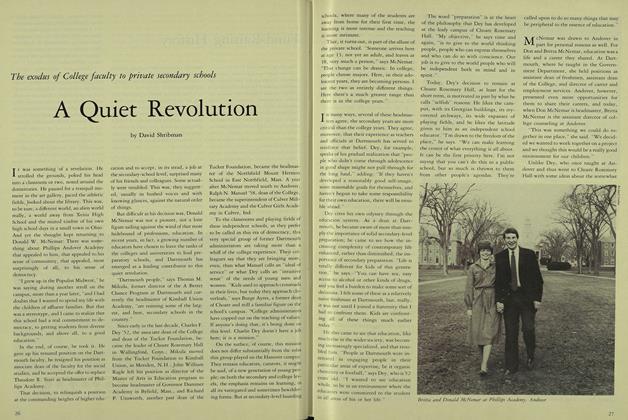
Professor Files with students at Tufts College last spring
MR. FILES, now living on his farm in Appleton, Maine, retired last June as Goldthwaite Professor of Rhetoric at Tufts College. His article is a shortened version of the University Lecture he delivered last spring, summing up his "educational philosophy" after more than 35 years of teaching. One of those years, 1916-17, was spent at Dartmouth as Instructor in English. A tribute in the Tufts Alumni Review praised him as "a rare man - a scholar, a philosopher, an artist, but an humble man who loves the simple life of a farmer." On his Maine farm, which includes ten acres of blueberry bushes, Professor Files has more to do than the average unretired man; yet he thinks he would be able to swing the Appleton Ridge Transcendental Energy Plant which you will read about in his article.
More From This Issue
-
 Feature
THE ECONOMIC OUTLOOK
January 1955 -
 Feature
McLaughry Closes 14-Year Regime As Dartmouth's Head Football Coach
January 1955 -
 Feature
Alumni and Tuck Faculty Join In Study of Stock Ownership
January 1955 -
 Class Notes
1918
January 1955 -
 Article
The Undergruduate Chair
January 1955 -
 Article
Twenty Years of "Browsing"
January 1955