1916
CERTAIN PEOPLE OF IMPORTANCE.... Whit McCoy was picked as one of the arbiters to pass on the cases of violence which occurred during the recent strike against the Southern Bell Telephone system. It appears that the Company, after the strike was over, discharged a number of employes who cut cables, destroyed company property and engaged in other forms of gangsterism. McCoy and his companion judges will decide whether their dismissal was justified. Naturally, such a selection indicates a high degree of qualification in the field of labor relations.
Max Spelke breaks into the columns of the New York Times in the shadow of his daughter, Ina Louise Spelke, who was married late in September to Alfred Edwin Cohan of New York, an alumnus of Cheshire Academy and the University of Pennsylvania. During the World War (2) he served as a lieutenant (jg) in the Maritime Service. The newspaper item refers to our Max as "a founding judge of the Connecticut State Juvenile Court, First District, and a special assistant to United States Attorney Generals from 1935 to 1940."
Col. John Ames was in Hanover in September visiting Ed Booth '18. John, retired from the Army with many honors, has been taking a well-earned vacation and relaxation, following his long foreign service, and will probably soon be heard from as selecting some line of activity to fill in his remaining forty-odd years. At least, when last seen in Washington he looked good for that much time.
Since this column will be devoted to the world-shaking and cosmic doings of classmates of 1916 (while the Newsletters cover the more intimate details of life among '16ers and their families), we want to go on record now as hailing the novel of the era, when and if Judge Phillips gets around to writing it. The Judge is working on this book under some disadvantages, such as not getting up early enough in the morning to work on it and being too tired in the evening, a disadvantage which most of you will recognize as hindering your activity in everything from taking off the screen doors to writing poetry, so you can sympathize with the Judge. However, we are not kidding when we say he is perfectly capable of coming up with a great job of writing and so we are appointing the secretary as the Judge's press agent well in advance, so we will be in a position to say: "We knew, him when he was living with Jack Little or when Jack Little was living with him." Jack is already an author of note.
General "Stew" Paul addressed the Terminal Island Commissioned Officers Mess of the Retired Officers Association (of which he is national president), and was the guest of honor on the occasion, early in September. Shorty Hitchcock, who was present, wrote he had not seen Stew for an even forty years, and found him "a genial, friendly man, who definitely knows what he is talking about. His address was very interesting. He talks with a sense of humor, is impressive, and very much wrapped up in the Association, of which, as you know, he is president. I think our Class has every reason to be very proud of him and his record. He spoke of you, Jack English, BillBrett, Bob Thieme, and other classmates whom he had seen or corresponded with recently."
Gran Fuller and Rod Soule are co-chairmen for the Fortieth Reunion of the Class. You will be getting news of the Reunion regularly, but get your affairs in order so you won't miss this one. Ponder this:
If you put your nose to a grindstone rough, And keep it down there long enough; You will soon forget there is such a thing As brooks that babble and birds that sing. Just three things will your world compose, You and the grindstone and your darned old nose.
Secretary, 4808 Broad Brook Drive, Bethesda 14, Md.
Treasurer, 27 Concord St., Nashua, N. H.
Bequest Chairman,
More From This Issue
-
 Feature
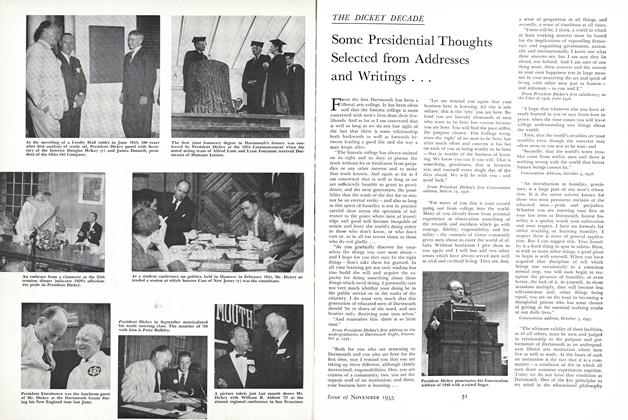
Some Presidential Thoughts Selected from Addresses and Writings ...
November 1955 -
 Feature
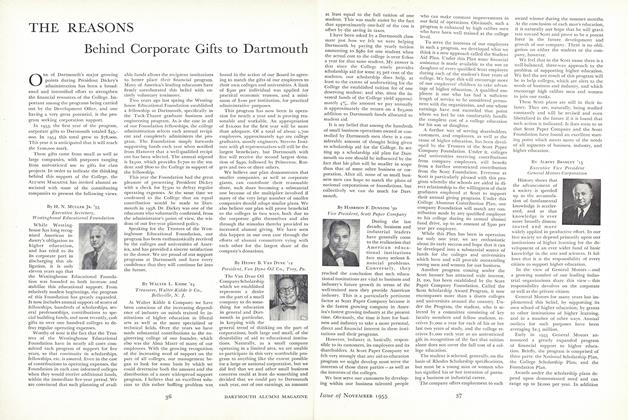
THE REASONS Behind Corporate Gifts to Dartmouth
November 1955 -
 Feature
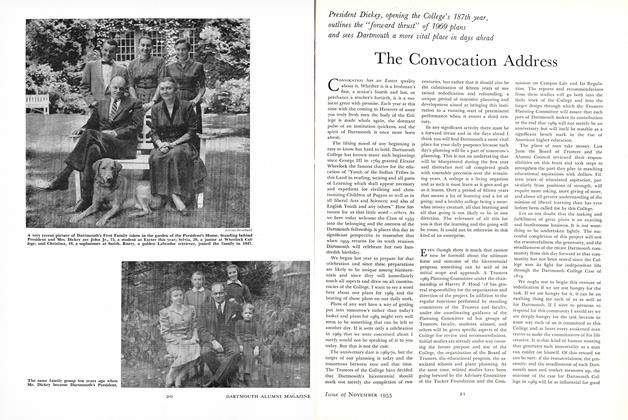
The Convocation Address
November 1955 -
 Feature
A Review of Major College Events
November 1955 -
 Feature
Some Moments Caught by the Camera
November 1955 -
 Article
Football
November 1955