Mt. Washington Pathfinder
Charles Jesse Stuart, 1809, Led the Long Procession of Dartmouth Men to the Summit, Now College Property
A LICHEN-CRUSTED granite slab near the center of the Old Main Street Cemetery in Lancaster, shire town of Coos County in northern New Hampshire, marks the resting place of one of Dartmouth's almost forgotten alumni, Charles Jesse Stuart, Class of 1809.
From this cemetery atop the unusual knoll rising above the Connecticut River intervale can be seen Mount Washington, flanked by three of the Southern Peaks in the Presidential Range which Stuart not only helped name but also surveyed for elevation with the most accurate methods then available.
The brief published records of Stuart's life usually identify him as a classmate of the illustrious Levi Woodbury. More obscure accounts, however, suggest he has a claim to fame in his own right.
After graduation, Stuart practiced law in Sanbornton, N. H., where "the choir did wonders under his lead and inspiration." He soon moved to Lancaster, then as now a bustling community in the White Mountain foothills rimming the upper Connecticut Valley.
Came 1820 and the decision by a group of townspeople to complete naming the unidentified prominent peaks of the highest mountain range in the Northeast. The self-appointed committee on nomenclature included Stuart; Adino Nye Brackett, brother of James Brackett, Class of 1805, and father of a Dartmouth graduate in 1844 with the same name; John W. Weeks; General John Wilson; Noyes S. Dennison and Samuel A. Pearson. Philip A. Carrigain of Concord, whose name now identifies a massive summit elsewhere in the White Mountains, accompanied the Lancaster adventurers, giving them official support as he had been Secretary of State for New Hampshire in 1805-1809 and had published his authoritative map of New Hampshire in 1816. It was indeed a "considerable large party of distinguished characters."
The expedition hired the services of Ethan Allen Crawford as "guide and baggage-carrier" and succeeded in reaching the summit of Mount Washington in late July via the Crawford Path which had been blazed only the previous year.
As Crawford himself tells the story, "We rode to the Notch, and there I was loaded equal to a pack-horse, with cloaks and necessary articles for two nights, with a plenty of what some call 'Black Betts' or 'O-be-joyful' as it was the fashion in those days, to make use of this kind of stuff, and especially upon such occasions. ... At the summit of Mount Washington they gave names to several peaks, and then drank healths to them in honor to the great men whose names they bore, and gave toasts to them; and after they had all got through they put it upon me to do the same; but as this was a new thing to me, and not being prepared, I could only express my feelings by saying I hoped all of us might have success and return to our respective families in safety, and find them in health; which was answered by a cheer from all, as they had cheered at other times before, when anyone had drank a toast."
During that historical climb these prominent peaks were given the names they still bear: Adams, Jefferson, Madison, Monroe, Franklin, and Pleasant. Because of the last two christenings, critics might conclude that Stuart did not excel in U.S. history at Dartmouth, but ex-Presidents were less numerous in 1820 than the peaks of what later became known as the Presidential Range.
A month after this reconnaissance, Stuart returned with Brackett, Weeks, and Richard Eastman to determine important elevations by the laborious but exact spirit-leveling process, using as their reference the low-water mark of the Connecticut River near the courthouse at Lancaster.
What seems like a simple outing today was a formidable operation in 1820, when a local surveyor wrote about the White Mountains, "all agree in assigning to them a greater altitude than to any in New England, if not in the United States."
The party was joined for five days by Joseph W. Brackett, brother of James Brackett, 1805, and uncle of Adino Nye Brackett, 1844; and two neighbors, Amos Lyro and Edward B. Moore.
Two members of the party were too late in meeting at the rendezvous on Mount Washington Summit to permit a safe descent to the lower slopes, so the group was "benighted" within ten feet of the summit and thus unexpectedly became the first known to have spent a night atop Mount Washington - on August 31, 1820.
The expedition's scribe, Adino N. Brackett, reported modestly, "It is believed that no human being ever passed a night there." He added, "During this cold, damp and dreary night, the wind shifted to the north-west, attended with rain, which forced a majority of the party from their resting places, to seek out new shelters from the inclemency of the weather, on the southern side of the precipice."
The surveyors returned safely to the valley after their week-long expedition with copious notes to support their contention that Mount Washington rose exactly 6,438 feet above sea level—a plus error of 140 feet as indicated by much later surveys. But their townspeople now had something other than relative mountain elevations to speculate about during the long winters following 1830.
STUART must have impressed the fabulous Ethan Allen Crawford during his two ascents of 1830, because Crawford asked him to return to Mount Washington in March 1821, to help him locate an easier and more direct route to the summit than the 8½-mile Crawford Path from the Crawford House.
The White Mountain pioneer ,felt the new path might well follow the Ammonoosuc River from what is now Fabyan to the base of a long prominent ridge due west of the summit.
As Crawford records the event, "In March (1821), I hired Esquire Stuart to come with his compass and go into the woods, and see if there could not be a better and more practicable way found to ascend the mountains. We set out with provisions, blankets, fireworks, and snowshoes for the woods. We set our compass, and spotted trees, which made a line to be followed at another time. When night came on, I built a camp and struck up a fire. We ate our supper and retired with our dog quietly to rest. We spent three days in making this search, and returned well satisfied we had found the best way; for the road which we had heretofore traveled was an uneven one, going up a hill and then down again, and this in so many successions, that it made it tiresome to those who were not accustomed to this kind of journeying. The way which we had now found was over a comparatively level surface for nearly seven miles, following the source of the Amanoosuc, or Ompompanusuk, until we arrived at the foot of Mount Washington, and then taking a ridge or spur of the hill."
This Crawford-Stuart route through what is now Bretton Woods to the summit became the popular Fabyan Bridle Path and the eventual location of the Mount Washington Cog Railway. Little did Esquire Stuart realize when he spotted that traverse to the key ridge that it would some day be followed by a railroad to be inherited 130 years later by his Alma Mater.
Stuart celebrated the first anniversary of that night atop Mount Washington by guiding the three Misses Austin of Jefferson on a five-day expedition to the summit, thereby scoring another first as con- temporary reporters considered Reverend Daniel Austin's ambitious sisters the first "females" to reach the summit.
On July 4, 1822 Stuart married Eliza Austin, one of the three sisters he had accompanied to Mount Washington the previous summer.
A month after the marriage Stuart was commissioned a Brigade Inspector of the Sixth Brigade, but there the written record fades. According to the Lancaster Town History, "Mr. Stewart (sic) was a man of fine address, and of convivial nature, too fond of drink to give his attention to his business. His death, at an early age, was hastened no doubt by intemperate habits."
The more charitable History of CoosCounty records, "He was a gentleman of fine address, a genial companion, a fine singer, and his presence was indispensable on the convivial occasions of those early days."
At a commemorative meeting in the Lancaster Congregational Church, Chester B. Jordan of Lancaster, Governor of New Hampshire in 1901-1903, later saw fit to remark, "Charles J. Stuart, a classmate of Levi Woodbury, was of great help to the church, and led the choir for years."
In May 1837, Stuart traveled his last uphill trail to the pine-shaded cemetery hill opposite the Coos County Courthouse in Lancaster.
Charles Stuart was probably the first Dartmouth alumnus to lead the procession of students and graduates who have found much fun, some fame, and occasional fortune on the slopes of Mount Washington. Within two eventful years he was the first to spend a night on the summit, to name many of its neighboring peaks, to determine their elevations, to locate what is now the most popular route up the mountain, and to guide a woman to the summit. More than that—he married tire gal.
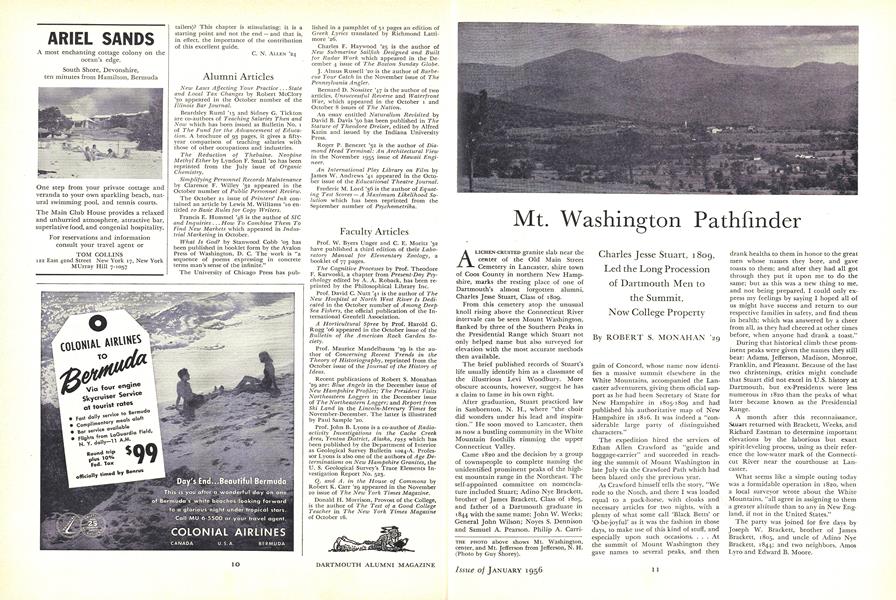
THE PHOTO above shows Mt. Washington, center, and Mt. Jefferson from Jefferson, N. H.