A Treasure of Petroglyphs
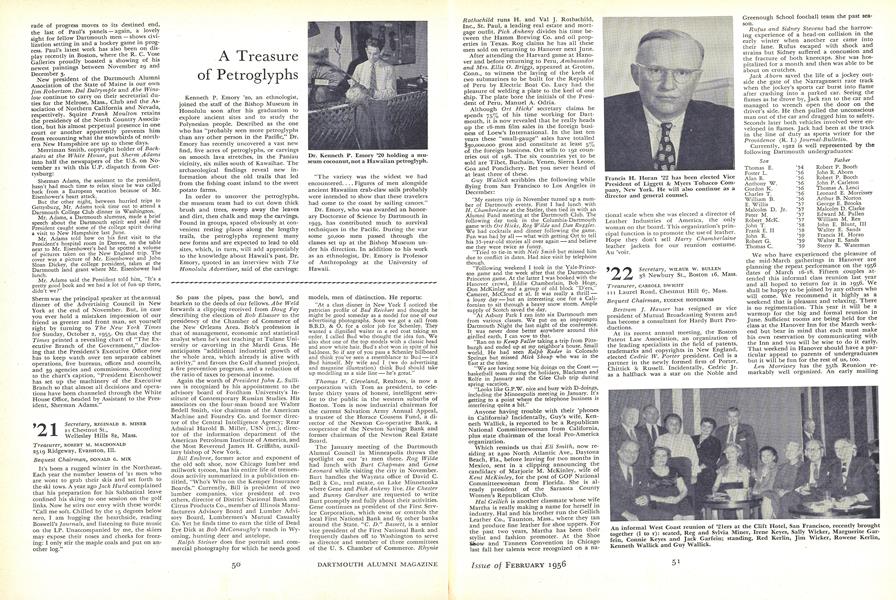
Kenneth P. Emory '20, an ethnologist, joined the staff of the Bishop Museum in Honolulu soon after his graduation to explore ancient sites and to study the Polynesian people. Described as the one who has "probably seen more petroglyphs than any other person in the Pacific," Dr. Emory has recently uncovered a vast new find, five acres of petroglyphs, or carvings on smooth lava stretches, in the Paniau vicinity, six miles south of Kawaihae. The archaeological findings reveal new information about the old trails that led from the fishing coast inland to the sweet potato farms.
In order to uncover the petroglyphs, the museum team had to cut down thick brush and trees, sweep away the leaves and dirt, then chalk and map the carvings. Found in groups, spaced obviously at convenient resting places along the lengthy trails, the petroglyphs represent many new forms and are expected to lead to old sites, which, in turn, will add appreciably to the knowledge about Hawaii's past. Dr. Emory, quoted in an interview with TheHonolulu Advertiser, said of the carvings: "The variety was the widest we had encountered. ... Figures of men alongside ancient Hawaiian crab-claw sails probably were intended to show that these travelers had come to the coast by sailing canoes."
Dr. Emory, who was awarded an honorary Doctorate of Science by Dartmouth in 1949, has contributed much to survival techniques in the Pacific. During the war some 50,000 men passed through the classes set up at the Bishop Museum under his direction. In addition to his work as an ethnologist, Dr. Emory is Professor of Anthropology at the University of Hawaii.
Dr. Kenneth P. Emory '20 holding a museum cocoanut, not a Hawaiian petroglyph.